Agent Reach: A Capability Layer That Gives Your AI Agent the Whole Internet — Without API Fees
Your AI agent can refactor a codebase, draft a migration plan, and rewrite half your documentation in one sitting. Then you ask it to go read what people are saying about a product on Twitter, and it freezes. The Twitter API costs money. Reddit returns a 403 to the server's IP. XiaoHongShu demands a login. Bilibili blocks anything that looks like a bot. The most capable part of your stack — the reasoning — is sitting behind a wall it cannot climb on its own.
This is the gap Agent Reach is built to close. The repository's own one-liner is blunt: give your AI agent one-click access to the entire internet. But the interesting part is not the feature list — it is the architectural decision underneath it. Agent Reach refuses to be "another tool." It calls itself a capability layer, and that distinction is the whole story.
The real 2026 bottleneck is reach, not reasoning
For two years the frontier of agent work has been reasoning: longer context, better planning, tool use. That race is largely won for everyday tasks. What is left underserved is something far more mundane — reach. The highest-density information an agent needs lives on social and niche platforms: Twitter threads, Reddit bug reports, YouTube walkthroughs, XiaoHongShu reviews, Bilibili explainers, GitHub activity. Every one of these has a moat.
The Agent Reach README tabulates the pain honestly:
| Platform | The wall |
|---|---|
| Twitter / X | Pay-per-use API, ~$215/month for moderate usage |
| Server IPs get 403'd; official API is approval-gated | |
| XiaoHongShu | Login required even to browse |
| Bilibili | Blocks overseas and server IPs |
None of these are hard problems individually. The trouble is that solving them is per-platform plumbing — find the tool, install the dependency, debug the cookie format, clean the HTML — and you redo it from scratch for every new agent and every new machine. Worse, the plumbing rots. Access methods that worked last quarter break this quarter when a platform tightens its anti-scraping. The maintenance burden, not the initial setup, is what actually kills these integrations.
A capability layer, not a wrapper
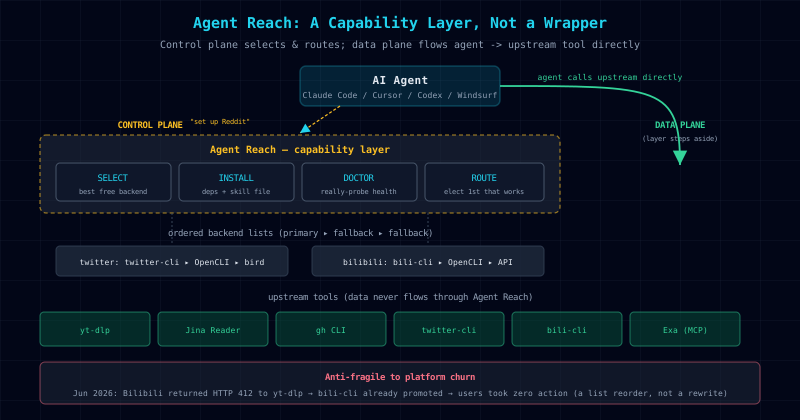
Here is the design decision that makes Agent Reach worth writing about. It explicitly sits one level above any concrete reader. It does not fetch tweets itself. It does not parse YouTube subtitles itself. There is no wrapper layer in the data path at all.
What it does is four things: select, install, health-check, and route. It picks the most reliable free backend for each platform right now, installs it, verifies it works, and registers a skill file so your agent knows which upstream tool to invoke. The actual reading is done by the agent calling that upstream tool directly — yt-dlp for YouTube, gh for GitHub, Jina Reader for arbitrary web pages, Exa for semantic search. Agent Reach gets out of the way the moment the connection is made.
That sounds like a small distinction. It is not. A wrapper that proxies every request becomes a single point of failure, a versioning bottleneck, and a thing you have to trust with your data. A selection-and-health layer that steps aside has none of those properties. When an upstream tool changes its flags, the wrapper breaks; the capability layer just updates a recommendation. The data never flows through Agent Reach, so there is nothing to audit in the hot path and nothing to slow it down.
Routing as configuration: ordered backend lists
The mechanism that makes the capability layer durable is deceptively plain. Every platform is an ordered list of backends — a primary plus fallbacks. Switching access methods is not a code rewrite; it is a reordering of that list.
The channels/ directory makes this literal. Each file is one platform, and its routing reads like a preference order:
channels/
├── web.py          → Jina Reader
├── twitter.py      → twitter-cli ▸ OpenCLI ▸ bird
├── youtube.py      → yt-dlp
├── github.py       → gh CLI
├── bilibili.py     → bili-cli ▸ OpenCLI ▸ search API
├── reddit.py       → OpenCLI ▸ rdt-cli
├── xiaohongshu.py  → OpenCLI ▸ xiaohongshu-mcp ▸ xhs-cli
├── linkedin.py     → linkedin-mcp ▸ Jina Reader
├── rss.py          → feedparser
└── exa_search.py   → Exa via mcporter
Crucially, each channel file does not merely check whether a command exists on disk. It really probes every candidate backend in order — actually exercises it — and the first one that genuinely works is elected. A backend that is installed but broken gets skipped, and you get a repair prescription instead of a silent failure.
This is what makes the project anti-fragile against platform churn, and the README cites a concrete, dated example. In June 2026, Bilibili's risk control started returning HTTP 412 to yt-dlp, killing that path entirely. Agent Reach had already demoted yt-dlp for Bilibili and promoted bili-cli, which needs no login to search and read. Users took zero action. (Note the nuance: yt-dlp remains the primary backend for YouTube, where it still excels across 1,800+ sites — it was only retired for Bilibili.) An earlier wave in March 2026 saw a batch of single-platform CLIs go end-of-life at once; the fix was a routing change, not a rewrite.
What works out of the box, and what needs a key
Agent Reach draws a clean line between zero-config channels and ones that need a login or cookie. Out of the box, with nothing configured, an agent gains:
- Web — any URL to clean Markdown via Jina Reader
- YouTube — subtitle extraction plus search, via yt-dlp
- RSS — any RSS/Atom feed, via feedparser
- GitHub — read and search public repos, via the
ghCLI - Web search — free semantic search across the web via Exa, auto-configured through MCP with no API key
- V2EX — hot topics, node topics, thread detail and replies through a public JSON API
Behind a one-time login or cookie, the harder platforms open up: Twitter/X (search, timeline, long-form reading via twitter-cli), Reddit (which has no zero-config path anymore — anonymous endpoints are fully blocked, so OpenCLI's browser session or rdt-cli with a cookie is mandatory), XiaoHongShu, LinkedIn, Xueqiu stock data, and Xiaoyuzhou podcast transcription via Whisper. You never memorize commands — you tell the agent "help me set up Reddit" and it walks you through exactly what it needs.
One built-in command ties it together: agent-reach doctor reports the status of every channel and tells you which backend each one is currently routing through. It is the single source of truth for "what is actually working right now."
Free by construction, local by default
The economics are deliberate. Every backend is an open-source tool that needs no paid API key — OpenCLI, twitter-cli, bili-cli, rdt-cli, yt-dlp, Jina Reader, Exa, feedparser, and the rest. The only optional cost is a residential proxy (~$1/month) and only if your network blocks Reddit or Twitter, as mainland China connections often do. On a local machine you need nothing.
Security follows the same local-first instinct. Credentials — cookies and tokens — live only in ~/.agent-reach/config.yaml with 600 permissions (owner read/write only), never uploaded. There is a --safe install mode that changes nothing on your system and merely lists what it would need, a --dry-run mode that previews every action, and a pluggable architecture: distrust one component and you swap out that single channel file without touching the rest. The README is candid about cookie risk, too — for any platform using cookie auth, it tells you to use a dedicated burner account, never your main, because scripted access can trip a platform's automation detection and get an account limited or banned.
# Default: full auto, good for personal machines
agent-reach install --env=auto

# Safe mode: changes nothing, just reports — good for shared servers
agent-reach install --env=auto --safe

# Preview only
agent-reach install --env=auto --dry-run

# One command to see what is working and which backend it routes through
agent-reach doctor
Installation itself is famously a single sentence. You paste a line like "Install Agent Reach: <url to install.md>" to your agent, and it handles the rest — installing the CLI, detecting Node.js and the gh CLI and mcporter, wiring up Exa search over MCP, deciding whether you are on a laptop or a server, and registering a SKILL.md so the agent later knows, on its own, which upstream tool a "go research this on Twitter" request should reach for. It is compatible with any agent that can run shell commands — Claude Code, Cursor, OpenClaw, Windsurf, Codex.
Where the layer stops
The project is honest about its boundary. Agent Reach is about reading — pulling content out of platforms. It is not about operating them: logged-in web actions, form submission, multi-account isolation, parallel browser sessions, the high-friction human-handoff moments in an automated flow. Those "hands-on" jobs are a different problem, and the README points you at browser-automation tooling for them rather than pretending to cover it. A capability layer that knows exactly what it is not is rarer, and more trustworthy, than one that claims everything.
It is also, by the author's own cheerful admission, a "pure vibe coding" project — built fast, maintained daily because the author uses it daily, with the rough edges that implies. The recent commit history backs up the "maintained daily" claim: a Whisper transcription module with a Groq-to-OpenAI fallback, the ordered-backend-candidates-plus-real-probing-doctor routing work, and a round of fixes from an adversarial code review. For an MIT-licensed tool whose entire job is to absorb the maintenance burden of a constantly shifting access landscape, "I use it every day so I keep it working" may be the most reassuring maintenance model there is.
Why this matters
Agent Reach is a small, single-author CLI, but it encodes an idea that is going to matter more as agents proliferate: the bottleneck is moving from can the model think to can the model reach, and reach is a maintenance problem, not a capability problem. Any individual platform integration is a weekend of work. Keeping forty of them alive across a year of anti-scraping arms races is a full-time job nobody wants. The clever move is not to build a thicker wrapper — it is to build a thin layer that picks the currently-best path, proves it works, and steps out of the way, so that when a path dies you change a list instead of rewriting a client. That is a pattern worth borrowing far beyond this one repository.
Sources
Agent Reach:
- Repository: https://github.com/Panniantong/Agent-Reach (MIT License, Python 3.10+)
- Chinese README inspected: project root
README.md— design philosophy, supported-platform matrix, backend routing table, security model, install/uninstall flags, FAQ - English README inspected:
docs/README_en.md— pain-point pricing table, capability matrix, "kept up to date" backend-churn note channels/directory structure and per-platform ordered backend lists, as documented in the README design-philosophy section- Author contact in repo: pnt01@foxmail.com, Twitter/X @Neo_Reidlab
Upstream backends referenced: