In traditional software engineering interviews, grinding LeetCode algorithms has long been the gold standard. Today, the rapid evolution of Applied AI, Large Language Models (LLMs), AI Agents, inference acceleration, and system quantization has fundamentally transformed technical hiring.
The open-source repository pallavi-shekhar/ai-engineering-interview-questions-company-wise (curated by Outcome School) aggregates real interview questions from 35 top AI frontier labs, tech giants, and AI-native startups.
The trend is undeniable: AI engineering interviews have evolved far beyond superficial prompt engineering and API glue code. They now demand rigorous understanding of Transformer mathematics, GPU memory bandwidth walls, deterministic agent harnesses, and empirical production evaluations (Evals).
1. Universal Foundations: The 10-Dimension Skill Tree
Across tier-1 technical interviews, questions consistently converge around ten core engineering domains:
1. LLM Internals & Mathematical Foundations
- Scaled Attention: Deriving why the $1/\sqrt{d_k}$ scaling factor is mandatory to prevent softmax gradients from vanishing into extreme plateaus.
- KV Cache Memory Footprint: Formulating exact KV Cache byte allocations across batch size, context length, layers, and hidden dimensions.
- Attention Evolution: Trade-offs between MHA, MQA, GQA, and DeepSeek's MLA (Multi-head Latent Attention) low-rank key-value compression.
- Positional Embeddings: RoPE (Rotary Position Embeddings), YaRN, and NTK-aware scaling for context extrapolation.
- Core Components: Mathematical justifications for Pre-LayerNorm / RMSNorm and SwiGLU activations over ReLU/GELU.
2. Inference, Serving & GPU Performance Engineering
- Prefill vs. Decode Disaggregation: Why prefill is compute-bound while single-token autoregressive decoding is memory-bandwidth-bound.
- Batching Architectures: Continuous (in-flight) batching versus static batching.
- Memory Virtualization: PagedAttention mechanics for fragmentation elimination; prefix caching hit rates and eviction policies.
- Acceleration: Mathematical bounds of Speculative Decoding; FlashAttention tiling and SRAM data reuse.
- Roofline Analysis: Calculating the theoretical max tokens/sec for a 70B parameter model on an NVIDIA H100 (3.35 TB/s HBM3).
3. Retrieval-Augmented Generation (RAG) & Search
- Chunking Pitfalls: Structural and semantic document chunking without splitting critical legal clauses or code definitions.
- Hybrid Retrieval & Reranking: Combining sparse BM25 and dense vector embeddings; Cross-Encoder reranking latency versus precision trade-offs.
- Index Selection: HNSW vs. IVF-PQ vs. Flat indexes across recall@k, index build time, and query latencies.
- Multi-Tenant Security: Enforcing row-level access control (ACLs) and tenant isolation at the retrieval vector stage.
4. Autonomous Agents & Tool Execution
- ReAct vs. Zero-Shot CoT: Loop execution failure modes and error recovery in multistep agent traces.
- Protocols & Formats: Structured outputs vs. tool calling; the role of the Model Context Protocol (MCP).
- Production Guardrails: Loop step budgets, token spend caps, cycle detection, reversible operations, and audit logging.
- Human-in-the-Loop: Designing gating approval workflows for high-risk mutations (database drops, financial transactions, external emails).
5. Fine-Tuning, Post-Training & Alignment
- Alignment Trajectory: Full progression from classic RLHF (Reward Model + PPO + KL penalty) to DPO (Direct Preference Optimization) and GRPO (Group Relative Policy Optimization, used in DeepSeek-R1).
- Parameter-Efficient Tuning (PEFT): LoRA rank selection and weight decomposition; QLoRA 4-bit NormalFloat quantization and double dequantization.
- Decision Frameworks: Concrete decision matrices for Prompting vs. RAG vs. Fine-Tuning based on cost, latency, and knowledge churn.
6. Evals & Observability
- LLM-as-a-Judge Calibration: Mitigating self-enhancement, position bias, and verbosity bias.
- Ground-Truth-Free Evals: Designing synthetic benchmarks and golden evaluation datasets when human annotation is cost-prohibitive.
- Regression Gates: Establishing automated PR and prompt CI/CD release gates to prevent regression.
- Agentic Evals: Benchmarking multi-turn trajectory success rather than isolated single-turn accuracy.
7. Safety, Defense & Trustworthy AI
- Prompt Injection Defense: Defense-in-depth against direct overrides and indirect injections via poisoned web pages or documents.
- Guardrail Architectures: Input filtering, decoding-time logit steering, and output guardrails.
- PII Governance: Real-time redaction and compliance in prompt pipelines and fine-tuning corpora.
8. Multimodal & Real-Time Voice AI
- Vision Integration: Linear projection adapters vs. Cross-Attention vs. native multimodal tokenization.
- Voice Agent Latency Budgets: Breaking down Time-to-First-Audio (TTFA) across VAD, ASR, LLM TTFT, and streaming TTS.
- Barge-in Handling: Instant audio stream flushing and state rollbacks when the user interrupts mid-sentence.
9. AI System Design
- Real-Time Code Completion (e.g., Cursor Tab): Millisecond context stitching, speculative streaming, and non-conflicting ghost-text insertion.
- Universal LLM Gateways: Provider fallbacks, load shedding, semantic caching, and quota management.
- High-Concurrency Chat: Architecting consumer-grade conversational platforms serving millions of concurrent requests.
10. Core Coding & Low-Level Implementations
- Coding Scaled Dot-Product Attention with causal masking from scratch.
- Implementing single-step autoregressive decode loops with KV Cache.
- Writing Byte-Pair Encoding (BPE) tokenizers.
- Building resilient async API batch dispatchers with jittered exponential backoff.
- Developing streaming SSE / chunked JSON stream parsers that tolerate arbitrary packet boundaries.
2. Company Archetypes: Four Industry Tiers
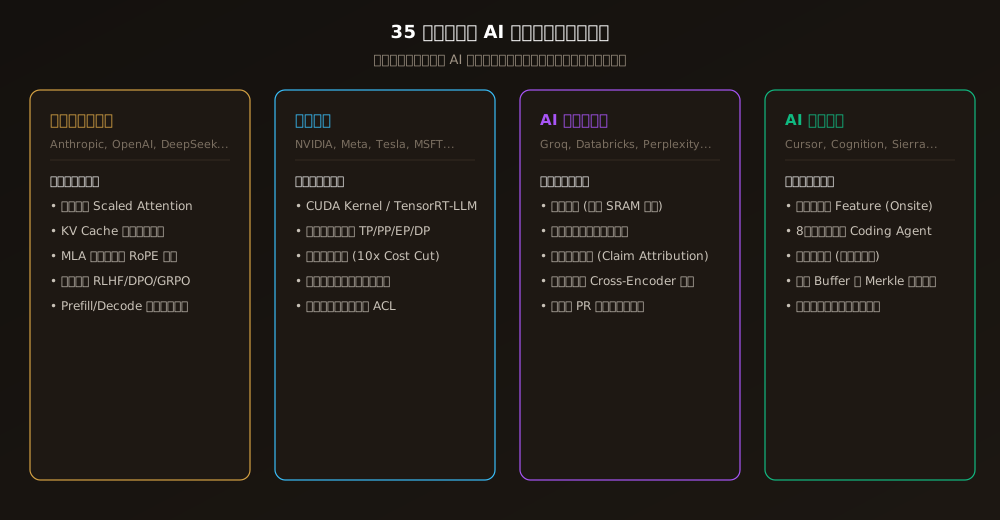
The 35 companies featured in the catalog exhibit distinct evaluation priorities:
- Frontier Model Labs (Anthropic, OpenAI, DeepSeek, Google DeepMind)
- Hardcore mathematics and foundational implementations. Candidates are asked to derive tensor shapes, implement custom attention kernels, analyze MLA low-rank projections, and dissect constitutional AI formulations.
- Tech Giants (NVIDIA, Meta, Tesla, Microsoft, Amazon AWS)
- Extreme hardware affinity and planetary-scale systems. Deep dives into CUDA kernels, TensorRT-LLM graphs, multi-dimensional tensor parallelism (TP/PP/EP/DP), autonomous driving data engines, and enterprise multi-tenant isolation.
- AI Infrastructure & Platforms (Groq, Databricks, Perplexity, Hugging Face)
- Novel silicon architectures (e.g., pure SRAM chips), sub-second web indexing pipelines, claim attribution algorithms, and PR-grade code reviews of open-source model libraries.
- AI-Native Product Unicorns (Cursor, Cognition, Sierra, Harvey)
- Production pragmatism. Real-world codebase on-sites, live coding of lightweight coding agent loops, deterministic business rule enforcement (e.g., strict refund authorization barriers), and state recovery.
3. The 2026 AI Engineering Paradigm Shift
- AI Pair Programming in Interviews: Modern interviewers allow and encourage coding agents. Candidates are judged on how effectively they guide the agent, formulate architectural specs, verify diffs, and steer the AI when it encounters roadblocks.
- Harness Over Model: In enterprise agent systems, the host harness (sandboxing, versioning, memory management, and deterministic recovery) matters more than marginal model benchmark gains.
- Quantitative Metrics Over Heuristics: Dismissing fuzzy prompt hacks in favor of rigorous memory math (activation vs. weights vs. KV Cache), latency profiles (TTFT vs. TPOT), and automated CI regression gates.
Related Reading
- The Fusion Workflow: Multi-Agent Software Factory & Autonomous Delivery —— Deterministic multi-agent pipelines and quality gates in production
- Prime Agent Harness Teardown: Sandboxing & Automated Verification —— Examining runtime environments for coding agents
- Generative Canvas Agent Architecture: Spatial Memory & Infinite Canvas Orchestration —— Agent interaction and stateful canvas execution