2026 Open-Source AI Video Generation Tools: Architecture, Capabilities, and Trade-offs Across 8 Projects
2026 Open-Source AI Video Generation Tools: Architecture, Capabilities, and Trade-offs Across 8 Projects
Halfway through 2026, the AI video generation competition is no longer about "which model generates more realistic clips." It's about "who can use AI to produce a complete video from start to finish." From short dramas to documentaries, from hand-drawn animations to product demos — GitHub has seen a surge of open-source projects with differing approaches but converging goals: end-to-end structured video creation powered by AI.
This article selects 8 representative projects and compares them across four dimensions: architecture design, Agent collaboration models, quality control, and extensibility. The selection spans from the most traditional web tools to the most radical agentic systems.
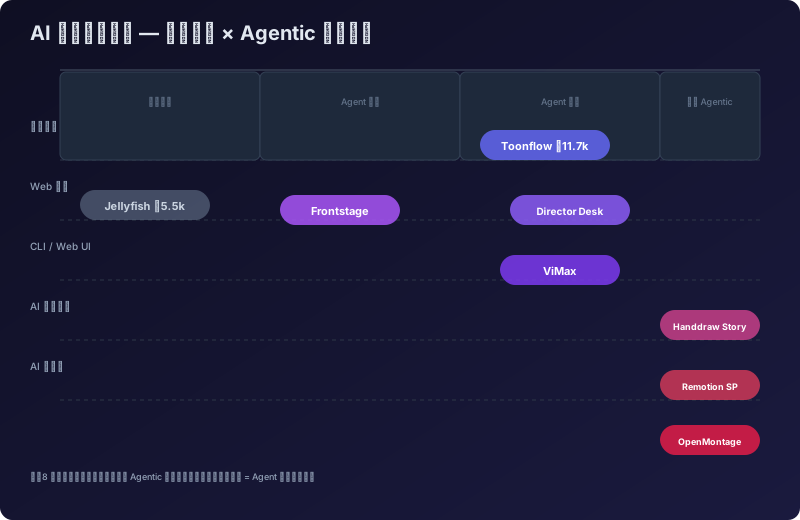
Project Overview
| Project | Stars | Stack | Form Factor | One-Liner |
|---|---|---|---|---|
| Toonflow | 11.7k | TypeScript + Vue3 + Electron | Desktop App | Novel → short drama factory |
| Jellyfish | 5.5k | FastAPI + React | Web App | AI short drama workspace |
| Frontstage | ⭐5 | TypeScript + WebGPU + Electron | Web + Desktop | AI-native multi-track video editor |
| Remotion Superpowers | ⭐82 | TypeScript + Remotion | Claude Code Plugin | 16-capability video toolbox |
| ViMax | — | Python + LangChain | CLI + Web UI | Agentic video generation framework |
| Director Desk | — | FastAPI + React + Redis | Web App | AI Showrunner platform |
| Handdraw Story Video | — | Python + HyperFrames | Codex Skill | Hyper-focused hand-drawn shorts |
| OpenMontage | — | Python + Remotion/HyperFrames | AI Assistant-driven | Universal video production system |
1. Agent Collaboration Models: From Manual to Fully Autonomous
This is the most differentiating dimension across the 8 projects, distributed along a continuous spectrum from fully manual to completely autonomous.
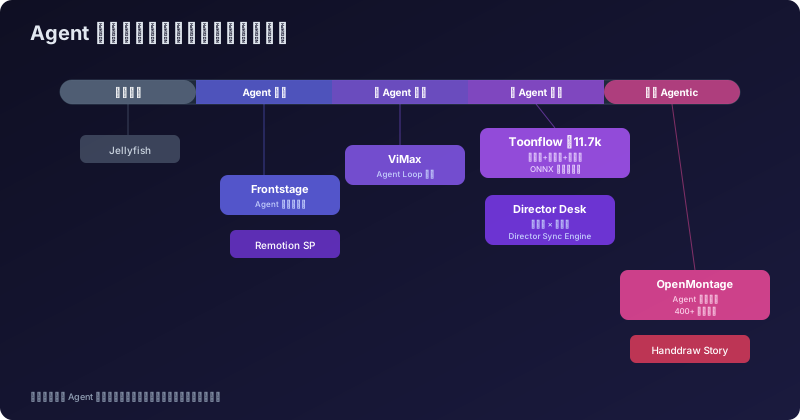
Manual end: Jellyfish
Jellyfish has no Agent at all — it's a traditional React + FastAPI web application. All operations require manual clicking: import scripts, confirm character extraction, manage shot status, initiate video generation. Its core value isn't in "intelligence" but in "data management": Jellyfish is the only project among the 8 with a complete entity-relationship model — characters, scenes, props, and costumes are uniformly managed across shots, with frontend and backend types automatically synchronized via OpenAPI.
Agent-assisted: Frontstage and Remotion Superpowers
Frontstage's Agent doesn't "generate video" — it operates a real multi-track timeline editor. 40+ tools cover cutting, layout, color grading, captions, generation, and export — the Agent's operations share the same Undo Stack as your manual edits. This is the closest design to an "AI editor" assistant.
Remotion Superpowers takes a different approach: wrapping Remotion's video capabilities as 5 MCP Servers, which Claude Code calls via standard MCP protocol. Suno music, ElevenLabs TTS, Pexels footage, FLUX/Kling/Veo generation, Whisper captions — the Agent orchestrates freely with no preset pipeline.
Single-Agent orchestration: ViMax
ViMax implements a complete LLM tool-calling loop (AgentLoop), plus Context Compaction (automatic summarization of long conversations), prompt part construction, progress callbacks, and other academic-grade engineering. Its pipelines are hardcoded Python classes (Idea2Video / Script2Video / Novel2Video), requiring code changes to extend.
Multi-Agent collaboration: Toonflow and Director Desk
Toonflow's three-layer Agent system is the most engineering-complete multi-agent design:
- Decision layer: task decomposition and planning
- Execution layer: content generation (script, storyboard, assets)
- Supervision layer: quality review and revision feedback
Combined with local ONNX vector retrieval for cross-session memory, it supports multi-round creative continuity. Toonflow's "chapter event graph" design is particularly unique — automatically extracting chapter events from source material and storing them as structured data, enabling precise context-aware adaptation and solving the information-loss problem in long-text-to-short-drama conversion.
Director Desk's Showrunner state machine models filmmaking as a strict pipeline: Script Breakdown → Scoping → Asset Generation → Scene Compilation → Master Release. Each stage is handled by an independent Agent (Writer / Storyboarder / Planner / Critic / Scene Breakdown). The critical design is the Director Sync Engine — when upstream character settings change, it traces the dependency graph and rebuilds only affected scenes, saving 80% on compute.
Fully Agentic: OpenMontage and Handdraw
OpenMontage's "Agent as orchestrator" model: the AI coding assistant reads YAML pipeline manifests → reads stage director skills (Markdown) → calls Python tools → self-reviews (Markdown) → checkpoints (JSON). All decision logic lives in instruction files; code handles only tools and execution.
Handdraw Story Video is in Codex Skill format — the AI assistant just reads SKILL.md and knows how to produce a hand-drawn good-deed story video. No other dependencies.
2. Quality Control: Who Takes Output Quality Seriously?
Quality control is the most overlooked yet most impactful dimension for AI video tools. A clear dividing line emerges from the comparison: only half the projects have structured quality mechanisms.
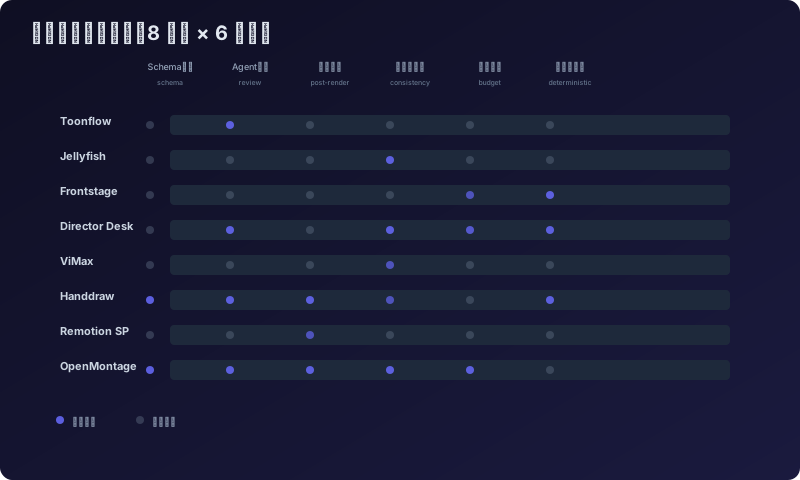
Quality benchmark 1: Handdraw Story Video — Deterministic post-processing
Handdraw proves the quality advantage of "AI handles creativity, deterministic scripts handle execution":
- Local line extraction: line art is not separately AI-generated; it's locally extracted from the color master image using
make_lineart.py— guaranteeing pixel-perfect alignment and eliminating the inherent flaw of "AI generating two inconsistent images" - Millisecond-precise timeline: each 5-second scene is specified to 0.01s precision (transition → line reveal → color fill → hold → exit)
- 8-beat narrative constraint: each scene has a fixed visual planning template (event | characters | location | prop | action/reaction | two visual details | framing)
- Multi-stage validation: story config validation → asset existence check → HyperFrames lint → render
Quality benchmark 2: Director Desk — Production-grade robustness
Director Desk's quality assurance comes from engineering details, not philosophy:
- SSE cooperative cancellation: immediately terminates backend model requests when the client disconnects, saving 90% on wasted API costs
- Precision FFmpeg timestamp offsetting: custom algorithm solves the classic video-frame-freezing bug in multi-clip concatenation
- Whisper VAD parameter tuning: voice activity detection tuned specifically for dramatic cuts with long silences and slow speech
- Dependency graph tracking: upstream changes automatically mark downstream affected assets as "stale," enabling targeted rebuilds
Quality benchmark 3: OpenMontage — Systematic quality gates
OpenMontage is the only project with a complete quality review chain:
- Stage review (Reviewer): CHAI standard — every finding must reference specific fields and propose executable fixes
- Pre-compose validation: delivery promise enforcement + slideshow risk detection
- Post-render self-review: ffprobe check + frame extraction + audio analysis + promise verification
- Full audit trail: every provider choice, style decision, and fallback has an auditable decision log
3. Extensibility: Declarative vs. Code-Driven
| Dimension | Toonflow | Jellyfish | Frontstage | Director Desk | ViMax | Handdraw | Remotion SP | OpenMontage |
|---|---|---|---|---|---|---|---|---|
| New video format | Change code | Change code | N/A (freeform editing) | Change state machine + agent | Change code | Change code | N/A | Add YAML + skills |
| New AI provider | TS programming | Change code | Change config | Change code | Register adapter | Change JSON | Add MCP server | Add Tool subclass |
| Provider auto-scoring | Manual | Manual | Manual | Manual | Manual | Manual | Manual | 7-dim auto-scoring |
| Custom knowledge/skills | ✅ Skill editing | ❌ | ❌ | Agent modularity | ❌ | ✅ SKILL.md | ✅ Plugin extension | ✅ Full skill system |
Two extremes:
OpenMontage's "declarative pipeline": adding a pipeline requires only a new YAML + 7 skill files, zero code changes. This is the ideal state of extensibility.
Frontstage and Remotion Superpowers' "no pipeline" approach: the Agent directly operates the editor's full capabilities or freely combines tools via MCP, natively supporting all formats — at the cost of output quality depending entirely on the Agent's own capabilities.
4. Five Emerging Industry Trends
Trend 1: Deterministic post-processing beats pure AI generation
Handdraw's local line extraction, Frontstage's WebGPU compositor, Director Desk's precision FFmpeg — three projects independently converge on the same pattern: constrain AI to the creative decision layer, run the execution layer with deterministic code. This isn't a step backward; it's engineering pragmatism. AI excels at creativity and variation, but for pixel alignment, timestamp precision, and frame blending, deterministic code is ten thousand times more reliable.
Trend 2: Knowledge externalization is a prerequisite for agentic systems
OpenMontage's 400 skill files, Toonflow's Markdown Skills, Handdraw's SKILL.md, Remotion Superpowers' plugin system — four projects extract Agent knowledge from code into independent files. When knowledge lives in Python/TypeScript code, an AI Agent cannot read, optimize, or reuse it. "Agent as orchestrator" presupposes "knowledge externalization."
Trend 3: MCP is becoming the standard Agent-tool protocol
Frontstage's MCP Server (43 tools) and Remotion Superpowers' 5 MCP Servers demonstrate the direction: the future isn't "embedding an Agent in every project," but "letting any Agent call your tools via MCP." MCP reduces the integration cost between video tools and AI Agents, paving the way for a "tool marketplace" model.
Trend 4: Quality gates are becoming mandatory, not optional
Among 8 projects, 4 have at least one layer of quality control. 2 rely on Agent self-judgment. 2 have none at all. As AI-generated content moves from "play" to "production delivery," pre-render validation + post-render self-review will become standard, not a bonus.
Trend 5: Tool complementarity beats zero-sum competition
The strongest impression after reviewing all 8 projects: they aren't competing; they're complementary. Toonflow solves "productization," Frontstage solves "editing experience," ViMax/Director Desk solve "Agent orchestration," OpenMontage/Handdraw solve "programmable knowledge," and Remotion Superpowers solves "tool composability." An ideal next-generation system should combine the strengths of all.
5. Selection Guide
| Need | Recommended | Why |
|---|---|---|
| Quick AI short drama, complete product | Toonflow | Desktop app, Chinese UI, ready out of the box |
| AI-assisted editing, real timeline needed | Frontstage | Only multi-track timeline AI editor |
| Build your own video production system | OpenMontage | Most advanced architecture, customizable skills |
| Claude Code user making videos | Remotion Superpowers | MCP plugin, freeform tool composition |
| Model real film production workflow | Director Desk | Showrunner state machine + dependency tracking |
| Academic research or multi-format exploration | ViMax | Mature Agent Loop, paper-backed |
| Produce a high-quality niche format | Study Handdraw approach | Deterministic pipeline + structural constraints |
| Need a short-drama data management tool | Jellyfish | Complete asset entity management |
Conclusion
This isn't just a tool review. The 8 projects represent 8 answers to the question: "What is the right abstraction level for AI video generation?"
- Toonflow says: a one-click product
- Frontstage says: a tool that assists professional editors
- ViMax says: an academically validated Agent framework
- Director Desk says: a simulation of every step in real film production
- OpenMontage says: a knowledge system that Agents can read and modify
- Handdraw says: absolute perfection in one format
- Remotion Superpowers says: a pluggable tool marketplace
- Jellyfish says: get data management right, leave the rest to the user
There is no correct answer. But for anyone entering this field, understanding these trade-offs matters more than picking the "best" tool.
References
- Toonflow GitHub Repository — 11,729 stars (as of 2026-07-21)
- Jellyfish GitHub Repository — 5,550 stars
- Frontstage GitHub Repository — GPL 3.0
- Remotion Superpowers GitHub Repository — ⭐82, MIT
- ViMax GitHub Repository — MIT, arXiv:2606.07649
- Director Desk GitHub Repository
- Handdraw Story Video GitHub Repository — MIT
- OpenMontage GitHub Repository — AGPLv3