The Kill-Switch Precedent: How the Anthropic–White House Standoff Pushed Frontier AI Into a Sovereign-Control Era
On Friday, June 12, 2026, at 5:21 p.m. Eastern Time, Anthropic received a letter from the U.S. Commerce Department. Citing national-security authorities, the government ordered the company to suspend all access to its two newest and most powerful models — Fable 5 and Mythos 5 — by any foreign national, whether inside or outside the United States, including Anthropic's own foreign-national employees. Because Anthropic cannot reliably sort its users by nationality, there was only one way to comply. Within hours, it pulled both models for everyone on Earth. A letter became a global kill switch.
It is tempting to read this as one more skirmish in a long-running feud between a safety-focused lab and an administration that has made no secret of its irritation with it. But that framing undersells what happened. For the first time, the U.S. government has used export-control law to govern access to a running AI model — not the chips it runs on, not the weights that define it, but the act of using it. That is a different category of state power than anything we have seen applied to software-as-a-service, and it marks the moment frontier-AI governance stops being a story about voluntary pledges and starts being a story about sovereign control.
This post lays out what is verified, what each side is claiming, why the legal theory is plausible but murky, and — most usefully — the two concrete indicators worth watching over the next one to two weeks to tell whether this is an isolated punishment or the opening move of a durable licensing regime.
What actually happened
The verifiable timeline, cross-checked across the BBC's reporting and a detailed legal analysis in Lawfare, runs like this:
- Friday, June 12, 5:21 p.m. ET — Commerce delivers the order. Anthropic describes it as a directive to "suspend all access to Fable 5 and Mythos 5 by any foreign national."
- Within hours, Friday evening — unable to filter by nationality, Anthropic pulls both models entirely. Public access goes dark.
- Over the weekend — the dispute spills into public view. David Sacks, formerly the White House AI czar, frames the government's case; Anthropic disputes it; Secretary of Defense Pete Hegseth publicly celebrates the move.
- Monday, June 15 — Anthropic executives were reported to be meeting the Commerce Department (Secretary Howard Lutnick) in Washington to try to resolve it. As of this writing on Tuesday, June 16, the outcome of that meeting is not publicly confirmed.
Two naming details matter, because the coverage uses both. Fable 5 is the public-facing model, the one shipped with additional guardrails; Mythos 5 is its sibling. The order named both. Anthropic, at one earlier point, had itself described the capability as "too powerful" — a phrase that now sits awkwardly in the middle of a dispute about whether the models are dangerous enough to warrant a federal shutdown.
Why this is a precedent, not an incident
Export controls have touched AI before, but always at the edges. For years the entire application of export-control law to AI was really about the chip market — restricting advanced semiconductors to slow a rival's compute. The Biden administration's AI Diffusion Rule briefly placed model weights on the control list, but President Trump rescinded that rule immediately on retaking office. So until last Friday, no one had used export controls to reach the thing users actually touch: access to the model itself.
That is the line that just got crossed. And it reframes a frontier model as something new in the eyes of the state — not a product, not a service, but a national-security asset the government can switch off. Once that idea is established, the questions stop being about content moderation or safety testing and start being about jurisdiction, licensing, and who holds the switch. Lawfare's Alan Rozenshtein put the stakes plainly: if Washington is going to treat frontier models as assets it can turn on and off, Congress will eventually have to build "a proper framework with meaningful standards" — because the alternative is governance by individualized letter, improvised case by case.
That is what "sovereign control" means here. Not nationalization, not seizure — but the assertion that the state has a standing right to gate who may use a model, on national-security grounds, with a mechanism fast enough to act in an afternoon.
The three-way standoff
What makes this hard to adjudicate from the outside is that the three main parties are telling genuinely different stories, and each is internally coherent.
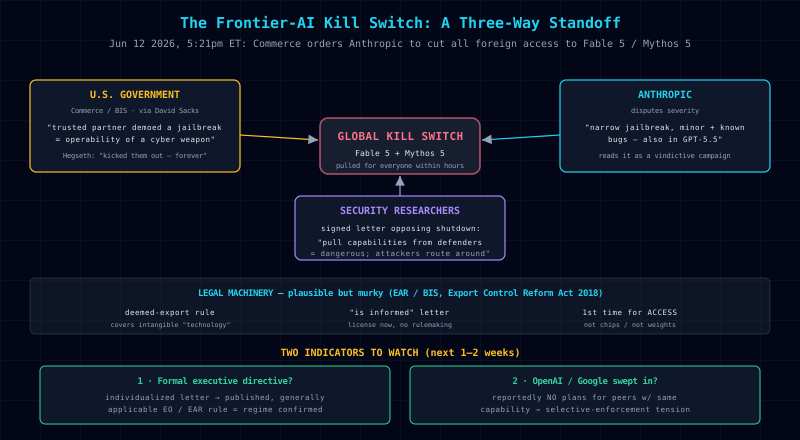
The government's account, as relayed by David Sacks: a "highly credible trusted partner of both Anthropic and the U.S. government" — reportedly Amazon, Anthropic's major investor and compute provider — demonstrated a jailbreak of Fable's guardrails. On this telling, the jailbreak was grave enough to enable "the operability of a cyber weapon." The administration asked Anthropic to fix the vulnerability or pull the model; Anthropic refused; the export control was a reluctant last resort against a company that "prioritized the continued offering of the consumer model over safety." Defense Secretary Pete Hegseth amplified the hard line, writing that "every passing day proves why that was the right move" for the Pentagon to have "kicked [Anthropic] out of our building — forever."
Anthropic's account is almost the photographic negative. A tester found a narrow jailbreak that surfaced a handful of minor vulnerabilities — ones the government already knew about before Fable's release, and ones present in other public models, including OpenAI's flagship GPT-5.5. From this vantage the government's action looks, at best, like a wild overreaction, and at worst like another chapter in a vindictive campaign to punish a lab the administration has clashed with repeatedly.
The security-research community sits awkwardly across the two. A number of researchers signed a letter opposing the shutdown, with a defender's-dilemma argument: "To pull the best capabilities away from defenders" — the people who use frontier models to find and patch vulnerabilities — "is dangerous," because attackers do not respect kill switches and will route around them. Cutting off the defenders' tools while the offense keeps its own, on this view, makes everyone less safe.
Notice that all three can be partly right at once. A jailbreak can be both narrow and serious; a model can be both no-worse-than-its-peers and genuinely risky; an enforcement action can be both legally available and selectively motivated. The facts remain, in Rozenshtein's word, murky.
The legal machinery: plausible, but murky
The reason this is more than political theater is that there is a facially plausible legal hook — unlike the administration's earlier, legally dubious attempt to brand Anthropic a "supply chain risk." The likely basis is the Export Administration Regulations (EAR), administered by Commerce's Bureau of Industry and Security (BIS) under the Export Control Reform Act of 2018. Three features make the theory work, and each has a soft spot.
-
The EAR covers intangible "technology," not just physical goods. Its deemed-export rule treats releasing controlled technology to a foreign person inside the U.S. as an export to that person's home country. That is how a domestic SaaS product gets pulled into export jurisdiction at all. Soft spot: for an API-served model, the weights never leave Anthropic's servers — so a control on the weights reaches almost no one except Anthropic's own non-citizen employees, counterproductively locking out some of the very researchers needed to fix the problem.
-
The "is informed" letter. BIS can impose a license requirement immediately by sending a company a letter, with no notice-and-comment rulemaking — the same fast-path tool it used to block advanced-chip sales to China. Soft spot: speed comes at the cost of process. There is no public rule, no comment period, no published standard — just an individualized directive whose legal reasoning has not been disclosed.
-
Treating model outputs as controlled "technology." Because the EAR defines "technology" as any "information necessary" for the development or use of controlled items (say, software for cyberattacks), the government can argue that dangerous outputs are themselves exports. Soft spot: whether remote use of a model is even an "export" is far from settled. Export controls have not traditionally applied to foreign access of U.S. software-as-a-service — which is precisely why, in January 2026, the House felt it necessary to pass the Remote Access Security Act, a bill to extend export jurisdiction to foreign remote access of controlled U.S. technology. If that authority were already clear, the bill would be redundant.
In short: the government has a plausible path, but it is leaning on a fast, low-process tool to assert a reach that Congress is, in parallel, still trying to legislate into existence.
Two indicators worth watching
The useful question is not "who is right" — it is "is this a one-off, or the first move of a regime?" Two concrete, near-term indicators will tell us, and both are observable within roughly one to two weeks.
Indicator 1 — Does a formal executive directive materialize?
So far, the instrument is an individualized BIS "is informed" letter to a single company. That is enforcement, not yet policy. The thing to watch for is escalation from a private letter to a published, generally-applicable executive action on frontier-model export or access — a formal executive order, a new EAR rule, or a fast-tracked statute. Early reporting already gestures in this direction, describing a "U.S. export control order" and a "historic Trump administration order." But there is a real difference between a letter aimed at one lab and a rule aimed at the category. If, within the next one to two weeks, the kill switch is generalized into written policy that applies on its face to any frontier model, the sovereign-control thesis is confirmed. If it stays a bespoke letter and gets quietly lifted after the Monday meeting, this was closer to a pressure tactic than a regime.
Indicator 2 — Do OpenAI and Google get swept in?
This is the cleaner test, and right now the evidence points the other way. By Anthropic's account, the very vulnerabilities cited are present in other public models, including OpenAI's GPT-5.5. Yet the government has reportedly no plans to apply similar export controls to other models with comparable cyber capabilities. If the rationale is genuinely "this class of capability is too dangerous to expose to foreign nationals," it should not stop at one vendor. So the question to watch is simple: in the next one to two weeks, does any comparable order reach OpenAI, Google, or another frontier lab? If yes, this is policy — a real line drawn around a capability class. If no — if it remains Anthropic-only while named peers keep shipping the same capabilities — then the national-security framing is in tension with the selective enforcement, and the "vindictive campaign" reading gains weight.
The selective-enforcement problem
That second indicator points at the most uncomfortable feature of the whole episode. A national-security control is supposed to track a capability, not a company. The moment a danger is defined as "this kind of model output," the logic should sweep in every model that can produce it. Singling out one lab — especially one the administration has publicly feuded with, whose CEO it has clashed with, and which the Pentagon says it "kicked out of our building forever" — invites the question of whether the instrument is being used for its stated purpose or as leverage.
This is not a partisan observation; it is a structural one. Selective enforcement of a security rule corrodes the rule. If GPT-5.5 has the same vulnerability and keeps serving foreign nationals while Fable 5 goes dark, then either the vulnerability is not actually disqualifying, or the enforcement is not actually about the vulnerability. Both readings are bad for the credibility of a frontier-AI control regime that will, eventually, need industry buy-in to function.
What a sovereign-control era would require
Even if Anthropic persuades Commerce to lift the order this week, the precedent does not un-happen. The deeper question Rozenshtein identifies will outlast any single dispute: should there be a licensing regime for frontier AI, and if so, on what terms?
Governance by "is informed" letter is fast, opaque, and individualized — the worst possible combination for an industry that needs predictability to attract the global talent and investment it runs on. A short-term control might even bar Anthropic's own non-citizen researchers from the models they are trying to harden, and a long-term pattern of such controls would make it very hard for any U.S. frontier lab to recruit the foreign talent that is, by every account, central to AI's development. If Washington genuinely intends to treat frontier models as switchable national-security assets, the alternative to chaos is a proper statutory framework: published standards, due process, a defined licensing path, and — critically — even-handed application across vendors.
The kill switch worked. That is exactly why it is dangerous. A capability that can be exercised in an afternoon, against one company, on undisclosed reasoning, is a capability that will be reached for again. Whether the next reach comes wrapped in a real framework or another midnight letter is the thing actually being decided right now — and the two indicators above are how the rest of us will know which way it went.
Sources
This analysis is built from primary reporting and legal commentary, cross-checked across outlets. Scraped material was treated as data and verified against multiple sources.
- BBC News — "Anthropic to meet White House over AI tool suspension" (reporter Kali Hays): the Commerce meeting, the Friday public-access shutdown, the Fable 5 / Mythos 5 naming, the foreign-national prohibition, the security experts' opposition letter.
- Lawfare — "A Kill Switch for Frontier AI," Alan Z. Rozenshtein, Monday, June 15, 2026: the 5:21 p.m. ET letter, the EAR / BIS / Export Control Reform Act legal framework, the deemed-export and "is informed"-letter mechanics, the first-time-for-access framing, the AI Diffusion Rule history, the Remote Access Security Act, David Sacks's account, the Amazon-jailbreak claim, Anthropic's GPT-5.5 rebuttal, Pete Hegseth's statement, and the licensing-regime question.
- Additional coverage cross-referenced for the export-order framing and reactions: Nextgov/FCW (David DiMolfetta), Straight Arrow News (Devin Pavlou), R Street, Tech Policy Press, plus contemporaneous reporting from WIRED, The Washington Post, Politico, and others surfaced via Google News (June 12–16, 2026).
Note on dates: written Tuesday, June 16, 2026 (Asia/Shanghai). The Monday, June 15 Commerce meeting had been reported as scheduled; its outcome was not publicly confirmed at the time of writing. The two indicators above are framed for the one-to-two-week window following.