BMAD-METHOD Deep Dive: How the 50K-Star AI Agile Development Methodology Turns Agents from 'Code Writers' into 'Product Builders'
You've used AI to write code. But have you used AI to build a product?
This isn't wordplay. The gap between "writing code" and "building a product" is the gap between "have AI implement a function" and "have AI deliver a complete feature from zero to one." The former needs a prompt. The latter needs a methodology.
This is the problem BMAD-METHOD sets out to solve.
As of July 2026, BMAD-METHOD has 50,191 stars and 5,777 forks on GitHub, making it the highest-starred methodology project in AI-assisted software development. Its positioning is explicit: Breakthrough Method for Agile AI Driven Development — not "AI coding tips," but "AI-driven agile development methodology."
What BMAD Actually Is
BMAD's core insight: the biggest bottleneck for AI coding assistants isn't code generation capability — it's the lack of structured workflows.
You can ask Claude Code to write a sorting algorithm and it delivers instantly. But if you say "build me a user authentication system," it starts guessing — no PRD, no architecture design, no user stories, no acceptance criteria. It's just "writing code," not "building a product."
BMAD's solution: encode professional software engineering roles and processes as structured workflows that AI agents can follow.
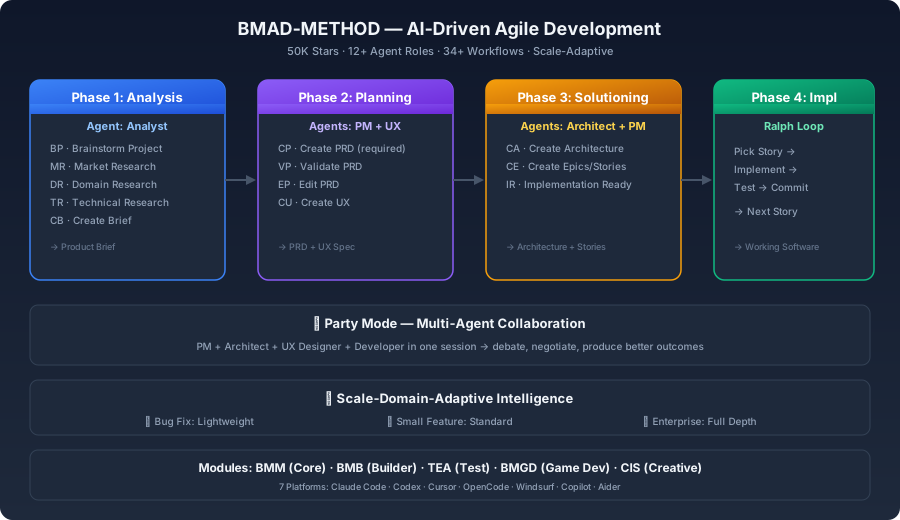
The Four-Phase Process
BMAD breaks software development into four phases, each driven by specialized agent roles:
Phase 1: Analysis — Agent: Analyst
Before writing any code, figure out what to build.
| Command | Workflow | Output |
|---|---|---|
BP |
Brainstorm Project | Guided brainstorming to clarify product direction |
MR |
Market Research | Market analysis, competitive landscape, customer needs |
DR |
Domain Research | Industry domain deep dive |
TR |
Technical Research | Technical feasibility, architecture options |
CB |
Create Brief | Product brief, locking in the core idea |
Phase 2: Planning — Agents: PM + UX Designer
Turn ideas into executable plans.
| Command | Workflow | Output |
|---|---|---|
CP |
Create PRD | Product Requirements Document (required) |
VP |
Validate PRD | PRD completeness validation |
EP |
Edit PRD | Improve an existing PRD |
CU |
Create UX | UX design specification |
Phase 3: Solutioning — Agents: Architect + PM
Turn plans into technical blueprints.
| Command | Workflow | Output |
|---|---|---|
CA |
Create Architecture | Technical architecture document (required) |
CE |
Create Epics and Stories | Epic and user story list (required) |
IR |
Implementation Readiness | Ensure PRD, UX, architecture, and stories are aligned (required) |
Phase 4: Implementation — Ralph Autonomous Loop
This is the most interesting part of the BMAD ecosystem. BMAD-METHOD itself only covers the first three phases (planning). Phase 4 (implementation) is handled by Ralph — an autonomous implementation loop engine.
Ralph reads the PRD, architecture docs, and user stories produced by BMAD, then autonomously loops: pick next Story → implement → test → commit → pick next. Humans only review at key checkpoints.
bmalph (398 stars) is the unified installer for BMAD + Ralph, deploying both systems with a single command.
Party Mode: Multi-Agent Role Collaboration
One of BMAD's most distinctive features is Party Mode — bringing multiple agent roles into a single session to discuss and collaborate like a real team.
For example, you can simultaneously introduce the PM, Architect, and UX Designer, and have them debate a PRD. The PM focuses on user value, the Architect on technical feasibility, the UX Designer on interaction experience — the three-way negotiation produces a far more comprehensive result than any single role's "self-Q&A."
This is essentially simulating a micro product team inside an AI session.
Scale-Domain-Adaptive Intelligence
Another design highlight is BMAD's scale-domain-adaptive capability. It automatically adjusts planning depth based on project complexity:
- Bug fix: Lightweight process, quick solution
- Small feature: Standard process, PRD + Architecture + Stories
- Enterprise system: Full process, all phases deeply expanded
This means you won't run the full PRD→Architecture→Epic pipeline for a typo fix, nor will you start coding an enterprise system from a single prompt.
Module Ecosystem
BMAD extends into specialized domains through its module system:
| Module | Purpose |
|---|---|
| BMad Method (BMM) | Core framework, 34+ workflows |
| BMad Builder (BMB) | Create custom agents and workflows |
| Test Architect (TEA) | Risk-based test strategy and automation |
| Game Dev Studio (BMGD) | Game development workflows (Unity, Unreal, Godot) |
| Creative Intelligence Suite (CIS) | Innovation, brainstorming, design thinking |
Comparison with ECC: Methodology vs. Operating System
BMAD and ECC are often compared, but their positioning is fundamentally different:
| Dimension | BMAD-METHOD | ECC |
|---|---|---|
| Stars | 50K | 227K |
| Positioning | Agile dev methodology | Agent operating system |
| Core value | Structured dev process | Skill library + self-evolution + security |
| Workflow | Four-phase (Analysis→Planning→Solutioning→Impl) | No preset process, compose on demand |
| Agent roles | 12+ specialized roles (PM, Architect, UX, etc.) | No preset roles |
| Party Mode | ✅ Multi-role collaboration | ❌ |
| Scale-adaptive | ✅ Auto-adjust depth | ❌ |
| Skill count | 34+ workflows | 261 skills |
| Self-evolution | ❌ | ✅ Dual-stream capture |
| Security | ❌ | ✅ AgentShield |
| Cross-platform | ✅ 7 platforms | ✅ 8 platforms |
| Business model | MIT free | MIT + Pro $19/mo |
BMAD answers "how to build a product." ECC answers "how to make agents better."
The two can complement each other: use BMAD for upfront planning (PRD→Architecture→Stories), producing structured development plans; use ECC for execution enhancement (skills, security, memory, self-evolution), making the implementation process more efficient.
Ratings
| Dimension | Score | Rationale |
|---|---|---|
| Methodology Completeness | 9/10 | Four phases + scale-adaptive, covering idea to deployment |
| Agent Role Design | 9/10 | 12+ roles, Party Mode multi-role collaboration is a unique highlight |
| Workflow Quality | 8/10 | 34+ workflows, professional PRD/Architecture/Story templates |
| Implementation Phase | 6/10 | Depends on Ralph, not native; bmalph integration still new |
| Documentation | 8/10 | Full doc site + Web Bundles + non-interactive install |
| Community | 7/10 | 50K stars but contributors relatively concentrated |
| Learning Curve | 7/10 | Four-phase flow is clear, but 34+ workflows take time |
| Ecosystem Extensibility | 8/10 | Module system + Builder supports customization |
| Overall | 7.8/10 | The definer of AI agile development methodology; implementation phase depends on external tools |
Conclusion
BMAD-METHOD's real value isn't "yet another AI coding workflow" — it redefines the process standard for AI-assisted software development. Traditional AI coding is "conversational": you state requirements, it writes code, with no product thinking, no architecture design, no user stories in between. BMAD encodes the complete professional software engineering process as AI-executable workflows, upgrading agents from "code generators" to "product development teams."
50K stars tells a clear story: developers don't need better code generation — they need better development processes.
For teams doing production-grade development with AI, BMAD is currently the most complete AI agile methodology. But its implementation phase (Phase 4) depends on Ralph, and the integration experience still has room for improvement. Recommended pairing with ECC — BMAD for planning, ECC for execution enhancement.
For individual developers, BMAD's Party Mode is an underrated feature — having multiple AI roles debate your idea produces far higher-quality results than a single prompt.
References
- BMAD-METHOD GitHub Repository — 50K+ stars, MIT license
- BMAD Official Documentation
- BMAD Roadmap
- bmalph — BMAD + Ralph Unified Installer (398 stars)
- Ralph — Autonomous Implementation Loop Engine
- BMAD Web Bundles — usable in Gemini/ChatGPT
- BMAD Discord Community