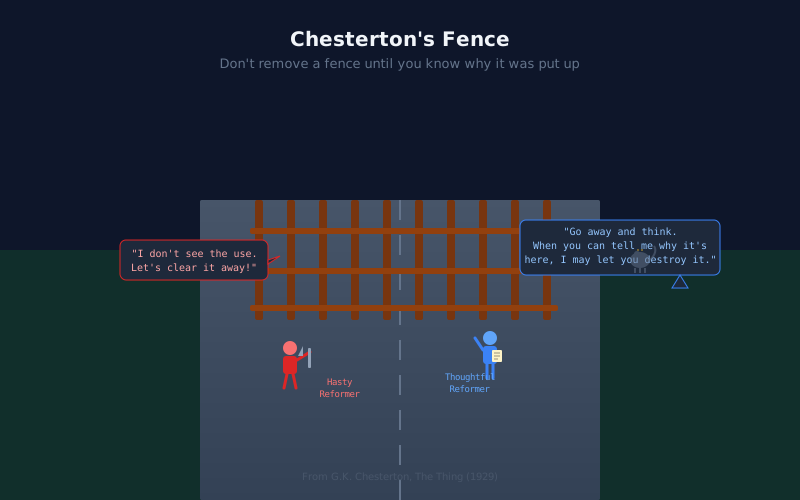
There is a certain kind of reformer who walks up to a fence stretched across a road, looks at it and says: "I don't see the use of this. Let us clear it away." The more intelligent reformer, G.K. Chesterton suggests, would answer: "If you don't see the use of it, I certainly won't let you clear it away. Go away and think. Then, when you can come back and tell me that you do see the use of it, I may allow you to destroy it."
This, in its simplest form, is Chesterton's Fence. Don't remove a fence until you know why it was put up in the first place. It is not a conservative doctrine that demands we preserve everything — it is a thinking discipline that demands we understand before we act.
Where It Comes From
Gilbert Keith Chesterton (1874–1936) was an English writer whose paradoxical style earned him the title "prince of paradox." He wrote detective fiction (the Father Brown series), Christian apologetics (Orthodoxy, The Everlasting Man), and voluminous social commentary. The fence parable appears in his 1929 book The Thing, specifically in an essay titled "The Drift from Domesticity."
Chesterton was writing in a period of aggressive modernism — when it was fashionable to dismiss inherited institutions as the irrational baggage of less enlightened times. The fence was his counterpunch.
The same impulse appears elsewhere in Chesterton's work. In his essay collection Heretics, he gives the example of a lamp-post that everyone wants to pull down. Some want electric light, some want scrap iron, some want darkness because their deeds are evil. The lamp-post comes down, and then there is "war in the night, no man knowing whom he strikes." Only afterwards does everyone realize they should have first discussed "what is the philosophy of Light."
The Principle
Fences do not appear by accident. Someone paid for the materials, dug the post holes, and spent a Saturday afternoon building it. They had a reason. That reason might have been bad. It might have been good once but is now obsolete. But until you know what it was, you are operating in the dark.
The principle has three layers:
First, epistemic humility. Your failure to see a purpose does not mean no purpose exists. This is especially true in complex systems, where cause and effect are separated by time, distance, and multiple feedback loops.
Second, second-order thinking. Removing a fence changes the system, not just the fence. Those changes ripple outward in ways that are hard to predict from first principles alone. The fence might be preventing something worse than the fence itself.
Third, burden of proof. The burden is on the reformer, not the preserver. If you want to change something, the minimum prerequisite is understanding it. You do not need to agree with the original reasoning — but you do need to know what it was.
The historian Will Durant captured a related idea: "Out of every hundred new ideas, ninety-nine or more will probably be inferior to the traditional responses which they propose to replace." Tradition is not always right — but it has survived a filtering process that new ideas have not yet undergone.
Software Engineering: The Legacy Code You Want to Delete
Chesterton's Fence appears nowhere more vividly than in software engineering, where the impulse to tear things down is a professional hazard.
Consider a developer who joins a project and encounters a baffling 200-line function with cryptic variable names, no tests, and a comment that just says "// don't touch." The instinct is natural: delete it, rewrite it, replace it with something clean and modern.
But why does that function exist? It might handle an edge case that appears only in production with a specific database version, under a specific load pattern, on the third Tuesday of a month with a full moon. It might be a workaround for a bug in a dependency that has not been fixed because the dependency is unmaintained. It might implement a business rule that made sense when the company had three customers in a specific regulatory regime.
None of this means the function should stay. It does mean that deleting it without understanding it is gambling with production. The better approach: trace the function's history through git blame, read the commit messages, search for related bug reports, and talk to the person who wrote it if they are still around. Then, and only then, decide.
This applies equally to architectural decisions. That microservice that seems redundant? It might be the only thing preventing a thundering herd on the primary database. That caching layer everyone complains about? It might have been added after a Black Friday outage that cost the company six figures. The naming convention that nobody likes? It might be required by a regulatory audit that runs every quarter.
Joel Spolsky famously wrote about this in the context of Netscape's doomed rewrite: "The single worst strategic mistake that any software company can make: they decided to rewrite the code from scratch." The Netscape team looked at their existing codebase and saw a fence. They tore it down without understanding why each part of it existed. Mozilla took years to recover from that decision.
Organizations and Social Systems
In 2013, a Chinese tech company experimented with a "flat" organizational structure — no titles, no managers, everyone reporting to everyone. Within six months, an invisible hierarchy had formed. It was more brutal than the formal one it replaced, because it operated through social coercion rather than transparent rules. The company quietly reintroduced management layers.
This is a classic Chesterton's Fence case. Hierarchies exist for reasons that are not immediately obvious to someone who only sees their dysfunctions: they provide clear escalation paths during crises, assign accountability for decisions, and prevent the most socially dominant person from controlling everything by default. Until you understand those functions, removing the hierarchy does not eliminate the need for those functions — it just forces them underground.
The same pattern appears in many areas:
- Company processes. That tedious approval workflow might exist because someone once deployed to production on a Friday afternoon and ruined the weekend for forty people.
- Code review policies. The requirement for two approvals before merging might feel bureaucratic, until you learn about the incident where a single-approval PR deleted the customer database.
- Meeting structures. The standing Monday meeting everyone hates might be the only time three critical teams actually synchronize.
When Chesterton's Fence Becomes Chesterton's Gate
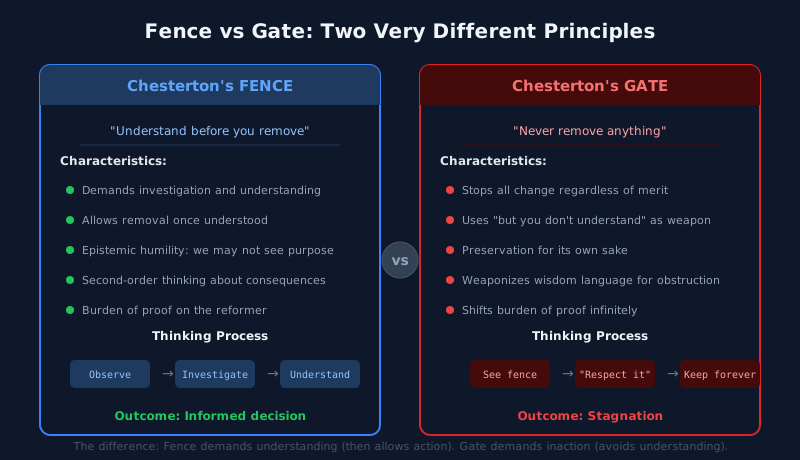
No mental model is absolute. Chesterton's Fence has a dark side: it can become a rhetorical weapon against any change whatsoever. Every fence, no matter how pointless, can be defended with "but you don't understand why it's there." This is not Chesterton's Fence — this is Chesterton's Gate, a barrier to progress dressed in the language of wisdom.
The distinction matters. Chesterton's Fence demands understanding before action. Chesterton's Gate demands inaction regardless of understanding. The first is a thinking tool; the second is obstructionism.
There are legitimate reasons to tear down a fence quickly:
- The house is on fire, and the fence is blocking the fire truck.
- You have already understood the fence and concluded it was a mistake (the original builder was drunk, the road has been rerouted, the wolves the fence was meant to keep out went extinct).
- The cost of understanding exceeds the cost of removing and rebuilding if necessary — this is rare but real in fast-moving software projects where reverting is cheap.
The key test: have you actually done the work of understanding, or are you using the fence metaphor to avoid doing that work? Chesterton himself was clear: once you understand why the fence exists, you are free to remove it if the reasoning no longer holds. He was not a preservationist. He was a proponent of informed action.
What Chesterton's Fence Is Not
It is important to clarify what this principle does not mean.
It does not mean old things are better. Age alone is not an argument. The fence might have been built for a bad reason. It might have been built for a good reason that no longer applies. The point is that you cannot know which case you are in without investigation.
It does not mean change is dangerous. Chesterton was a reformer himself — he just believed in informed reform. Understanding the fence is the prerequisite for building something better, not a permanent argument against building anything.
It does not mean you need perfect knowledge. You do not need to trace every nail in the fence back to its geological origins. You need to understand the function — what problem the fence was solving, and for whom. That is usually discoverable through a few hours of git archaeology or a few conversations with the people who were there.
A Practical Framework
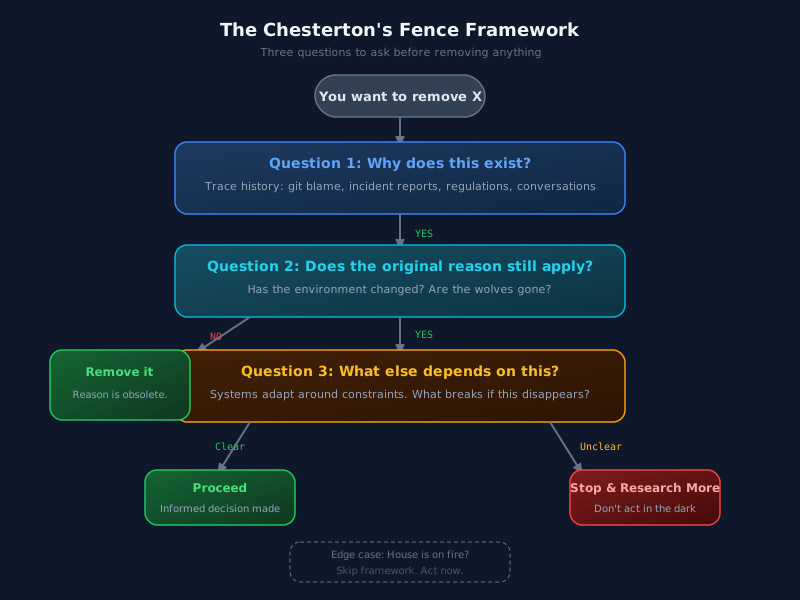
When you encounter a fence you want to remove, ask three questions:
-
Why does this exist? Trace the history. Find the person, the commit, the incident report, the regulation. If you cannot find the reason, you have not looked hard enough.
-
Does the original reason still apply? The wolves may be gone. The company may have outgrown the process. The bug in the dependency may have been fixed. If the reason is obsolete, the fence can go.
-
What else depends on the fence? Systems adapt around constraints. People build workflows around that annoying approval process. Other services might depend on that "redundant" microservice. Remove the fence, and those adaptations become broken assumptions.
If you can answer all three questions clearly, you are no longer operating in the dark. Whether the fence stays or goes is now a considered decision rather than an impulse. That is all Chesterton asked.
The fence on the road is still there. Someone is looking at it, wondering why. That someone is doing it right.