Clypra Deep Dive: Redefining Open-Source Video Editor Tech Stack with Tauri + React
The open-source video editor space has long had a paradox: powerful tools (Blender VSE, Kdenlive) have steep learning curves, while user-friendly ones (Clipchamp, CapCut) tend to be closed-source or cloud-only. And the tech stack choice has barely changed in a decade — C++ for the engine, Qt for the UI, almost without exception.
Clypra breaks this inertia.
Clypra is a modern open-source video editor developed by the AIEraDev team, with a distinctly 2026 tech stack: Tauri (Rust) for the desktop shell and performance layer, React for the UI layer. This combination is nearly unprecedented in video editing, representing a new technical direction — replacing C++ with Rust for compute-intensive tasks, and replacing Qt with web technologies for cross-platform UI.
Architecture: The Tauri + React Chemistry
Clypra's architecture can be decomposed into three layers:
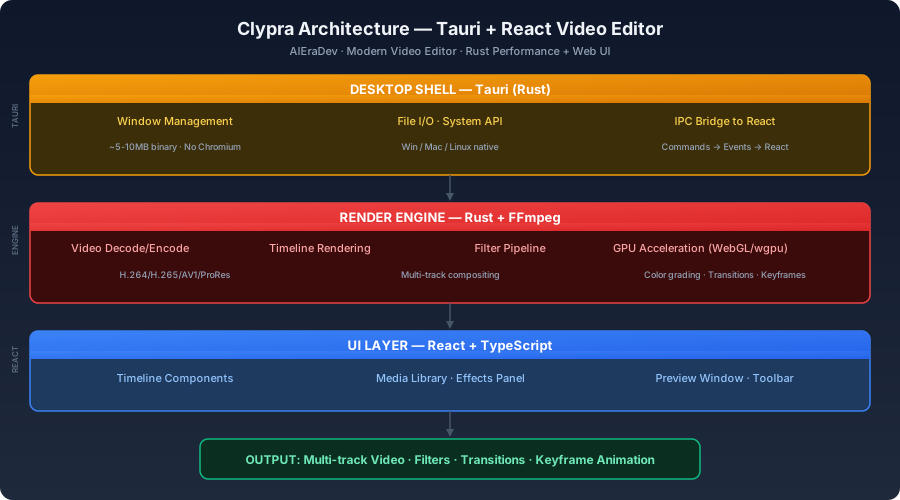
| Layer | Technology | Responsibility |
|---|---|---|
| Desktop Shell | Tauri (Rust) | Window management, system API calls, file I/O, IPC communication |
| Render Engine | Rust + FFmpeg | Video decode/encode, timeline rendering, filter pipeline, GPU acceleration |
| UI Layer | React + TypeScript | Timeline interaction, media management, preview window, toolbar |
Why Tauri Instead of Electron?
This is Clypra's most critical architectural decision. Electron-based video editors (like LosslessCut) face two core problems:
- Memory overhead: Electron ships with Chromium, baseline memory usage starts at 200MB+. For a video editor that needs to simultaneously load multiple video tracks and cache frame data, memory pressure is immense.
- Performance bottlenecks: Video processing (decode, encode, filters) is purely compute-intensive — JavaScript/Node.js can't handle it. Native modules are required (FFmpeg WASM or Node native bindings), and IPC communication with Electron's main process adds another layer of overhead.
Tauri's solution is more elegant: Rust directly handles all compute-intensive tasks, communicating with the React UI via Tauri's IPC bridge. Rust's performance approaches C/C++, memory safety is guaranteed by the compiler, and there are no GC pauses. Tauri's binary size (~5-10MB) is far smaller than Electron (150MB+), making it more user-friendly.
Why React Instead of Qt?
Qt is the traditional choice for video editors (Kdenlive, Shotcut, and Olive all use it), but it has several pain points:
- C++ development velocity: UI iteration is slow, hot reload is inconvenient
- Cross-platform consistency: Qt rendering often differs across Linux/Windows/macOS
- Ecosystem: Third-party component libraries are far less rich than React's ecosystem
React's component model naturally fits video editor UIs — the timeline is a set of draggable clip components, the media library is a set of filterable card components, the effects panel is a property editor. React's declarative rendering makes UI state management more controllable, and web technologies enable UI iteration speeds far beyond native solutions.
Core Features
Clypra's feature set is designed around "modern video creator needs":
- Multi-track timeline: Video, audio, text, effects on multiple tracks
- Real-time preview: WebGL-based GPU-accelerated preview
- Filters & effects: Built-in color correction, transitions, keyframe animation
- Format support: Mainstream video/audio/image formats via FFmpeg
- Export pipeline: Multiple resolution, bitrate, and format export presets
Comparison with Other Open-Source Video Editors
| Dimension | Clypra | Kdenlive | Shotcut | Olive | LosslessCut |
|---|---|---|---|---|---|
| Desktop Framework | Tauri (Rust) | Qt (C++) | Qt (C++) | Qt (C++) | Electron |
| UI Layer | React | Qt Widgets | Qt Widgets | Qt Quick | HTML/JS |
| Render Engine | Rust + FFmpeg | MLT + FFmpeg | MLT + FFmpeg | Custom (C++) | FFmpeg |
| Memory Usage | Low (expected) | Medium | Medium | Medium | High (Electron) |
| Bundle Size | ~10MB | ~100MB | ~100MB | ~80MB | ~150MB |
| Dev Efficiency | ⭐⭐⭐ | ⭐⭐ | ⭐⭐ | ⭐⭐ | ⭐⭐⭐ |
| Maturity | 🆕 New | Mature | Mature | In dev | Mature |
| Multi-track | ✅ | ✅ | ✅ | ✅ | ❌ |
| Keyframe Animation | ✅ | ✅ | ✅ | ✅ | ❌ |
| Real-time Preview | ✅ GPU | ✅ GPU | ✅ GPU | ✅ GPU | ❌ |
Clypra's core differentiator is the advancement of its tech stack choice — it's currently the only known open-source video editor using the Tauri + React stack. But in terms of feature maturity, it cannot compete in the short term with deeply established projects like Kdenlive and Shotcut.
Technical Challenges
While Clypra's tech stack is forward-looking, it faces several key challenges:
-
Tauri's IPC bottleneck: Video editing requires high-frequency transmission of large amounts of frame data (4K 60fps ≈ 1.5GB/s raw data). Whether Tauri's IPC channel can handle this throughput is a critical test.
-
Web-based UI performance: React's virtual DOM combined with numerous draggable timeline components could encounter rendering bottlenecks in complex projects (dozens of clips, dozens of effects). Sophisticated virtualization and memo optimization will be essential.
-
Ecosystem maturity: Many foundational libraries in video editing (MLT, frei0r filters, etc.) are C/C++ ecosystem. Rust's FFmpeg bindings (like
ffmpeg-next) are usable but not yet as mature as C native interfaces in functionality and stability. -
GPU acceleration path: Video rendering requires deep GPU acceleration (encoding, filters, compositing). Rust's GPU compute ecosystem (wgpu, cuda) is rapidly developing but needs time to match the maturity of MLT + Movit.
Ratings
| Dimension | Score | Rationale |
|---|---|---|
| Tech Stack Innovation | 9/10 | Tauri + React is pioneering in video editing |
| Architecture Design | 7/10 | Clear layering but needs time to prove |
| Feature Completeness | 5/10 | New project, features iterating rapidly |
| Performance Potential | 8/10 | Great potential from Rust + GPU acceleration |
| Developer Experience | 8/10 | React hot reload + Tauri fast builds |
| Community Activity | 5/10 | New project, community still forming |
| Cross-platform | 8/10 | Tauri natively supports Win/Mac/Linux |
| Overall | 7.1/10 | Right technical direction, needs time and community to realize potential |
Conclusion
Clypra's value isn't "yet another open-source video editor" — it represents a generational update in video editing tool tech stacks. The C++ + Qt combination has served this domain for two decades, but pain points around development velocity, memory safety, and cross-platform consistency have persisted. The Tauri + React combination offers a new path: Rust's performance and safety replacing C++, React's development efficiency and ecosystem replacing Qt.
This path isn't without challenges — IPC bandwidth, UI virtualization, and GPU acceleration are all hard problems. But if Clypra can crack them, it could become the "Figma moment" for open-source video editing — proving that web technologies + a native performance layer can produce better products than traditional approaches in this domain.
For developers, Clypra's tech stack choice alone is worth attention — it's answering a question from 2006 with a tech stack from 2026. For video creators, keep it on your radar but hold off on production use until it crosses the 1.0 threshold.
References
- Clypra GitHub Repository — AIEraDev Team
- Clypra Releases
- Tauri Official Documentation — Rust Desktop Framework
- FFmpeg — Underlying Video Processing Engine
- Kdenlive — Qt Open-Source Video Editor
- Shotcut — MLT Open-Source Video Editor
- Sogou Search — Clypra Results