Cognee Deep Dive: Architecture, Mechanisms, and Trade-offs of the AI Agent Memory Platform
Cognee Deep Dive: Architecture, Mechanisms, and Trade-offs of the AI Agent Memory Platform
Anyone who has used an AI coding agent for more than a week hits the same wall: the agent doesn't remember what you asked it to change last week. Every new session is a blank slate — you re-explain the project structure, coding conventions, and where you left off. Worse, even within a single session, once the context window fills up with conversation history, the agent "forgets" what was discussed at the beginning.
This is the memory problem for AI agents. And Cognee (as of June 2026: 24,626 GitHub stars, 2,291 forks, Apache-2.0 license) is one of the most active open-source solutions. It's not just another vector database wrapper — it uses knowledge graphs for structured reasoning, vectors for semantic search, ontologies for concept alignment, and a skill system for tool orchestration, aiming to give agents a memory layer that truly remembers, recalls, and reasons.
What Cognee Actually Is
Cognee's positioning is clear: an open-source AI memory platform for agents. Its core API has just four verbs:
await cognee.remember("Cognee turns documents into AI memory.")
results = await cognee.recall("What does Cognee do?")
await cognee.forget(dataset="main_dataset")
await cognee.improve()  # optimize the knowledge graph based on feedback
But behind those four verbs lies a full cognitive architecture. Cognee is not a simple "store text → vectorize → similarity search" pipeline. Its design philosophy: memory isn't just storage — it's understanding, connecting, and reasoning.
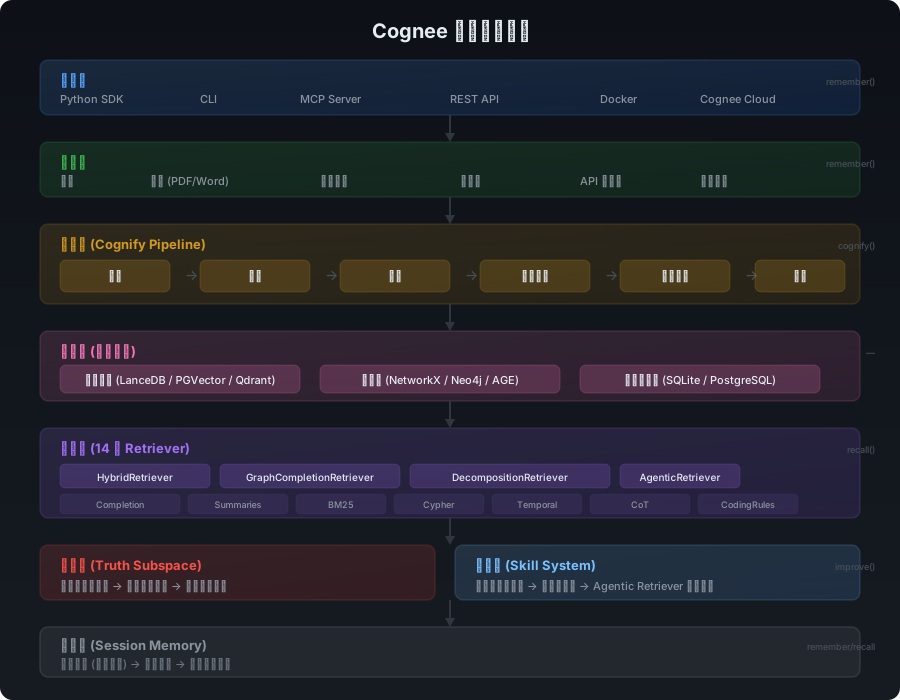
| Layer | Component | Responsibility |
|---|---|---|
| Access | Python SDK / CLI / MCP Server / REST API | Unified entry point, local and cloud deployment |
| Ingestion | Ingestion module | Multi-format data intake (text, docs, code, databases) |
| Cognition | Cognify pipeline | Classify → chunk → summarize → extract entities → build graph |
| Storage | Vector engine + Graph engine + Relational DB | Hybrid storage: semantic vectors + structured graph + metadata |
| Retrieval | 14 Retrievers | Adaptive routing: from simple vector search to Agentic ReAct loops |
| Alignment | Truth Subspace | Centroid-based truth alignment, weighted ranking of retrieval results |
| Skills | Skill + Tool system | Dataset-scoped procedural knowledge, loaded on demand by Agentic Retriever |
| Session | Session Memory | Fast cache + background sync to permanent graph |
Core Mechanisms, Layer by Layer
1. Ingestion and Cognify: From Raw Data to Structured Knowledge
Cognee's data processing pipeline is called Cognify. It's not a fixed pipeline but a configurable task graph. Each task is an async function registered via the @task decorator and orchestrated by run_tasks.
# Cognee's task definition pattern
@task(batch_size=20)
async def classify_documents(chunks, classification_model=None):
    # Use LLM to classify document chunks
    ...

@task()
async def extract_graph(chunks, graph_model=None):
    # Extract entities and relationships from text, build knowledge graph
    ...
The standard Cognify flow includes:
- Classification: LLM determines the type of each text chunk (factual statement, code, dialogue, metadata, etc.)
- Chunking: Semantic boundary-aware text splitting with configurable strategies
- Summarization: Structured summaries for each chunk
- Entity Extraction: Identify entities and their attributes from text
- Graph Construction: Extract relationships between entities, building triplets (subject-relation-object)
- Embedding: Vectorize text chunks and triplets, store in vector engine
Key design decision: Cognee's graph construction is not a pure NLP pipeline — it relies heavily on LLMs for entity recognition and relationship extraction. This means graph quality directly depends on the underlying LLM's capability, but it also means Cognee can handle implicit relationships in unstructured text that traditional NER+RE pipelines miss.
2. Knowledge Graph: CogneeGraph Design
Cognee's graph engine is called CogneeGraph, a custom graph abstraction layer supporting multiple backends:
- NetworkX (default, in-memory)
- Neo4j (production-grade graph database)
- PostgreSQL + Apache AGE (PG graph extension)
Core CogneeGraph elements:
# CogneeGraph core data structures
class Node:
    id: UUID
    type: str          # entity type
    attributes: dict   # key-value properties
    embedding: list    # vector embedding

class Edge:
    source: Node
    target: Node
    relationship: str  # relationship type
    attributes: dict
Graph construction is incremental: when new data arrives, Cognee attempts to merge new entities with existing ones (deduplication via fields marked with the Dedup annotation) and connect new relationships to existing ones. This means the graph evolves as data grows — a key differentiator from "rebuild the index from scratch" approaches.
3. Retrieval Layer: 14 Retrievers with Adaptive Routing
Cognee's retrieval layer is the most complex part of the system. It provides 14 retrievers covering the full spectrum of retrieval strategies:
| Retriever | Strategy | Use Case |
|---|---|---|
CompletionRetriever |
Pure vector similarity | Simple semantic matching |
SummariesRetriever |
Summary vector search | Quick overview |
ChunksRetriever |
Text chunk vector search | Precise content location |
BM25Retriever |
Sparse keyword retrieval | Exact term matching |
LexicalRetriever |
Lexical-level retrieval | Code/identifier search |
HybridRetriever |
Chunk + entity + global context | General multi-channel retrieval |
GraphCompletionRetriever |
Graph triplet search + LLM completion | Relational reasoning |
GraphCompletionDecompositionRetriever |
Query decomposition + sub-query graph search | Complex multi-hop questions |
GraphCompletionCoTRetriever |
Graph + chain-of-thought reasoning | Questions requiring reasoning chains |
CypherSearchRetriever |
Natural language → Cypher query | Structured graph queries |
NaturalLanguageRetriever |
NL → Cypher (with retry) | Natural language graph interface |
TemporalRetriever |
Time-aware graph search | Time-sensitive queries |
CodingRulesRetriever |
Coding convention retrieval | Code agent scenarios |
AgenticRetriever |
ReAct loop + tool calls + skills | Complex autonomous retrieval |
HybridRetriever is the workhorse for general use. It retrieves from three channels simultaneously:
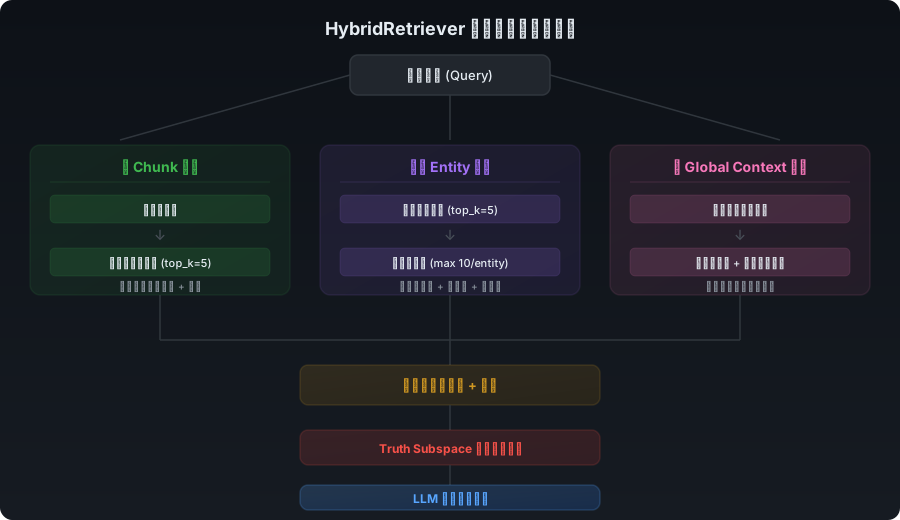
| Channel | Content | Retrieval Method |
|---|---|---|
| Chunk | Raw text chunks | Vector similarity |
| Entity | Knowledge graph entities and their edges | Entity vector search + edge ranking |
| Global Context | Global context summary index | Summary vector search |
Results from all three channels are merged, weighted by Truth Subspace alignment, then fed to the LLM for final answer generation.
GraphCompletionDecompositionRetriever is key for complex queries. It first decomposes the user's question into 2-5 sub-questions:
User question: "What are the fundamental architectural differences between Cognee and mem0?"
    ↓ Decompose
Sub-question 1: "What is Cognee's core architecture?"
Sub-question 2: "What is mem0's core architecture?"
Sub-question 3: "How do their storage and retrieval layers differ?"
    ↓ Parallel retrieval
Each sub-question independently runs GraphCompletion flow
    ↓ Merge
Deduplicate edges → build joint context → LLM generation
AgenticRetriever is the most powerful retriever. It implements a ReAct loop: at each step, the LLM decides whether to call a tool (search the graph, load a skill, execute code) or deliver a final answer. Skill procedure bodies are not pre-loaded into the system prompt — only names and descriptions appear in the catalog; the LLM fetches bodies on demand via the load_skill tool (progressive disclosure).
4. Truth Subspace: Making Retrieval Results "More True"
Truth Subspace is one of Cognee's most distinctive designs. The core idea: define a "truth subspace" in embedding space, using a set of basis vectors (centroids) to represent the direction of "truthful information," then project retrieved nodes onto this subspace to compute truth scores.
# Truth Subspace core computation (simplified)
def truth_score(node_vec, basis_vecs):
    coords = [cosine(node_vec, basis) for basis in basis_vecs]
    # The closer the coordinates are to basis vectors, the higher the score
    return sigmoid(sum(coords) / len(coords))
The motivation is clear: in a knowledge graph, not all nodes are equally reliable. Some information is factual, some is speculative, some is outdated. Truth Subspace attempts to add a "credibility" dimension to retrieval results, helping the LLM distinguish "what we know for sure" from "what we're less certain about."
But here's an important honesty check: how are the Truth Subspace basis vectors determined? From the code, centroids are loaded via load_centroids(), meaning they must be pre-computed and configured. If the basis vector selection is biased, the entire truth alignment will systematically favor certain types of information. This is a powerful but caution-requiring mechanism.
5. Skill System: Procedural Memory for Agents
Cognee's skill system is another noteworthy design. A Skill is not just a prompt template — it's a complete data model:
class Skill(DataPoint):
    name: str              # unique identifier
    description: str       # functional description
    procedure: str         # execution procedure (Markdown)
    declared_tools: list   # declared tool list
    dataset_scope: list    # dataset scope
    is_active: bool        # activation status
    maintainer: str        # maintainer
    skill_version: str     # version
    tags: list             # tags
Skills are stored in the knowledge graph, associated with datasets. At runtime, the Agentic Retriever can see the catalog of all skills within the current dataset scope, but skill procedure bodies are only loaded when the LLM calls the load_skill tool — this is progressive disclosure, preventing the context window from being flooded with skill descriptions.
This design allows Cognee to store not just "factual knowledge" (knowledge graph) but also "procedural knowledge" (skills), giving agents the genuine ability to "know how to do things."
Comparison with Similar Projects
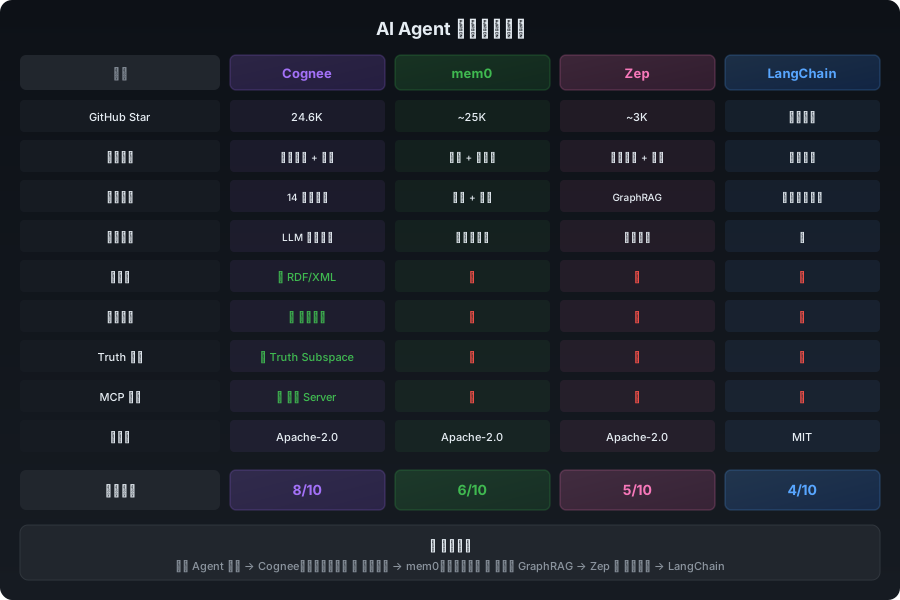
| Dimension | Cognee | mem0 | Zep | LangChain Memory |
|---|---|---|---|---|
| Stars (as of 2026.06) | 24.6K | ~25K | ~3K | Embedded module |
| Storage Model | Knowledge graph + vectors | Vectors + limited graph | Knowledge graph + vectors | Primarily vectors |
| Retrieval Strategy | 14 retrievers, adaptive | Semantic search + basic filters | GraphRAG | Basic vector search |
| Graph Construction | LLM-driven automatic | Limited graph support | Automatic | None |
| Ontology | RDF/XML + configurable | None | None | None |
| Skill System | Full Skill model | None | None | None |
| Truth Alignment | Truth Subspace | None | None | None |
| Session Memory | Session + background sync | Session-level | Session-level | Session-level |
| Deployment | Local / Docker / Cloud | Local / Cloud | Local / Cloud | Embedded |
| MCP Support | Native MCP Server | None | None | None |
| Claude Code Plugin | Official plugin | None | None | None |
| License | Apache-2.0 | Apache-2.0 | Apache-2.0 | MIT |
Cognee clearly leads in architectural depth: 14 retrievers, Truth Subspace, skill system, ontology support — these are capabilities mem0 and Zep currently lack. However, mem0 wins on ease of use: its API is simpler, documentation is friendlier, and onboarding is faster.
Multi-Dimensional Scoring
| Dimension | Score | Notes |
|---|---|---|
| Architecture | 9/10 | Clean layering, good modularity, strong extensibility. Pipeline task system is elegantly designed |
| Retrieval Capability | 9/10 | 14 retrievers cover nearly all scenarios; adaptive routing is a highlight |
| Graph Quality | 7/10 | LLM-driven construction is flexible but quality is unstable; lacks a deterministic rule layer |
| Usability | 6/10 | API is clean but configuration is complex; docs have room for improvement; 334 open issues |
| Production Readiness | 7/10 | Docker/MCP/Cloud deployment is solid, but graph DB dependencies and config complexity are barriers |
| Community Ecosystem | 8/10 | 24K+ stars, active community, Claude Code plugin, multi-language clients |
| Innovation | 8/10 | Truth Subspace, skill system, progressive disclosure are differentiated innovations |
Overall: 8/10. Cognee is currently the most architecturally complete open-source solution in the AI agent memory space. If your agent needs more than "similarity search" — genuine structured reasoning and cross-session knowledge accumulation — Cognee is the top choice. But be prepared to invest engineering time in configuration and tuning.
Limitations and Risks
-
Heavy LLM dependency: Graph construction, entity extraction, and query decomposition all depend on LLMs. If the underlying model is weak, the entire system's output quality cascades downward. The paper (arXiv:2505.24478) also notes that hyperparameter optimization significantly impacts performance — default configurations are not necessarily optimal.
-
Truth Subspace opacity: The origin and update mechanism of basis vectors is opaque. If basis vectors don't reflect the true information distribution, truth alignment may introduce systematic bias.
-
Complexity tax: 14 retrievers means choice paralysis. While Cognee has adaptive routing, understanding each retriever's appropriate use case still requires a learning curve.
-
Graph evolution consistency: While incremental graph construction is elegant, at scale with high-frequency updates, the accuracy of entity merging and relationship deduplication needs ongoing attention.
Conclusion
Cognee is not another "vector database wrapper" — it's a complete cognitive architecture. From ingestion to Cognify, from graph construction to multi-strategy retrieval, from Truth Subspace to the skill system, every layer has clear design intent and engineering trade-offs.
Our recommendation: if your AI agent project needs cross-session long-term memory and you're willing to invest time understanding its architecture, Cognee is the best open-source choice available. Start with HybridRetriever, gradually introduce GraphCompletionDecompositionRetriever for complex queries, and finally use AgenticRetriever + skill system for fully autonomous memory management.
For rapid prototyping or simple scenarios, mem0's lightweight approach may be more suitable. But if you're building an agent system that needs to truly understand context, Cognee's architectural depth will pay significant dividends in the mid-to-late stages of your project.
References
- Cognee GitHub Repository — 24.6K stars, Apache-2.0
- Cognee Official Documentation
- Cognee Research Paper: Optimizing the Interface Between Knowledge Graphs and LLMs for Complex Reasoning (Markovic et al., 2025)
- Cognee Claude Code Plugin
- Cognee MCP Server
- Cognee Docker Images
- mem0 GitHub Repository
- Zep GitHub Repository