DeerFlow 2.0 Deep Dive: Architecture, Competitors, and the Multi-Agent Framework Landscape
One year after its quiet launch, ByteDance's DeerFlow has exploded to 65,000+ GitHub stars, making it the most-starred open-source AI agent framework in the world. But numbers alone don't tell the story. DeerFlow 2.0 is a ground-up rewrite — it shares no code with v1 — that rethinks what a "multi-agent framework" should be. Instead of yet another graph builder or role-playing toolkit, it positions itself as a SuperAgent harness: a middleware-driven execution platform where a single lead agent orchestrates subagents, sandboxes, memory, skills, and IM channels to handle tasks spanning minutes to hours.
This post dissects the architecture from source code, then benchmarks it against nine competing frameworks to answer the question: is DeerFlow genuinely different, or just well-marketed?
What DeerFlow 2.0 Actually Is
DeerFlow stands for Deep Exploration and Efficient Research Flow. At its core, it is a Python 3.12+ backend with a Next.js 16 frontend, built on top of LangGraph for stateful agent execution. But calling it "a LangGraph wrapper" misses the point entirely. The value-add is the 14-middleware harness pipeline, the subagent orchestration layer, the sandbox abstraction, and the channel manager — none of which exist in LangGraph itself.
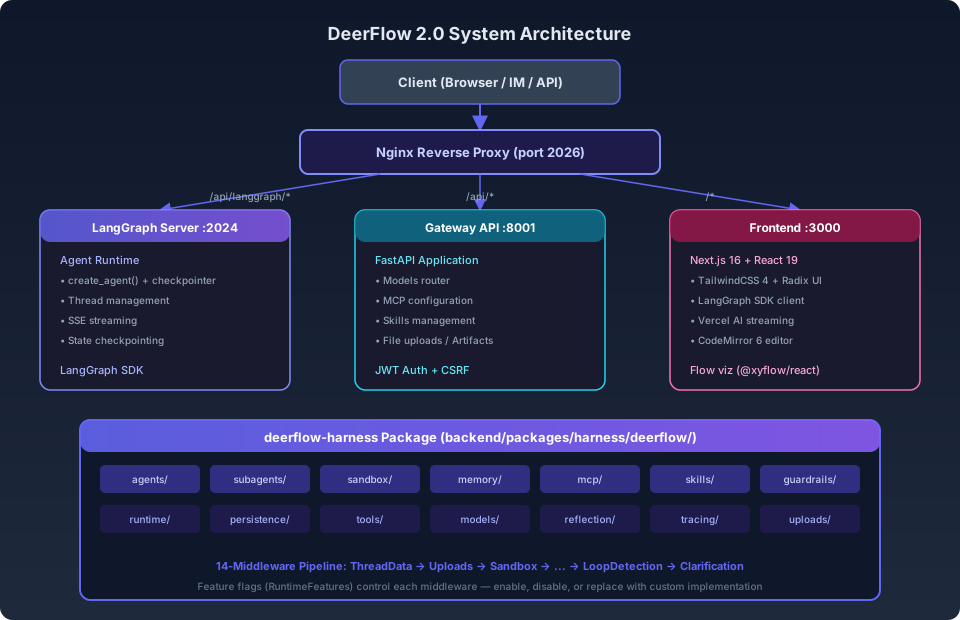
Architecture: The Harness, Not the Graph
The system has three layers:
- Nginx (port 2026) — unified reverse proxy routing
/api/langgraph/*to the LangGraph server,/api/*to the Gateway API, and/*to the frontend - LangGraph Server (port 2024) — agent runtime, thread management, SSE streaming, checkpointing
- Gateway API (port 8001) — models, MCP config, skills management, file uploads, artifacts
The core framework lives in backend/packages/harness/deerflow/, organized into 15 sub-packages: agents, community, config, guardrails, mcp, models, persistence, reflection, runtime, sandbox, skills, subagents, tools, tracing, uploads.
The Lead Agent + Subagent Pattern
DeerFlow does NOT use a traditional supervisor/planner/worker hierarchy. Instead, a single lead agent receives a task tool (when subagent_enabled=True) that spawns subagents on demand. The lead agent decomposes, delegates via parallel task() calls, and synthesizes results — all within the same conversation context.
Each subagent is a fresh LangGraph create_agent() instance with its own model, tools (filtered via allow/deny lists), skills, and system prompt. Built-in types include general-purpose (any non-trivial task) and bash (command execution), with custom agents defined in config.yaml.
Key design decisions:
- Concurrency control:
SubagentLimitMiddlewaretruncates excess paralleltaskcalls (default max 3 per response) - Multi-batch execution: If the lead agent generates >3 sub-tasks, it launches 3 per turn, waits for results, then launches the next batch
- Isolated event loops: Subagents run on a persistent isolated asyncio loop to avoid cross-loop conflicts
- Cooperative cancellation:
cancel_eventthreading.Event checked atastream()iteration boundaries - ACP integration: External agents like Claude Code and Codex CLI can be invoked as tools via the Agent Client Protocol
The 14-Middleware Pipeline
This is DeerFlow's most distinctive architectural contribution. Every request passes through an ordered middleware chain:
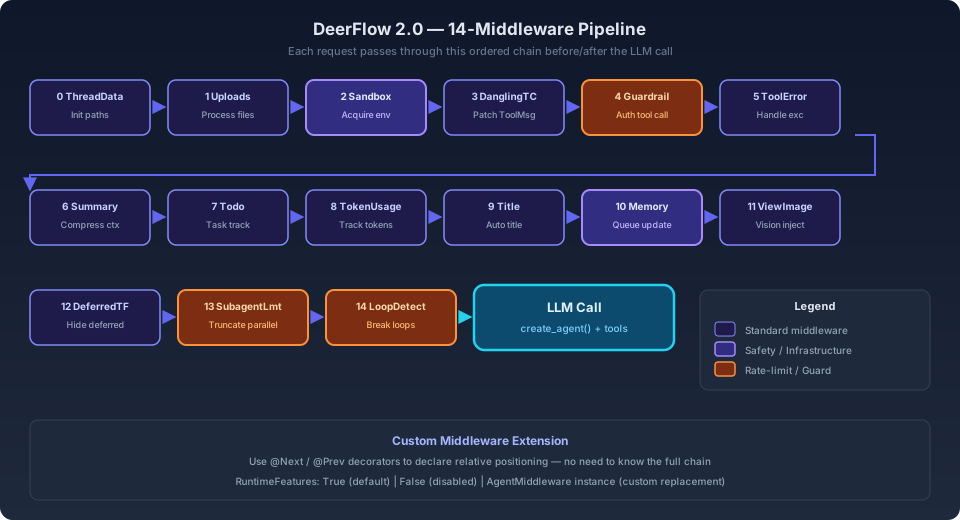
| Order | Middleware | Purpose |
|---|---|---|
| 0 | ThreadData | Initialize workspace/uploads/outputs paths |
| 1 | Uploads | Process uploaded files, inject file list |
| 2 | Sandbox | Acquire sandbox environment (lazy or eager) |
| 3 | DanglingToolCall | Patch missing ToolMessages |
| 4 | Guardrail | Pre-tool-call authorization (optional) |
| 5 | ToolErrorHandling | Convert tool exceptions to ToolMessages |
| 6 | Summarization | Context reduction near token limits |
| 7 | Todo | Task tracking (plan mode) |
| 8 | TokenUsage | Token tracking (optional) |
| 9 | Title | Auto-generate conversation title |
| 10 | Memory | Queue conversation for memory update |
| 11 | ViewImage | Vision model support |
| 12 | DeferredToolFilter | Hide deferred tool schemas |
| 13 | SubagentLimit | Truncate excess parallel task calls |
| 14 | LoopDetection | Break repetitive tool loops |
Custom middlewares can declare relative ordering via @Next/@Prev decorators — a plugin-like extensibility model without needing to know the full chain. Feature flags (RuntimeFeatures) allow each middleware to be enabled, disabled, or replaced with a custom implementation.
Sandbox: Virtual Filesystem + Docker Isolation
The sandbox abstraction provides execute_command(), read_file(), write_file(), list_dir(), glob(), grep(), and update_file() through two providers:
- LocalSandboxProvider: Direct execution on host (dev only)
- AioSandboxProvider: Docker-based isolation with Kubernetes support
Virtual path mapping ensures consistent semantics across providers:
| Virtual Path | Physical Path |
|---|---|
/mnt/user-data/workspace |
.deer-flow/threads/{thread_id}/user-data/workspace |
/mnt/user-data/uploads |
.deer-flow/threads/{thread_id}/user-data/uploads |
/mnt/user-data/outputs |
.deer-flow/threads/{thread_id}/user-data/outputs |
/mnt/skills |
skills/ |
Memory: LLM-Powered Fact Extraction
DeerFlow's memory system goes beyond simple key-value stores. The MemoryUpdater sends conversation + current memory to an LLM, which returns structured JSON with:
- User context: work context, personal context, top-of-mind items
- History: recent months, earlier context, long-term background
- Facts: id, content, category, confidence, source — filtered by confidence threshold
Per-agent and per-user scoping ensures isolation. The MemoryMiddleware queues updates after each turn, and a memory_flush_hook runs before summarization to prevent data loss.
MCP Integration: Hot-Reloadable Tool Discovery
Using langchain-mcp-adapters, DeerFlow supports stdio, SSE, and HTTP transports for MCP servers — including OAuth flows (client_credentials and refresh_token). The key innovation is hot reload: get_cached_mcp_tools() checks file mtime and reinitializes the MCP client when configuration changes, without restarting the agent.
When tool_search is enabled, MCP tools register in a DeferredToolRegistry and the tool_search tool is added, allowing the agent to dynamically load tool schemas on demand rather than bloating the initial prompt.
Skill System: Self-Evolving Markdown
Skills are Markdown files with YAML frontmatter (name, description, license, allowed-tools) stored in skills/public/ (built-in) and skills/custom/ (user-installed). When skill evolution is enabled, the agent can create or update skills after complex tasks — a form of procedural memory that persists across sessions.
Channel Manager: 8 IM Platforms Without Public IP
The channel architecture supports Telegram (Bot API polling), Slack (Socket Mode), Feishu/Lark (WebSocket), WeCom (WebSocket), WeChat (WebSocket), DingTalk (Stream Push), and Discord — all without requiring a public IP, since they use polling or outbound WebSocket connections.
Competitive Landscape: 9 Frameworks Compared
I benchmarked DeerFlow against the nine most significant multi-agent frameworks available today. The full comparison:
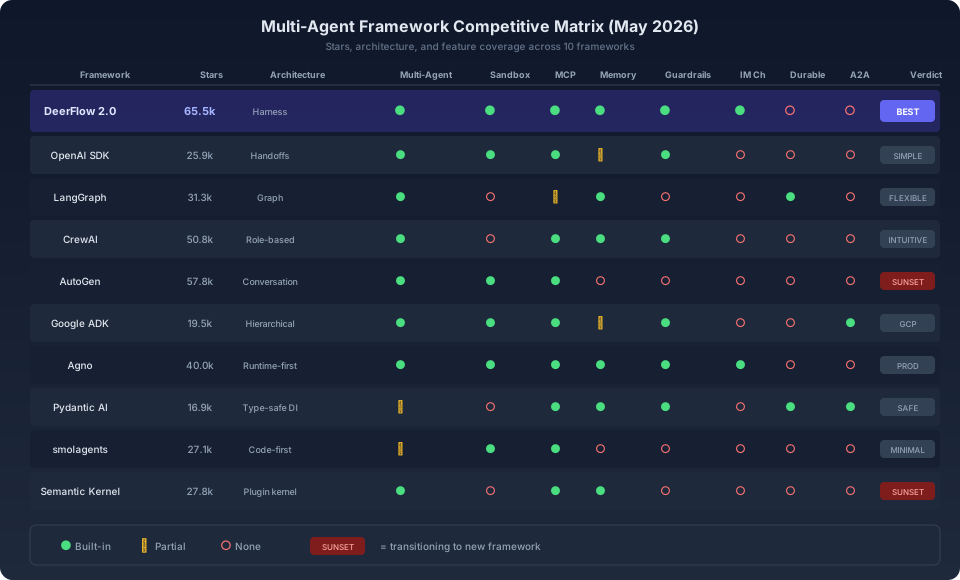
| Feature | DeerFlow | OpenAI SDK | LangGraph | CrewAI | AutoGen | Google ADK | Agno | Pydantic AI | smolagents | Semantic Kernel |
|---|---|---|---|---|---|---|---|---|---|---|
| Stars | 65.5k | 25.9k | 31.3k | 50.8k | 57.8k | 19.5k | 40.0k | 16.9k | 27.1k | 27.8k |
| License | MIT | MIT | MIT | MIT | CC-BY-4.0 | Apache-2.0 | Apache-2.0 | MIT | Apache-2.0 | MIT |
| Architecture | Harness | Handoffs | Graph (Pregel) | Role-based | Conversation | Hierarchical | Runtime-first | Type-safe DI | Code-first | Plugin kernel |
| Multi-agent | Subagents | Handoffs + agents-as-tools | Subgraphs | Crews | Group chat | Sub-agents | Teams | Limited | Limited | Multi-agent |
| Built-in sandbox | Yes | Yes | No | No | Yes | Yes | Yes | No | Yes | No |
| MCP support | Yes | Yes | Via LC | Yes | Yes | Yes | Yes | Yes | Yes | Yes |
| Long-term memory | Yes | Sessions | Yes | Yes | No | Sessions | Yes | Durable | No | Vector DBs |
| Guardrails | Yes (config) | Yes | No | Yes | No | Yes (confirm) | Yes (approve) | Yes | No | No |
| IM channels | 8 platforms | No | No | No | No | No | Yes | No | No | No |
| Durable execution | No | No | Yes | No | No | No | No | Yes | No | No |
| A2A protocol | No | No | No | No | No | Yes | No | Yes | No | No |
Category Winners
Most flexible workflow: LangGraph. Its Pregel-inspired stateful graphs allow arbitrary control flow — cycles, branches, parallel paths — that no other framework matches. If your agent workflow is non-linear (approval gates, retry loops, conditional branches), LangGraph is the right choice.
Most intuitive API: OpenAI Agents SDK. Handoffs and agents-as-tools are dead simple. The guardrail system is well-designed. But it's Python-only, has no IM channels, and no built-in memory beyond sessions.
Best for enterprise teams: CrewAI. The role-based metaphor (agents as team members with roles, goals, backstories) resonates with non-technical stakeholders. 100k+ certified developers and a managed cloud platform. But no sandbox and limited streaming.
Most production-ready out-of-box: Agno. The "AgentOS" runtime exposes 50+ API endpoints, has workspace approval flows, and wraps other frameworks. It's the only framework that treats agents as production services from day one.
Most minimal: smolagents. ~1k LOC core, code-first paradigm where agents think in Python code rather than JSON tool calls. Best for research and prototyping. Not for production.
Most type-safe: Pydantic AI. Dependency injection, structured outputs, and Pydantic validation everywhere. Ideal for teams that value correctness over flexibility.
DeerFlow 2.0 Strengths
-
Full-stack SuperAgent: Research, code, create — one system handles it all. No other framework combines deep research, code execution, content creation, and IM delivery in a single package.
-
Middleware-driven extensibility: The 14-middleware pipeline with
@Next/@Prevpositioning is genuinely novel. It solves the "callback hell" problem that plagues simpler agent frameworks. -
Sandbox + safety built-in: Docker/K8s isolation with virtual filesystem mapping and guardrails — only OpenAI SDK and AutoGen offer comparable safety out-of-box.
-
Coding agent integration: Native ACP support for Claude Code and Codex CLI as tools. No other framework treats external coding agents as first-class tools.
-
IM channel breadth: 8 platforms without public IP. No other agent framework comes close to this IM coverage.
-
Self-evolving skills: Agents that create and update their own skill documents after complex tasks is a form of procedural memory not found elsewhere.
-
ByteDance ecosystem: First-class support for Doubao, DeepSeek, and Kimi models — critical for the Chinese market.
DeerFlow 2.0 Weaknesses
-
No durable execution: LangGraph and Pydantic AI offer crash recovery and checkpoint resume. DeerFlow checkpoints via LangGraph, but doesn't expose this as a first-class feature.
-
No A2A protocol: Google ADK and Pydantic AI support Agent-to-Agent protocol for inter-framework communication. DeerFlow's subagent model is intra-framework only.
-
Young and unproven: Despite 65k stars, DeerFlow is barely one year old. LangGraph, CrewAI, and Semantic Kernel have years of production deployment.
-
LangGraph dependency: The entire runtime depends on LangGraph's execution model. If LangGraph makes breaking changes, DeerFlow must follow.
-
No multi-language SDK: Google ADK has Python/Java/Go. Semantic Kernel has C#/Python/Java. DeerFlow is Python-only (TypeScript is frontend only).
-
No managed cloud: CrewAI and LangGraph offer managed platforms. DeerFlow is self-hosted only.
-
Middleware complexity: The 14-middleware pipeline is powerful but has a steep learning curve. Debugging middleware ordering issues requires understanding the full chain.
When to Choose DeerFlow vs Alternatives
| Scenario | Best Choice | Why |
|---|---|---|
| Deep research tasks (web search + synthesis) | DeerFlow | Built-in search tools, long-horizon design, memory |
| Enterprise workflow automation | LangGraph | Durable execution, flexible graph model |
| Team-based collaboration simulation | CrewAI | Role-based metaphor, managed platform |
| Quick prototyping / research | smolagents | Minimal code, fast iteration |
| Production API services | Agno | Runtime-first, 50+ endpoints, AgentOS |
| Type-safe regulated environments | Pydantic AI | Pydantic validation, DI, structured outputs |
| Google Cloud deployments | Google ADK | Vertex AI, A2A, multi-language SDKs |
| Full-stack agent with IM delivery | DeerFlow | 8 IM channels, no public IP needed |
| Agent that writes and deploys code | DeerFlow | ACP integration, sandbox, coding agents as tools |
The Bigger Picture: Where Multi-Agent Frameworks Are Going
Three trends emerge from this comparison:
Trend 1: From orchestration to infrastructure. The earliest frameworks (AutoGen, CrewAI) focused on how agents talk to each other. The newer generation (DeerFlow, Agno, Google ADK) focuses on everything around the agents — sandboxes, persistence, deployment, monitoring. The orchestration pattern itself is becoming commoditized; the infrastructure is the differentiator.
Trend 2: Convergence on MCP. Every major framework now supports the Model Context Protocol. This is good for the ecosystem — tools built for one framework increasingly work with others. The question is whether MCP will become the "HTTP of agents" or fragment into dialects.
Trend 3: The "one agent to rule them all" vs. "swarm of specialists" debate. DeerFlow's single-lead-agent-with-subagents model represents one pole. CrewAI's role-based crews and AutoGen's group chats represent the other. Neither has won yet — the right pattern depends entirely on the task.
Verdict
DeerFlow 2.0 is not just another agent framework — it is an agent operating system. The middleware pipeline, sandbox abstraction, memory system, skill evolution, and channel manager form a coherent platform that handles the full lifecycle of complex agent tasks. Its weaknesses (no durable execution, no A2A, LangGraph dependency) are real but fixable in future versions.
For teams building research agents, coding assistants, or content creation pipelines that need to run for hours and deliver results across multiple channels, DeerFlow is the most complete open-source option available today. For teams that need durable workflows, type safety, or Google Cloud integration, alternatives remain stronger.
The 65k stars are not empty hype — they reflect genuine architectural innovation in a crowded field.
Sources
DeerFlow 2.0:
- Repository: https://github.com/bytedance/deer-flow (MIT, 65.5k stars)
- Documentation: https://deerflow.tech
- Key source files inspected:
backend/docs/ARCHITECTURE.md— system architecture overviewbackend/packages/harness/deerflow/agents/lead_agent/agent.py— lead agent factorybackend/packages/harness/deerflow/subagents/executor.py— subagent execution with isolated event loopbackend/packages/harness/deerflow/sandbox/sandbox.py— abstract sandbox interfacebackend/packages/harness/deerflow/guardrails/— guardrail middleware and providersbackend/packages/harness/deerflow/agents/memory/— LLM-powered memory updater and storagebackend/packages/harness/deerflow/mcp/client.py— MCP client with hot-reloadbackend/packages/harness/deerflow/skills/loader.py— progressive skill loadingbackend/app/channels/— IM channel manager (Telegram, Slack, Feishu, WeCom, etc.)backend/langgraph.json— LangGraph agent registration
OpenAI Agents SDK:
- Repository: https://github.com/openai/openai-agents-python (MIT, 25.9k stars)
LangGraph:
- Repository: https://github.com/langchain-ai/langgraph (MIT, 31.3k stars)
CrewAI:
- Repository: https://github.com/crewAIInc/crewAI (MIT, 50.8k stars)
AutoGen:
- Repository: https://github.com/microsoft/autogen (CC-BY-4.0, 57.8k stars)
- Note: Microsoft is transitioning AutoGen to "Microsoft Agent Framework"
Google ADK:
- Repository: https://github.com/google/adk-python (Apache-2.0, 19.5k stars)
Agno:
- Repository: https://github.com/agno-agi/agno (Apache-2.0, 40.0k stars)
Pydantic AI:
- Repository: https://github.com/pydantic/pydantic-ai (MIT, 16.9k stars)
smolagents:
- Repository: https://github.com/huggingface/smolagents (Apache-2.0, 27.1k stars)
Semantic Kernel:
- Repository: https://github.com/microsoft/semantic-kernel (MIT, 27.8k stars)
- Note: Microsoft is transitioning Semantic Kernel to "Microsoft Agent Framework"