ECC Deep Dive: How the 227K-Star Agent Operating System Turns AI Coding Assistants from 'Usable' to 'Indispensable'
How long have you been using AI coding assistants? A week? A month? If you're like me, you've probably accumulated a list of things you have to re-teach every single time: this project uses pnpm not npm, don't write !important inline styles, lead with the conclusion, tests use vitest not jest.
Every new session, all of that knowledge evaporates. You type it again, it makes the same mistakes again, you correct it again.
This is the problem ECC sets out to solve. But ECC's ambition goes far beyond "remembering preferences" — it aims to be the operating system for AI agents.
As of July 2026, ECC has 227,004 stars, 34,708 forks, and 230+ contributors on GitHub — making it one of the highest-starred projects in the AI coding tool ecosystem. It's not a "Claude Code config pack" — it spans Claude Code, Codex, Cursor, OpenCode, Gemini, Zed, GitHub Copilot, and Hermes, providing a unified agent capability layer across 8 platforms.
What ECC Actually Is
ECC's full name has no official expansion (the community guesses "Efficient Coding Companion" or "Enhanced Claude Code"), but its positioning is crystal clear: the native operating system for Agent Harnesses.
In one sentence: ECC is a system of Skills, Instincts, Memory, Security, and Research that transforms AI coding assistants from "one-shot conversation tools" into "continuously evolving engineering partners."
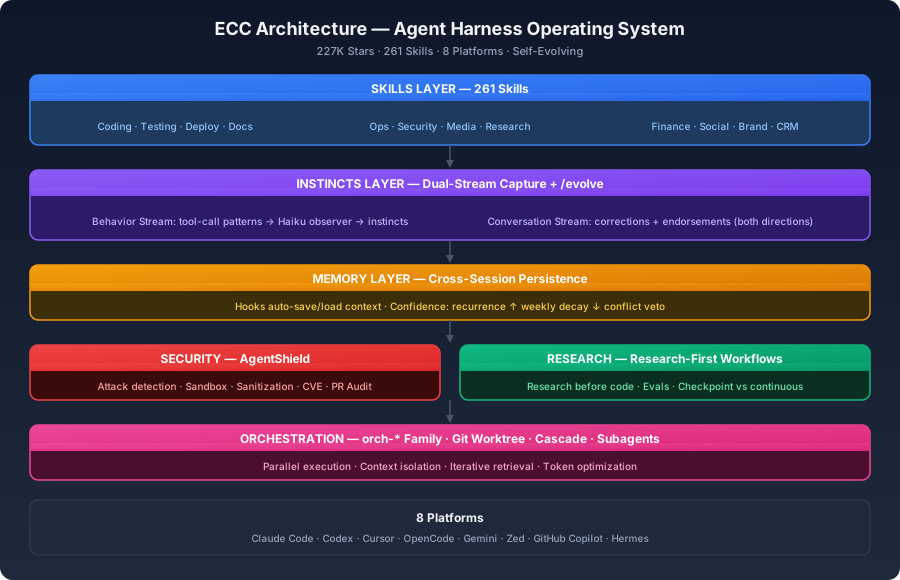
| Layer | Component | Capability |
|---|---|---|
| Skills | 261 Skills | Covering coding, testing, deployment, docs, ops, security, media production — the full lifecycle |
| Instincts | Instincts + Hooks | Tool-call pattern observation → auto-distilled into confidence-weighted behavioral rules |
| Memory | Memory Persistence | Cross-session auto-save/load of context, solving the "start over every time" problem |
| Security | AgentShield | Attack vector detection, sandboxing, input sanitization, CVE scanning |
| Research | Research-First | Research-before-coding workflows, avoiding "write it all wrong then redo" |
| Orchestration | orch-* family | Subagent orchestration, Git worktree parallelization, cascade method |
Core Mechanism: Capture and Judgment Are Separated
ECC's most essential design philosophy is embodied in its self-evolution system (claude-code-self-evolution): capture is cheap and automatic, judgment is deliberate and rare.
Two data streams run continuously:
- Behavior Stream (What you DO): A hook records every tool-call pattern. A small observer model (calling Claude Haiku) distills repeated patterns into confidence-weighted "instincts."
- Conversation Stream (What's SAID): At session end, all critical moments are captured — when you corrected Claude, when Claude caught itself, when you endorsed a move, when a framing landed. Corrections and endorsements are captured from both directions (you→Claude and Claude→itself).
Both streams just dump candidates into a queue. Nothing becomes durable until you run /evolve, a unified review surface that clusters every signal, routes each through four gates, and writes whichever artifact fits:
rule < memory < skill < agent
It prefers the cheapest, most reversible artifact. A rule is a few lines of Markdown loaded only when relevant. A skill costs system-prompt tokens in every session forever — so it only escalates when it must.
Conflict is a veto, not an average. One real counterexample refutes "this is globally true" and blocks promotion, no matter how many times the pattern agreed elsewhere. A learning system that only counts agreement quietly grows a self-contradictory ruleset.
Confidence moves on three axes. Recurrence raises it, weekly decay lowers it, semantic conflict vetoes it. Stale lessons fade on their own.
Cross-Platform: Write Once, Run on Seven
ECC v2.0.0's most critical architectural decision is the cross-harness abstraction layer. The same set of skills, rules, and MCP configurations runs on Claude Code, Codex, Cursor, OpenCode, Gemini, Zed, and GitHub Copilot.
| Platform | Instructions File | Command Mechanism |
|---|---|---|
| Claude Code | CLAUDE.md |
.claude/commands/ |
| OpenAI Codex | AGENTS.md |
Codex Skills (.agents/skills/) |
| Cursor | .cursor/rules/bmad.mdc |
_bmad/COMMANDS.md |
| OpenCode | AGENTS.md |
OpenCode Skills (.opencode/skills/) |
| GitHub Copilot | .github/copilot-instructions.md |
_bmad/COMMANDS.md |
| Hermes | ~/.hermes/skills/ecc-imports/ |
Hermes Skills |
The significance: you don't reinvent the wheel for each platform. Skills and rules accumulated in Claude Code migrate seamlessly to Codex or Hermes.
ECC's integration with Hermes deserves special attention. ECC v2.0.0 provides a dedicated Hermes setup guide, positioning Hermes as the "operator shell" and ECC as the "reusable workflow substrate":
Telegram / CLI / TUI
        ↓
      Hermes (operator shell)
        ↓
 ECC skills + hooks + MCPs (reusable substrate)
        ↓
 Google Drive / GitHub / browser automation / research APIs / media tools / finance tools
Security: AgentShield
ECC's security layer (AgentShield) is another differentiator. It's not a standalone security scanner — it's security checkpoints embedded in the agent workflow:
- Attack vector detection: Identifies prompt injection, indirect injection, tool-call hijacking
- Sandbox execution: High-risk operations run in isolated environments
- Input sanitization: External data auto-cleaned before entering agent context
- CVE scanning: Automatic dependency vulnerability detection
- PR auditing: GitHub App automatically reviews PRs for security issues
The ECC Tools GitHub App offers a free tier (public repos) and a Pro tier ($19/seat/month, private repos).
Comparison with Similar Projects
| Dimension | ECC | BMAD-METHOD | Ralph | claude-code-self-evolution | Hermes Skills |
|---|---|---|---|---|---|
| Stars | 227K | 50K | — | 0 | — |
| Positioning | Agent OS | Agile dev methodology | Autonomous impl loop | Self-evolution layer | Agent platform |
| Skill count | 261 | 34+ | — | 4 | Variable |
| Cross-platform | ✅ 8 platforms | ✅ 7 platforms | ✅ CLI platforms | ❌ Claude Code only | ✅ Own platform |
| Self-evolution | ✅ Dual-stream | ❌ | ❌ | ✅ Core feature | ✅ Memory+Skills |
| Security scanning | ✅ AgentShield | ❌ | ❌ | ❌ | ❌ |
| Memory persistence | ✅ Hooks | ❌ | ❌ | ✅ | ✅ |
| Token optimization | ✅ Prompt slimming | ❌ | ❌ | ❌ | ✅ |
| Parallelization | ✅ Worktree+Cascade | ❌ | ❌ | ❌ | ✅ Subagents |
| Business model | MIT + Pro $19/mo | MIT free | MIT free | MIT free | Open source |
| Hermes integration | ✅ Official guide | ❌ | ❌ | ❌ | Native |
ECC leads in skill count, cross-platform coverage, security capabilities, and self-evolution mechanisms. BMAD-METHOD is more systematic in structured development workflows (PRD→Architecture→Epic→Story). The two can complement each other — BMAD for planning, ECC for execution and continuous optimization.
Ratings
| Dimension | Score | Rationale |
|---|---|---|
| Skill Richness | 10/10 | 261 skills covering the full lifecycle — the most comprehensive in the industry |
| Cross-Platform | 9/10 | 8 platforms with a unified abstraction layer |
| Self-Evolution | 9/10 | Dual-stream capture + four-gate routing, elegantly designed |
| Security | 8/10 | AgentShield embedded in workflow, not post-hoc scanning |
| Documentation | 8/10 | Shortform + Longform + Security guides, well-structured |
| Community | 9/10 | 230+ contributors, active Discord |
| Learning Curve | 6/10 | 261 skills take time to digest |
| Hermes Integration | 7/10 | Official guide exists but requires manual configuration |
| Overall | 8.3/10 | The category-defining Agent OS, but the sheer volume demands learning investment |
Conclusion
ECC's real value isn't "yet another Claude Code config pack" — it redefines the upper bound of what AI coding assistants can be. Traditional AI coding tools are "conversational": you ask, it answers, the session ends, everything resets to zero. ECC transforms them into "operating-system-like": with a skill library, memory, security policies, self-evolution capabilities, and cross-platform portability.
227K stars isn't an accident. It solves the real pain point every AI coding assistant user faces: having to re-teach it every single time. And ECC's answer is: let it learn to remember on its own.
For developers already deep into AI coding assistants, ECC is currently the most complete "agent capability enhancement layer." But 261 skills means the learning curve isn't trivial — start with the Shortform Guide, install core skills first, then expand gradually.
For Hermes users, ECC's official integration guide provides a clear path: Hermes as the operator interface (chat, cron, orchestration), ECC as the reusable workflow substrate (skills, rules, security). The two complement rather than compete.
References
- ECC GitHub Repository — 227K+ stars, MIT license
- ECC Official Website
- ECC Shortform Guide
- ECC Longform Guide
- ECC Security Guide
- ECC Hermes Setup Guide
- ECC v2.0.0 Release Notes
- claude-code-self-evolution — ECC-based self-evolution learning layer
- ECC Discord Community