In modern engineering and digital production ecosystems, the term "Fusion Workflow" typically refers to two prominent paradigms:
- AI Software Engineering Orchestration (Runfusion / Fusion Software Factory): A deterministic multi-agent workflow transforming natural language requirements into production-ready software.
- Professional VFX & Node-Based Compositing (DaVinci Resolve Fusion): The Hollywood-grade node graph processing flow used for visual effects and procedural graphics.
In the AI developer ecosystem, Runfusion/Fusion has emerged as a compelling paradigm shift from ad-hoc chat-based code generation to industrial software factories. This article provides a comprehensive teardown of the Runfusion workflow, followed by an architectural comparison with DaVinci's node-based compositing.
1. The Context: From "Chatbox Scripting" to "Software Factory"
Traditional AI-assisted coding typically involves Copilot completions or prompt-response cycles in conversational chat windows. In real-world enterprise repositories, this pattern suffers from three fundamental bottlenecks:
- Statelessness & Hallucination: AI models lack unified project-wide architectural context and emit breaking patches.
- Workspace Pollution & Write Contention: Direct edits on active development branches introduce unverified regressions and block concurrent multi-tasking.
- Absence of Strict Verification Gates: Missing compiler checks, automated unit testing loops, and rigorous multi-stage review pipelines.
Runfusion/Fusion addresses this by modeling software development as an industrial factory pipeline: every feature and bug fix is treated as an isolated work order, orchestrated across specialized agents, isolated via Git worktrees, and validated against strict quality gates.
2. Core Execution Lifecycle of Fusion AI
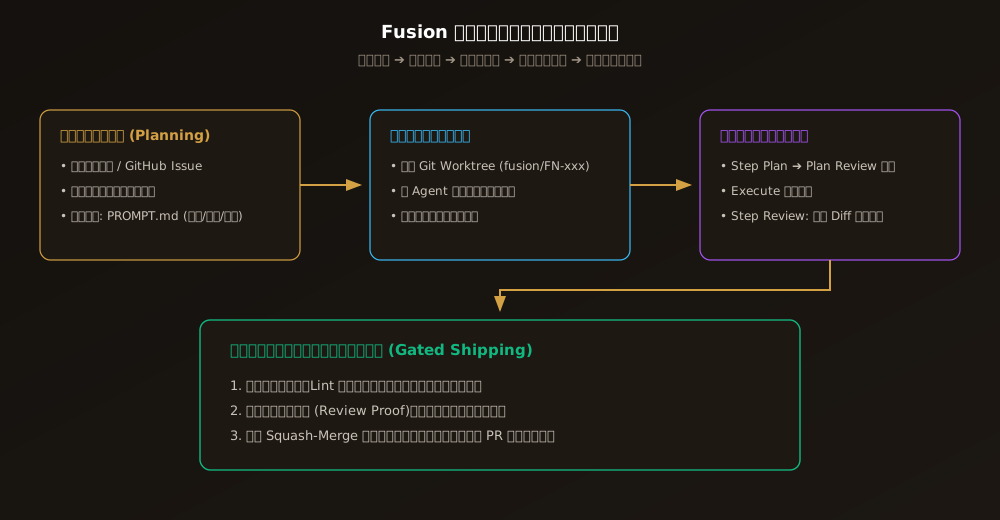
Fusion structures development into a deterministic state-machine workflow:
Stage 1: Intent Extraction & Spec Planning
- Input: Natural language task descriptions or auto-synced GitHub Issues.
- Repository Reconnaissance: The Planning Agent surveys directory structures, dependency manifests, and architectural patterns.
- Contract Freezing: The system generates a standardized
PROMPT.mdspecification defining:- Atomic execution steps
- Explicit scope boundaries (allowed files to modify)
- Concrete acceptance criteria and verification commands
Stage 2: Git Worktree Physical Isolation
- To eliminate file contention and workspace pollution, Fusion spins up an isolated Git Worktree per task (e.g.,
fusion/FN-123). - Multiple agents can compile, install dependencies, and execute tests concurrently in distinct directories without race conditions.
Stage 3: Stepwise Dual-Review Execution Loop
Rather than outputting monolithic code changes, Fusion enforces an iterative micro-loop:
- Step Planning: The executing agent drafts atomic steps.
- Plan Review: A review agent evaluates the plan against architectural constraints before code is written.
- Execution: Code changes are committed within the isolated worktree.
- Step Review: An audit agent inspects git diffs and regressions before progressing to the next step.
Stage 4: Pre-Merge Quality Gates
- Automated Gate Validation: Compiles the code, runs linter rules, and executes full unit/integration test suites.
- Content-Binding Review Proof: Generates cryptographic SHA fingerprints of audited diffs to ensure no unreviewed code is merged.
Stage 5: Autonomous Merge & Shipping
- Based on configured deployment policies, verified branches are either squash-merged directly into upstream trunks or opened as clean, documented GitHub Pull Requests.
3. Built-In Workflow Catalog
Fusion provides pre-configured Directed Acyclic Graphs (DAGs) tailored for various tasks:
| Workflow Name | Identifier | Architecture & Characteristics |
|---|---|---|
| Coding (Default) | builtin:coding |
Full stepwise progression: planning, dual-review loops, and gated verification. |
| Quick Fix | builtin:quick-fix |
Lean pipeline for bug fixes and doc updates, minimizing review overhead. |
| Review-Heavy | builtin:review-heavy |
Enforces deep security and architectural audits for core infrastructure and billing modules. |
| Compound Engineering | builtin:compound-engineering |
Integrates planning, spec reviews, implementation, and post-merge organizational learning capture. |
| Marketing / Design | builtin:marketing / design |
Creative pipelines producing structured deliverables reviewed against design specs. |
4. Key Architectural Capabilities
- Multi-Node Mesh: Seamless synchronization across local workstations, cloud instances, and mobile task monitors.
- Model-Agnostic Runtimes: Plug-and-play support for Anthropic Claude, OpenAI, local Ollama endpoints, and external agent runtimes like Hermes Agent or Codex.
- Inter-Agent Mail & Communication Hubs: Built-in messaging protocols allowing agents to exchange tickets, clarify ambiguities, and hand off reviews asynchronously.
5. Comparative Perspective: DaVinci Resolve Fusion
In VFX and post-production, Fusion refers to the node-based compositing environment built by Blackmagic Design:
- Layer Stack vs. DAG Flow: Unlike layer-based compositing (Photoshop / After Effects) where complexity scales exponentially, DaVinci Fusion models pixels as an explicit Directed Acyclic Graph. Data flows from sources through processing nodes (keys, masks, transforms) to final output.
- Non-Destructive Modularity: Any node can be tapped, re-routed, or modified without breaking upstream inputs or downstream nodes.
- 3D Spatial Environment: Features native 3D camera projections, particle systems, and Lua/Python scripting hooks for procedural generation.
6. Synthesis: The Shared Philosophy of Fusion
Both software factory pipelines and node-based visual compositors share foundational systems principles:
- Decoupling & Modularity: Complex outputs are factored into discrete, verifiable nodes or sub-agent steps.
- Traceability & Non-Destructive Editing: Every intermediate mutation is recorded, inspectable, and reversible.
- Pipeline Orchestration: Moving past manual monolithic tasks to structured execution graphs that guarantee reproducibility.
Related Reading
- AI Video Remake Pipeline Stability: Root Causes, COTS Parts & Defensive Design —— State decomposition and quality gates in generative workflows
- Generative Canvas Agent Architecture: Spatial Memory & Infinite Canvas Orchestration —— Agent interaction and stateful canvas execution
- Building a Modern Agent Memory Stack: Three-Tier Architecture —— Managing long-term memory across autonomous agents