Gizmo Product Strategy Deep Dive: Turning TikTok's Habit Loop into an Anki Learning Loop
Gizmo is easy to misread.
At first glance it looks like another AI tutor: upload notes, ask questions, generate flashcards, prepare for exams. That category is crowded. Quizlet has AI study guides. StudyFetch turns lectures into flashcards. Knowt markets itself as a free Quizlet alternative. Anki remains the power-user default for spaced repetition.
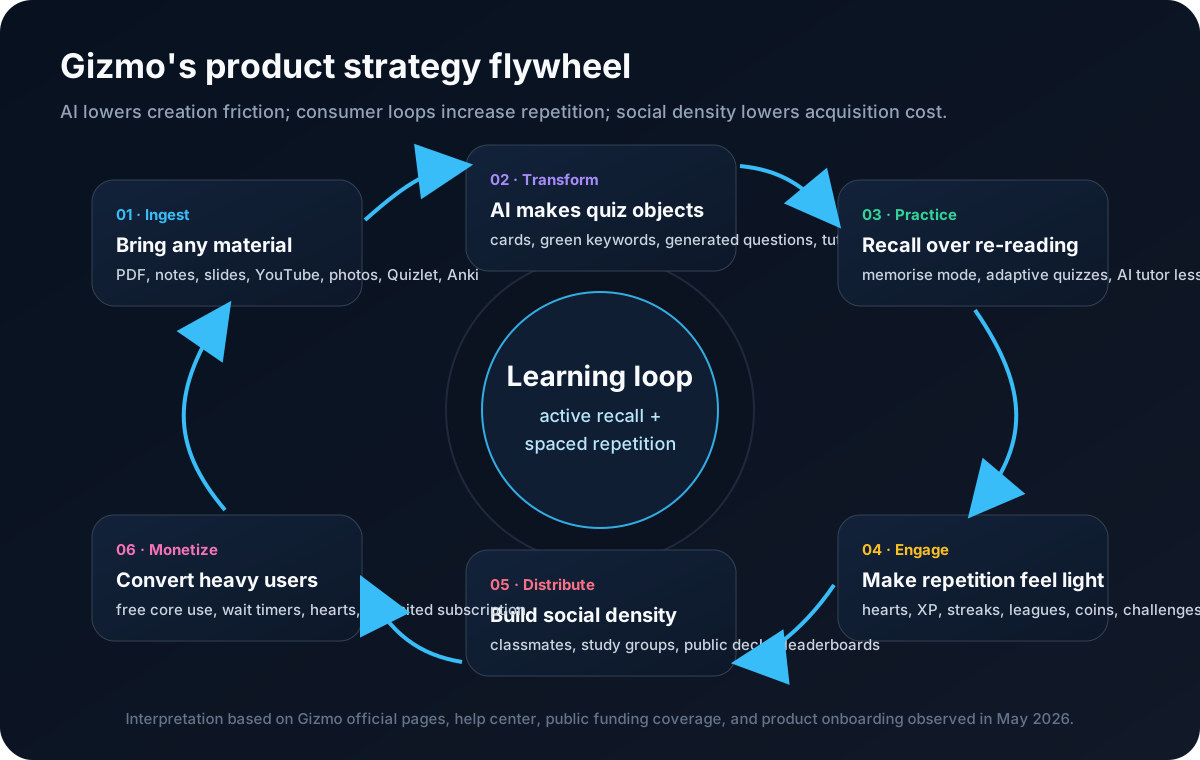
But Gizmo's real product strategy is sharper than “ChatGPT for studying.” It is trying to build a consumer learning network where AI removes the work of making study material, while game and social loops make students repeat that material often enough to remember it.
The company's own line is aggressive: “Get addicted to learning.” Its careers page calls the product “Duolingo for Anything.” Its CEO frames the mission as “better screen time,” not less screen time. That is the heart of the strategy: take the habit loop that normally pulls students toward TikTok, Instagram, and games, and redirect it toward active recall and spaced repetition.
The company: small team, large consumer traction
Gizmo is a London-headquartered AI education company founded in 2021. Public materials list Petros Christodoulou as CEO, Robin Jack as CTO, and Paul Evangelou as CPO. The company was originally associated with Save All, which is still visible in its App Store developer name.
In April 2026, Gizmo announced a $22 million Series A led by Shine Capital, with participation from Ada Ventures, Seek Investments, GSV, and NFX. NFX had previously led a $3.5 million seed round. Funding coverage reported more than 13 million learners across 120+ countries. Gizmo's careers page claims more than 1.5 million monthly active users and $5 million in annual recurring revenue.
Those numbers matter because the company is not positioning itself as a school procurement product first. The center of gravity is consumer: students choose it themselves, bring their own material, invite classmates, and pay when they hit usage limits.
The App Store listing reinforces that positioning. Gizmo appears as “Gizmo: AI Tutor,” subtitle “AI flashcards & quizzes,” with a 4.8 rating from around 11,000 ratings. Its category is Education, but it also appears under Games, Puzzle, and Trivia. That category blend is not accidental. Gizmo wants to make studying feel closer to a game than to a productivity tool.
The product wedge: turn passive content into quizzable memory objects
Most learning tools fail before the learning starts. A student has a PDF, slides, a YouTube lecture, messy handwritten notes, or a Quizlet deck. Turning that material into good flashcards is tedious. Anki is powerful, but card creation and maintenance require discipline. Traditional note-taking tools preserve information, but do not automatically force recall.
Gizmo attacks that friction directly.
Its App Store description emphasizes AI Import: Quizlet, Anki, YouTube, PDFs, notes, PowerPoint, and handwritten scans can become flashcards and quizzes. The onboarding flow I observed pushes the same idea. After age and student segmentation, Gizmo asks users to upload learning material: PDF, pasted notes, PowerPoint, YouTube, photographed notes, or other sources.
This is the wedge: do not ask the student to design a learning system. Ask them to bring whatever they already have.
Once content is imported, Gizmo turns it into what I would call “quizzable memory objects”: cards, highlighted answer targets, generated questions, and AI tutor prompts. Its help center says the AI Tutor can start from a topic or from an existing deck; when it starts from a deck, it teaches using the cards as a foundation, expands on them when appropriate, and quizzes based on green highlighted words. Memorise mode uses spaced repetition and active recall: correct answers appear less often; wrong answers return sooner.
That product architecture is important. The AI tutor is not floating above the product as a generic chat surface. It is anchored to cards, decks, highlighted terms, and practice history. AI creates and explains; the learning loop still depends on retrieval practice.
The deeper thesis: learning is remembering
Gizmo's early Save All-era blog posts make the product philosophy unusually explicit. “Learning is Remembering” argues that learning is an alteration in long-term memory, and that working memory is too limited to support complex understanding unless the necessary pieces have been internalized. “Learn Exponentially” argues for spaced repetition as a compounding process: each well-timed review extends the retention interval.
This thesis is both powerful and incomplete.
It is powerful because a huge amount of school and university learning really does fail at the memory layer. Students reread notes, watch lectures again, highlight passages, and feel familiar with the material, but cannot retrieve it under exam conditions. Active recall and spaced repetition are better aligned with the actual failure mode.
It is incomplete because not all learning is remembering. Mathematical problem solving, writing, design judgment, laboratory technique, programming fluency, and physical skills require transfer, feedback, practice, and sometimes mentorship. Remembering is necessary, but not sufficient.
Gizmo's strategic choice is to start where memory is the bottleneck. That is a smart wedge. It gives the product a clear job to be done: “I have material I need to remember; make me practice it until it sticks.” From there, the AI Tutor can expand toward explanation and understanding, but the core loop remains measurable: questions answered, cards retained, streaks maintained, leagues climbed.
The consumer loop: make repetition feel like progress
Spaced repetition has one brutal weakness: consistency.
Anki users know the feeling. The algorithm works, but the backlog grows. The review queue becomes a chore. The tool is effective precisely because it asks you to return when memory is about to decay, but that is rarely when you feel motivated.
Gizmo's answer is to wrap the learning science in consumer app mechanics:
- Hearts create a cost for mistakes and a monetization boundary.
- XP turns every answer into visible progress.
- Streaks turn daily activity into identity and loss aversion.
- Streak freezes soften failure and bring users back.
- Leagues create weekly competition, promotion, and relegation.
- Coins, challenges, and study games add lightweight reward loops.
- Public decks and study groups make learning material shareable.
The CEO's quote captures the thinking: people are addicted to “progress, novelty, social connection, and reward.” Gizmo's bet is that those same forces can make recall practice feel less like homework.
This is why “Duolingo for Anything” is a better description than “AI tutor.” Duolingo did not win because it had the deepest language pedagogy. It won because it made daily practice easy, visible, and emotionally sticky. Gizmo is applying the same consumer logic to any subject a student can upload.
Social strategy: classrooms without selling to schools first
The most interesting part of Gizmo's onboarding is not the AI import screen. It is the social segmentation before it.
The product asks whether the user is at university, school, work, or somewhere else. On the university path it asks for year level, then institution, and shows school suggestions with apparent classmate counts. Help articles also describe study groups, friend following, leagues, and public decks.
This suggests a campus-density strategy. Gizmo does not need to begin with institutional sales. It can enter through individual students, cluster them by school or university, and create local network effects:
- A student imports or creates a deck.
- The deck becomes useful to classmates.
- Classmates join, follow, compete, or reuse public cards.
- The institution name becomes a social proof surface.
- More local users improve relevance and distribution.
This is a classic consumer-social path applied to education. The company is not only building a study tool; it is trying to build a learning graph around shared exams, shared courses, and shared motivation.
The public claim of more than one million free flashcard sets also matters here. Content libraries are distribution assets. They reduce cold-start friction for new users and create search surfaces. Quizlet has long benefited from this dynamic. Gizmo is adding AI-generated supply and game mechanics on top.
Monetization: generous free use with deliberate friction
Gizmo's free tier is more generous than a simple trial. Its help center says users can create unlimited cards and decks and do unlimited quizzing for free. But there are limits designed around intensity:
- Lose 15 hearts while quizzing, and you wait 10 minutes before continuing.
- Use Magic Import, and you may wait 20 minutes before importing again.
- Unlimited removes those restrictions.
That is a familiar consumer subscription pattern. Let casual users learn for free. Let motivated students hit friction at the exact moment they are most engaged. Convert the user who is studying for an exam, importing multiple materials, losing hearts, and wanting to continue now.
The App Store lists multiple Gizmo Unlimited price points, including weekly and annual-looking amounts, and the help center mentions student discounts. This gives Gizmo room to segment by urgency: weekly subscriptions for exam crunch, annual subscriptions for habitual learners, discounted plans for students.
The reported $5 million ARR, if accurate, suggests this freemium model is already producing meaningful revenue for a small team.
Competitive map: where Gizmo is differentiated
Gizmo sits at the intersection of five categories:
| Product | Core strength | Gizmo's differentiation |
|---|---|---|
| Quizlet | Massive content network and study brand | More explicit AI import + game/social habit loop |
| Anki | Powerful spaced repetition and user control | Much easier onboarding, mobile consumer design, social motivation |
| Knowt | Free Quizlet alternative with AI study tools | Gizmo leans harder into addiction, streaks, leagues, and paid consumer loop |
| StudyFetch | AI conversion of course materials into study tools | Gizmo emphasizes game mechanics and social graph more visibly |
| RemNote | Notes plus spaced repetition for knowledge workers | Gizmo is less knowledge-management-heavy and more student/game-first |
The key point is that AI flashcard generation alone is not defensible. Everyone can add it. The defensibility has to come from somewhere else: habit, content network, social graph, brand among students, mobile distribution, and learning history.
Gizmo appears to understand this. AI is the accelerant, not the moat. The moat, if one emerges, will be the consumer learning loop.
Product risks
The strategy is compelling, but it has real risks.
First, card quality matters. AI-generated flashcards can be shallow, ambiguous, or wrong. A student may remember the wrong thing with high confidence. Gizmo partially addresses this through highlighted terms, editing, and tutor expansion, but trust remains central.
Second, gamification can optimize the wrong behavior. If the product rewards question volume too strongly, students may chase XP instead of understanding. The best version of Gizmo must distinguish productive struggle from empty repetition.
Third, the memory-first thesis has boundaries. It works well for exam facts, definitions, language vocabulary, anatomy, law rules, and many structured courses. It is weaker for open-ended projects, writing taste, design, research, and applied problem solving unless paired with richer feedback loops.
Fourth, student consumer markets are seasonal. Usage spikes around exams and falls during breaks. Weekly subscriptions may monetize urgency, but retention must survive academic cycles.
Fifth, privacy is not optional. Gizmo invites users to upload notes, documents, photos, YouTube links, and school context. That data may contain sensitive educational and personal information. As AI education tools become mainstream, privacy and parental trust will become product features, not legal footnotes.
Why the strategy is worth studying
The broader lesson from Gizmo is not “make an AI tutor.” That lesson is too generic.
The better lesson is: use AI to remove the creation cost from a proven behavior, then use consumer mechanics to make that behavior happen more often.
For Gizmo, the proven behavior is active recall plus spaced repetition. The old problem was that making cards was boring and returning every day was hard. AI solves the first problem. Streaks, leagues, hearts, public decks, classmates, and mobile notifications attack the second.
That combination is why the company is interesting. It is not betting that students want to chat with an AI for hours. It is betting that students want to feel progress, avoid distraction, and convert whatever they already have into a practice loop that feels almost game-like.
If Gizmo succeeds, the winning product category will not be “AI tutor.” It will be something closer to “consumer social learning infrastructure”: a place where materials, memory, motivation, classmates, and subscriptions reinforce each other.
The phrase “Get addicted to learning” can sound like marketing excess. But as a product strategy, it is precise. Gizmo is trying to make the habit loop of TikTok serve the learning loop of Anki. That is a much more interesting company than another chatbot with flashcards.
Sources
- Gizmo official website: https://gizmo.ai/
- Gizmo App Store listing: https://apps.apple.com/us/app/gizmo-ai-tutor/id1610516671
- Gizmo Help Center: https://help.gizmo.ai/
- Gizmo LinkedIn company page: https://www.linkedin.com/company/gizmo-ai/
- Gizmo careers page: https://apply.workable.com/gizmo/
- Tech.eu funding report, “Gizmo secures $22M Series A to advance AI-powered education”: https://tech.eu/2026/04/15/gizmo-secures-22m-series-a-to-advance-ai-powered-education/
- TechFundingNews funding report, “Gizmo raises $22M Series A to make learning as addictive as social media”: https://techfundingnews.com/gizmo-22m-series-a-ai-learning-app/
- Gizmo / Save All blog posts: “Learning is Remembering” and “Learn Exponentially”
- Hacker News Algolia discussions for “Learning Is Remembering,” “Learn Exponentially,” and “Show HN: Gizmo – Learn anything with an AI tutor”
- Competitor references: Quizlet, Anki, Knowt, StudyFetch, and RemNote public product pages