Wire harnesses are everywhere. Open the hood of any car, peek inside an aircraft panel, or look behind the dashboard of a modern factory robot — and you will find them: bundles of color-coded wires wrapped in protective sleeves, snaking through tight spaces, carrying power and signals between hundreds of components. This is harness engineering, the discipline that designs, routes, tests, and maintains the electrical nervous system of virtually every complex machine on Earth.
Despite its ubiquity, harness engineering rarely gets the spotlight. It lives in the shadow of the flashier components it connects — the batteries, ECUs, sensors, and actuators. Yet a single faulty harness can ground an entire vehicle fleet or halt a production line. The global automotive wiring harness market alone was valued at over $50 billion in 2024, and it is projected to grow steadily as vehicles become more electrified and autonomous. This article surveys the landscape: who the major players are, which standards govern the field, what tools engineers use, and where the industry is headed.
The Anatomy of a Wire Harness
A wire harness, also called a cable harness, wiring loom, or cable assembly, is an assembly of electrical cables bound together by protective materials — typically rubber, vinyl, electrical tape, conduit, or braided sleeving. The harness serves multiple functions simultaneously:
- Physical protection: bundling wires shields them from vibration, abrasion, moisture, and heat.
- Space optimization: routing hundreds of individual wires would be chaotic; a harness collapses them into a manageable form factor.
- Installation efficiency: instead of connecting dozens of individual wires, a technician installs one pre-assembled unit.
- Electrical safety: flame-retardant sleeving reduces fire risk, and organized routing prevents accidental shorts.
Harness design sits at the intersection of two engineering disciplines. Mechanical engineering determines the physical parameters: bend radius, operating temperature range, chemical resistance, and vibration tolerance. Electrical engineering defines the logical architecture: wire gauge selection, signal integrity, grounding topology, and communication protocol compatibility.
In a modern passenger vehicle, the wiring harness can stretch over 2 kilometers in total wire length and weigh more than 30 kilograms. It connects everything from the engine control unit to the rear window defroster, passing through dozens of connectors, splices, and terminal blocks along the way.
The Industry Giants
Yazaki Corporation
Yazaki is the world's largest automotive wire harness manufacturer, controlling roughly 30% of the global market. Founded in Japan in 1941 as a small family business, the company now employs over 192,000 people across more than 30 countries — with approximately 90% of its workforce based outside Japan. Yazaki's product portfolio extends beyond harnesses into instruments, connectors, terminals, and gas equipment. In 2015, Automotive News ranked Yazaki as the 13th largest automotive supplier globally.
Yazaki's growth strategy has been tightly coupled with Japanese automakers' overseas expansion. When Toyota, Honda, and Nissan built factories in North America, Europe, and Southeast Asia to circumvent trade barriers in the 1970s through 1990s, Yazaki followed them. This proximity-to-customer model remains a core operational principle: harness factories are typically located within a few hours' drive of vehicle assembly plants, because shipping bulky, configuration-specific harnesses over long distances is prohibitively expensive.
Sumitomo Electric Industries
Sumitomo Electric holds the largest market share in wiring harness systems, alongside Yazaki — the two Japanese giants together dominate the global landscape. Founded in 1897 as a copper wire manufacturer, Sumitomo Electric has grown into a $26.5 billion conglomerate with over 400 subsidiaries and more than 280,000 employees. The company delivered its first wiring harness for four-wheel vehicles in 1961 and has since built an extensive manufacturing presence across Asia, Europe, and the Americas.
Beyond automotive harnesses, Sumitomo Electric is a leading producer of optical fiber, compound semiconductors, and superconducting wires used in particle physics research at CERN. The company's deep R&D culture — it spends heavily on materials science and manufacturing process innovation — gives it a competitive edge in high-voltage harnesses for electric vehicles, where thermal management and weight reduction are critical.
Aptiv (formerly Delphi Automotive)
Aptiv traces its lineage to GM's Automotive Components Group, spun off as Delphi Automotive Systems in 1995. After a turbulent period that included a 2005 Chapter 11 bankruptcy, Delphi sold its powertrain division and rebranded as Aptiv in 2017, sharpening its focus on the "brain and nervous system" of the vehicle — electrical architecture, connectors, and autonomous driving technology.
Aptiv's harness business descends from Delphi Packard Electric Systems, which was already a major harness supplier to global automakers. Today, Aptiv competes aggressively in the high-growth segments of EV architecture and advanced driver-assistance systems, where harness complexity is orders of magnitude higher than in conventional vehicles.
Leoni AG
Leoni, headquartered in Nuremberg, Germany, is a leading European cable and harnessing manufacturer. The company supplies wiring systems to automakers across the continent, with major production facilities in Eastern Europe — including Ukraine, Serbia, and Romania. The 2022 Russian invasion of Ukraine demonstrated how critical Leoni's Ukrainian plants are to the European automotive supply chain: when production halted in Stryi and Kolomyia, multiple European car factories experienced widespread stoppages.
Leoni also produces cables and power cords for the technology sector, having supplied Dell and Gateway 2000 during the dot-com boom from its plant in Ireland.
TE Connectivity
While TE Connectivity is not exclusively a harness manufacturer, its connectors, terminals, and sensors are the building blocks from which harnesses are assembled. Founded in 1941 as Aircraft and Marine Products (AMP), TE Connectivity now operates with 89,000 employees serving customers in approximately 140 countries. The company's transportation segment supplies products used in vehicle body and chassis systems, powertrain, infotainment, and hybrid/electric mobility — all application domains where harness engineering is central.
Other Notable Players
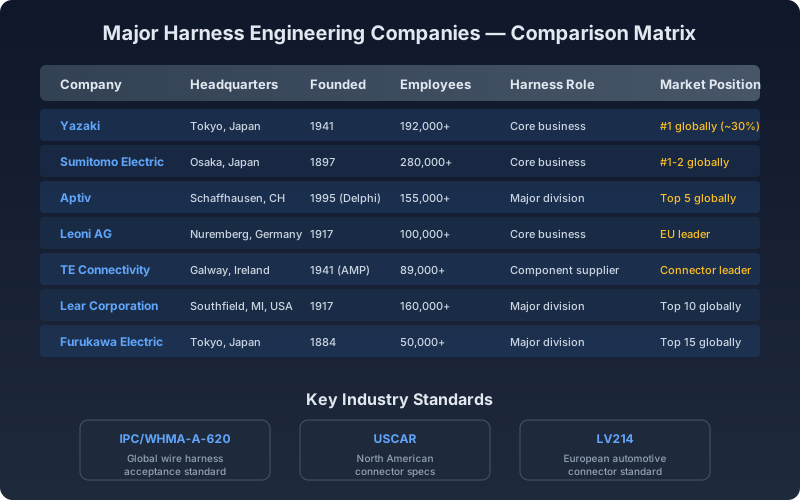
Lear Corporation, best known for automotive seating, maintains a significant electrical distribution systems division. Furukawa Electric supplies wire harnesses and electronic components from its Japanese base. Bosch, the world's largest automotive supplier, integrates harness engineering into its broader vehicle systems work — though harness manufacturing is not Bosch's primary business.
Standards and Quality
Harness engineering is governed by a dense web of industry standards. Here are the most consequential:
IPC/WHMA-A-620 — The Global Baseline
IPC/WHMA-A-620, "Requirements and Acceptance for Cable and Wire Harness Assemblies," is the most widely referenced standard in the industry. Published jointly by IPC (Association Connecting Electronics Industries) and WHMA (Wiring Harness Manufacturer's Association), it defines acceptance criteria across three product classes:
- Class 1 — General Electronic Products: functionality is the primary requirement; failure is an inconvenience. Applies to toys, consumer gadgets, and non-critical items.
- Class 2 — Dedicated Service Electronic Products: consistent and extended performance is expected; uninterrupted service is not vital. Applies to laptops, home appliances, and communication equipment.
- Class 3 — High Performance Electronic Products: continuous performance is mandatory; downtime cannot be tolerated. Applies to life-support systems, military equipment, and aerospace applications.
The standard covers everything from electrostatic discharge protection and conduit installation to crimping, soldering, pull-test requirements, and repair procedures. For any harness engineer, knowing the IPC/WHMA-A-620 class system is foundational.
USCAR — North American Automotive Standards
The United States Council for Automotive Research (USCAR) publishes a family of standards specific to automotive electrical connectors and wiring systems. USCAR specifications cover connector performance testing, terminal retention force, environmental sealing, and wire-to-terminal crimp validation. These standards are mandatory for tier-one suppliers selling into Ford, GM, and Stellantis.
LV214 — European Connector Standards
LV214, originating from Germany's automotive industry, specifies test sequences and requirements for automotive connectors. It covers vibration profiles, thermal cycling, and electrical load testing — critical for validating connector reliability under the harsh conditions of an engine bay or underbody installation.
ISO 8092 — Vehicle Wiring Harness Classification
ISO 8092 defines the classification and requirements for road vehicle electrical wiring harnesses. It establishes terminology, test methods, and performance criteria that serve as the reference point for European and Asian automakers' internal specifications.
Design Tools and Software
Harness design has historically been a fragmented discipline, with mechanical CAD, electrical CAD, and manufacturing engineering operating in separate toolchains. Several software categories serve the modern harness engineer:
Electrical CAD for Schematic Design
Engineers use electrical CAD tools — such as Zuken E3.series, Mentor Graphics Capital Harness Systems, and AutoCAD Electrical — to create the logical definition of each harness: which wires connect which pins, what signal types run on each conductor, and where splices occur. These tools generate the "from-to" lists that drive downstream design.
Mechanical CAD for 3D Routing
Once the logical design is complete, mechanical engineers route the harness in 3D space using tools like CATIA, Siemens NX, or Creo. This step determines exact wire lengths, bend radii, clip and grommet positions, and clearance from hot or moving parts. Modern CAD packages include harness-specific modules that simulate bundle stiffness, minimum bend radius violations, and clash detection with surrounding components.
Manufacturing Documentation
The final output is a full-scale formboard drawing — traditionally a physical pegboard, increasingly a digital work instruction on a tablet — showing the exact routing, branch points, connector orientations, and tape/loom application points for assembly technicians.
Open-Source and Emerging Tools
Several open-source projects aim to democratize harness design:
- WireViz is a Python-based tool that generates wiring diagrams from YAML descriptions, producing high-quality harness documentation suitable for small-scale projects and prototyping.
- KiCad, the popular open-source PCB design suite, has growing community support for harness-level documentation through its schematic editor and custom field annotations.
- Horizon EDA, a newer open-source EDA tool, treats harnesses and connectors as first-class design objects rather than afterthoughts.
For hobbyists and small teams, these tools lower the barrier to professional-quality harness documentation.
Automation and Digitalization Trends
Harness manufacturing remains one of the most labor-intensive processes in modern industry. Unlike PCB assembly — which has been highly automated since the 1980s — wire harness production still relies heavily on manual labor. The reasons are inherent to the product:
- Wires are flexible and non-rigid, making robotic manipulation difficult.
- Each harness is vehicle-configuration-specific; a single car model may have dozens of variants depending on trim level and options.
- Processes like routing wires through convoluted tubing, taping branch points, and inserting connectors require fine motor skills and tactile feedback that robots struggle to replicate.
Where Automation Excels
Pre-production steps are far more automated: wire cutting, stripping, and terminal crimping machines from manufacturers like Komax and Schleuniger process thousands of wires per hour with micron-level precision. Automated test systems validate every circuit in a finished harness, applying continuity, isolation, and high-voltage tests in seconds.
Industry 4.0 and the Digital Twin
The most significant trend in harness engineering is the adoption of digital twin technology. A digital twin is a virtual replica of the physical harness and its manufacturing process, continuously updated with real-time data from the production floor. This enables:
- Virtual commissioning: engineers can simulate harness assembly and routing before cutting a single wire, catching design errors early.
- Process optimization: machine learning models analyze production data to identify bottlenecks and predict quality issues.
- Traceability: every wire, terminal, and connector is tracked from raw material to finished harness, critical for regulatory compliance in aerospace and medical applications.
Modular Harness Architectures
Tesla has been a catalyst for rethinking automotive harness design. The Model Y reportedly reduced total wiring length by over 90% compared to legacy architectures, using zonal controllers connected by high-speed Ethernet backbones rather than point-to-point wiring. This approach — sometimes called "zonal architecture" — replaces long, heavy, configuration-specific harnesses with shorter standardized segments connected to local computing nodes. It is a paradigm shift that every major automaker is now pursuing.
Learning Path and Resources
For engineers looking to enter or advance in harness engineering, a structured approach helps:
Academic Foundation
A degree in electrical engineering, mechanical engineering, or mechatronics provides the theoretical grounding. Courses in materials science (for understanding wire insulation, connector platings, and environmental degradation) and electromagnetic compatibility (for managing signal integrity in complex harnesses) are particularly valuable.
Core Knowledge Areas
- Connector and terminal selection: understanding contact resistance, current rating, environmental sealing, and mating cycle life.
- Wire sizing and derating: calculating voltage drop, ampacity, and thermal limits across harness segments.
- Grounding and shielding: designing for electrical noise immunity in mixed-signal environments.
- Manufacturing processes: crimping, ultrasonic welding, soldering, and overmolding.
Certification and Standards Training
IPC offers certification programs — Certified IPC Specialist (CIS) and Certified IPC Trainer (CIT) — for IPC/WHMA-A-620. These credentials are widely recognized and often required by employers. USCAR training materials and LV214 test specifications are available through industry consortia and standards bodies.
Books and Publications
- "Automotive Wiring and Electrical Systems" by Tony Candela — a practical, hands-on guide for automotive electrical work.
- SAE International technical papers on wiring harness design and validation provide peer-reviewed insights into specific engineering challenges.
- "Cable Harness Design" by Dr. Paul B. Crilly covers theoretical and practical aspects across industries.
Community and Online Resources
- The Wiring Harness Manufacturer's Association (WHMA) publishes technical articles, hosts annual conferences, and maintains a member directory.
- EEVblog and the EEVblog Electronics Community Forum have active threads on harness design, testing, and manufacturing.
- LinkedIn groups such as "Wire Harness & Cable Assembly Industry" and "Automotive Wiring Harness Professionals" provide networking and job opportunities.
Hands-On Practice
Nothing substitutes for building harnesses. Start with a simple project — a custom wiring harness for a race car data logger, a robotics project, or a home automation control panel. Document the schematic, create a formboard drawing, cut and crimp wires, assemble the harness, and test every circuit. The gap between a clean schematic and a functional, durable harness is where engineering judgment develops.
The Road Ahead
Harness engineering sits at a fascinating inflection point. Three converging forces will reshape the field over the next decade:
-
Vehicle electrification: the shift from 12V to 400V and 800V architectures demands new materials, connectors, and safety protocols. Harnesses for battery packs, inverters, and high-power distribution are fundamentally different from legacy low-voltage designs.
-
Autonomous driving: level 4 and 5 systems add sensor suites — lidar, radar, cameras — each with its own harness requirements. Redundant power and signal paths, required for functional safety, double the complexity of critical harness segments.
-
Sustainability and circular economy: automakers face increasing pressure to design for disassembly and recycling. Harnesses account for a significant fraction of a vehicle's copper and plastic content, making them a prime target for end-of-life recovery initiatives.
For engineers, these changes mean that harness design is no longer a commodity discipline delegated to cost-focused suppliers. It is becoming a strategic differentiator — the quality of a vehicle's electrical architecture directly affects range, reliability, upgradability, and safety. The field needs engineers who understand both the physics of high-voltage power delivery and the logic of networked computing nodes.
Whether you are an electrical engineer looking to specialize, a mechanical engineer wanting to bridge into electronics, or a hobbyist fascinated by how things are made — harness engineering offers a rich, challenging, and increasingly important career path. The wires that run through every machine are not an afterthought. They are the system.
Sources
Wikipedia:
- Cable harness: https://en.wikipedia.org/wiki/Cable_harness
- Yazaki Corporation: https://en.wikipedia.org/wiki/Yazaki
- Sumitomo Electric Industries: https://en.wikipedia.org/wiki/Sumitomo_Electric_Industries
- Aptiv: https://en.wikipedia.org/wiki/Aptiv
- Leoni AG: https://en.wikipedia.org/wiki/Leoni_AG
- TE Connectivity: https://en.wikipedia.org/wiki/TE_Connectivity
- Lear Corporation: https://en.wikipedia.org/wiki/Lear_Corporation
- Furukawa Electric: https://en.wikipedia.org/wiki/Furukawa_Electric
- IPC (electronics): https://en.wikipedia.org/wiki/IPC_(electronics)
Industry Standards:
- IPC/WHMA-A-620E: Requirements and Acceptance for Cable and Wire Harness Assemblies
- USCAR specifications: connector performance testing and crimp validation for North American automotive
- LV214: automotive connector qualification tests (German automotive industry)
Tools and Open-Source:
- WireViz: https://github.com/formatc1702/WireViz
- KiCad: https://www.kicad.org/
- Horizon EDA: https://github.com/horizon-eda/horizon
- Zuken E3.series: https://www.zuken.com/us/product/e3-series/
- Mentor Graphics Capital Harness Systems (Siemens): https://eda.sw.siemens.com/en-US/capital/