Harness Engineering: The Complete Guide to Building Reliable AI Agents in 2026
The AI agent landscape in 2025–2026 has been defined by a single, uncomfortable truth: models are getting dramatically better, yet agents remain frustratingly unreliable in production. The gap between a "demo-ready" agent and a production-grade system is enormous — and it has a name. The industry is converging on a new discipline called Harness Engineering.
Agent = Model + Harness. The model reasons. The harness does everything else.
That terse equation, framed by OpenAI and echoed by Anthropic, LangChain, Red Hat, and Martin Fowler, distills the central insight of the agent era: the model is a component, not the system. The system is the scaffolding built around it.
This article is a comprehensive field guide to harness engineering as it stands in Q2 2026. We cover origins, architecture, the tooling ecosystem, production case studies, and a practical adoption roadmap — backed entirely by public references from OpenAI, Anthropic, Google, Microsoft, and the open-source community.
1. The Three-Wave Evolution
To understand where harness engineering fits, trace the evolution of how we interface with large language models:
| Wave | Discipline | What It Solves | Limitation |
|---|---|---|---|
| 1 | Prompt Engineering | How to phrase a query for a good single-turn response | Doesn't scale to multi-step tasks |
| 2 | Context Engineering | How to dynamically manage what the model knows at each step | Still assumes the model will behave correctly given enough context |
| 3 | Harness Engineering | How to build the entire runtime environment so agents reliably complete long-horizon tasks | — |
This progression is not academic. Datawhale's open-source tutorial self-harness explicitly traces the path: Prompt Engineering → Context Engineering → Harness Engineering, with each wave absorbing the lessons of its predecessor rather than replacing it.
Prompt engineering answers "what to say." Context engineering answers "what the model needs to know right now." Harness engineering answers "how to build a system where the model can operate safely, recoverably, and verifiably for hours or days."
2. What Exactly Is a Harness?
OpenAI's original framing — published at openai.com/index/harness-engineering — defines harness engineering as the discipline of designing the scaffolding that lets agents operate reliably in an agent-first world.
Martin Fowler's synthesis (March 2026) is the clearest conceptual map. He identifies three interlocking systems:
- Context Engineering — curating what the agent knows: project structure, conventions, past decisions, current state.
- Architectural Constraints — deterministic linters, structural tests, and type systems that prevent classes of errors before they happen.
- Entropy Management — periodic agents that repair documentation drift, detect stale assumptions, and keep the codebase coherent over time.
Thoughtworks' Birgitta Böckeler (April 2026) provides the most actionable mental model, framing a coding-agent harness as two interleaved mechanisms:
- Feedforward controls (Guides) — anticipate unwanted outputs and steer the agent before it acts. Examples: AGENTS.md, CLAUDE.md, system prompt templates, directory structure maps, time budget warnings.
- Feedback controls (Sensors) — observe after the agent acts and help it self-correct. Examples: custom linter error messages optimized for LLM consumption, test failure reports with actionable diagnostics, type-checker output that includes repair hints.
Both guides and sensors come in two execution modes:
- Computational — deterministic, fast (milliseconds), run by the CPU. Tests, linters, type checkers.
- Inferential — semantic analysis, LLM-as-judge. Slower, more expensive, non-deterministic.
The critical insight: computational controls are dramatically cheaper than inferential ones. A harness that layers cheap deterministic checks before invoking expensive LLM-as-judge evaluations saves both cost and latency while providing a stronger correctness guarantee.
3. The Anatomy of an Agent Harness
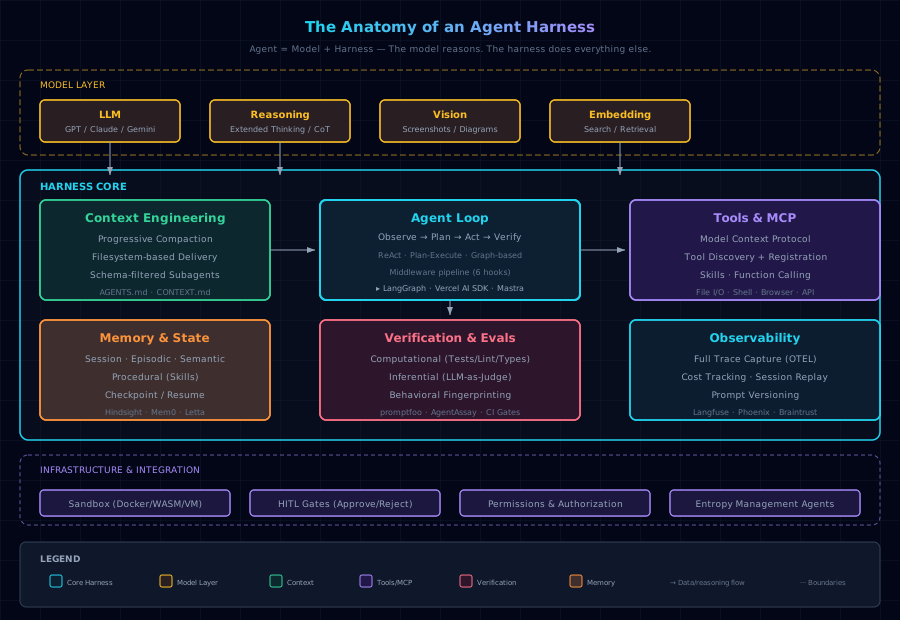
LangChain's structural breakdown (The Anatomy of an Agent Harness, blog.langchain.com) identifies five primitives that compose every production harness:
3.1 Filesystem as Collaboration Surface
The filesystem is the most underrated harness component. It provides durable state that survives crashes and a collaboration surface between human and agent. Microsoft's Azure SRE agent case study is the most compelling evidence: exposing source code, runbooks, query schemas, and past investigation notes as files, and letting the agent use read_file, grep, find, and shell outperformed 100+ specialized tools. Their "Intent Met" score rose from 45% to 75% on novel incidents.
3.2 Code Execution with Sandboxing
Agents need to run code to verify their own output. But running untrusted code in the same process or container as the agent is a security disaster. Production harnesses isolate execution in sandboxes — Docker containers, ephemeral VMs, or WebAssembly runtimes. AgentScope Runtime and OpenAI's Agents SDK sandbox execution (April 2026) are reference implementations.
3.3 Memory and State
Memory is the hardest harness component to get right. The design space spans four levels:
| Level | What | Example Tools |
|---|---|---|
| Session state | In-flight context, current task progress | LangGraph checkpointing |
| Episodic memory | Past conversations, decisions, outcomes | Hindsight, Mem0 |
| Semantic memory | User preferences, project conventions, domain knowledge | Letta, MemPalace |
| Procedural memory | Reusable workflows, skills, patterns | Hermes skills, Claude Code custom commands |
The crucial deployment consideration: memory persistence is a learned semantic. A 2026 study (Agents Learn Their Runtime, arXiv:2603.01209) showed that mismatching your runtime persistence mode to the model's training-time semantics produces either 80% missing-variable errors or 3.5× token overhead. Your harness must honor the persistence semantics the model was trained to expect.
3.4 Context Management and Compaction
Context rot — the progressive degradation of agent performance as the conversation accumulates irrelevant history — is the primary failure mode for long-running agents. The 2026 solutions:
- Progressive compaction — LangChain's LangGraph and Vercel AI SDK implement multi-stage compaction: snip irrelevant turns → micro-compact similar messages → auto-compact on threshold.
- Schema-filtered planning subagents — the OpenDev paper (arXiv:2603.05344) introduces subagents that enforce behavioral constraints via tool schema rather than runtime checks, preventing context pollution at the architectural level.
- Filesystem-based context delivery — instead of shoving everything into the prompt, expose it as files the agent can selectively read. This is Microsoft's key lesson from the SRE agent migration.
3.5 Tool Interfaces and MCP
Anthropic's Writing Effective Tools for Agents (engineering blog) establishes the principle that tool design is agent UX. Poor tool naming, ambiguous schemas, and silent failures are the most common source of agent unreliability.
The Model Context Protocol (MCP) has become the de facto standard for tool registration. As of Q2 2026, every major framework — OpenAI Agents SDK, Anthropic Claude Agent SDK, Vercel AI SDK, LangGraph, Mastra, Google ADK — supports MCP natively. The protocol's strength is not its transport mechanism but its tool discovery model: agents can interrogate available tools dynamically rather than relying on hard-coded registries.
3.6 Verification Loops and Evals
If context management prevents failures, verification loops catch the ones that slip through. The state of the art in agent verification:
- Deterministic checks first — OpenAI's skill testing framework (Testing Agent Skills Systematically with Evals, April 2026) layers JSONL trace capture for deterministic checks (command sequences, token budgets, repo cleanliness) before rubric-based LLM-as-judge grading. The layering principle: add expensive checks only where they reduce meaningful risk.
- Behavioral fingerprinting — AgentAssay (arXiv:2603.02601) detects 86% of regressions vs. 0% with binary pass/fail testing. Stochastic PASS/FAIL/INCONCLUSIVE verdicts grounded in hypothesis testing cut token costs 78%.
- CI integration — LangChain's 33-item evaluation readiness checklist covers the full lifecycle from error taxonomy to grader specialization to CI integration. The key separation: capability evals (low pass rate, improvement target) and regression evals (near-100%, protection target) must be separate pipelines.
3.7 Observability and Tracing
When an agent fails at step 87 of a 120-step task, you need to know why. The observability stack has matured rapidly:
| Tool | Specialization | Self-Hostable |
|---|---|---|
| Langfuse | Prompt versioning + trace + evals | Yes |
| Arize Phoenix | Trace UI + eval runtime | Yes |
| Braintrust | Evaluation-first, Brainstore full-trace search | SaaS |
| Pydantic Logfire | SQL-queryable traces, MCP server | SaaS |
| OpenLLMetry | OpenTelemetry-based instrumentation | N/A (library) |
| AgentOps | Session replay, cost tracking, 10+ framework support | No |
Google's BigQuery Agent Analytics launch (2026) treats agent traces as analytical data rather than dashboard exhaust — the important shift is that observability becomes queryable infrastructure.
4. Key Projects and Ecosystem
The harness engineering ecosystem in Q2 2026 can be organized into four tiers:
4.1 Full-Stack Frameworks
These provide the complete harness runtime — agent loop, state management, tool integration, tracing:
| Framework | Stars | Language | Key Differentiator |
|---|---|---|---|
| Vercel AI SDK | — | TypeScript | 20M+ monthly downloads, 25 provider, MCP native |
| LangGraph | 12k+ | Python/TS | Explicit graph-based agent loop, checkpointing |
| Mastra | 22k+ | TypeScript | 40+ providers, serverless deployer, RAG |
| Microsoft Agent Framework | — | .NET/Python | Semantic Kernel + AutoGen unified, DevUI debugger |
| Google ADK | — | Python | Multi-agent topology, HuggingFace/GitHub integrations |
| CrewAI | 26k+ | Python | Role-based multi-agent, enterprise focus |
4.2 Harness-Native Tools
Tools purpose-built for harness engineering, not retrofitted from general-purpose frameworks:
| Project | Stars | Description |
|---|---|---|
| AutoHarness (aiming-lab) | 264 | Lightweight governance framework — 2-line wrap, 6-step pipeline, risk pattern matching, YAML constitution. 958 tests. |
| Nexent (ModelEngine Group) | 4,385 | Zero-code platform auto-generating production agents from Harness Engineering principles |
| moss-harness (cybernetix-lab) | 162 | Production-grade template: reliable, observable, recoverable runtime |
| OpenHarness (THU NMRC) | 98 | Long-term autonomous agent execution for OpenClaw |
| ClawProBench (suyoumo) | 576 | Live-first benchmark harness with deterministic grading |
4.3 Educational Resources
| Resource | Type | Language |
|---|---|---|
| awesome-harness-engineering (ai-boost) | Curated list (741 stars) | EN / ZH / DE / 9 languages |
| self-harness (Datawhale) | Open-source tutorial (98 stars) | ZH |
| miniMaster | Minimum viable harness implementation | Python |
4.4 Specialized Components
- Memory: Hindsight, Mem0, Letta, MemPalace, LangGraph persistence
- Sandbox: AgentScope Runtime, Daytona, OpenAI Sandbox execution
- Observability: Langfuse, Phoenix, Braintrust, Logfire, AgentOps, Helicone
- HITL: AWS HITL Patterns, HITL Protocol (open standard), AutoResearchClaw
- Security: Microsoft AgentRx (systematic failure debugging), METR red-team reports
5. Production Case Studies
5.1 Microsoft Azure SRE Agent
Scale: 35,000+ production incidents handled autonomously.
Impact: Time-to-mitigation reduced from 40.5 hours to 3 minutes.
Architecture: Filesystem-based context engineering system (100+ tools replaced by read_file, grep, find, shell), MCP for external service integration, human-in-the-loop governance.
Key lesson: Exposing everything as files outperforms specialized tooling. "Intent Met" score rose from 45% to 75%.
5.2 Meta Ranking Engineer Agent (REA)
Scale: Multi-day ML pipeline automation for ads ranking.
Architecture: Hibernate-and-wake checkpointing for resuming interrupted 6-hour tasks without losing context.
Key lesson: Harness design for scientific workflows where individual turns exceed model context limits but the overall pipeline must maintain coherence across days.
5.3 LangChain Coding Agent (Terminal Bench)
Impact: Harness-only changes moved their coding agent from rank 30 to top 5 on Terminal Bench 2.0 — no model swap.
Changes: Structured verification loops, context injection (directory maps + time budget warnings), loop-detection middleware, and a "reasoning sandwich" concentrating maximum thinking at planning and verification phases.
Key lesson: Harness design is the primary performance lever, not model capability.
5.4 OpenAI Symphony
Architecture: An orchestration layer that monitors issue trackers, creates isolated per-issue workspaces, and surfaces proof-of-work artifacts (CI status, review feedback, walkthrough videos) as the handoff signal.
Key lesson: The in-repo WORKFLOW.md pattern — versions agent runtime policy alongside code — is an emerging best practice for governance.
6. Practical Adoption Roadmap
Based on patterns observed across the above case studies, here is a phased roadmap:
Phase 1: Feedforward Controls (Week 1)
- Create
AGENTS.md/CLAUDE.mdwith project conventions, code style, testing requirements - Write a system prompt template that includes project structure map and time budget warnings
- Establish a
CONTEXT.mddomain glossary
Phase 2: Feedback Controls (Week 2)
- Add custom linter rules with LLM-optimized error messages (include repair hints)
- Configure deterministic test suites that run on every agent change
- Set up
promptfooor equivalent for regression evals
Phase 3: Structured Context (Week 3)
- Move from free-form prompts to structured context delivery (filesystem-based)
- Implement progressive compaction (LangGraph checkpointing or equivalent)
- Add verification checklists as harness artifacts
Phase 4: Observability (Week 4)
- Instrument with OpenLLMetry or Langfuse for full trace capture
- Set up cost tracking per session / per agent
- Establish regression eval pipeline in CI
Phase 5: Production Hardening (Ongoing)
- Implement sandboxed execution for untrusted tool calls
- Add human-in-the-loop gates at critical decision points
- Set up periodic entropy-management agents (documentation repair, stale assumption detection)
- Version harness policy alongside code (
WORKFLOW.mdor equivalent)
7. Why Now?
Harness engineering has coalesced as a discipline in early 2026 because three forces converged:
- Model capability plateau in agent-specific tasks — frontier models (Claude Opus 4.6, GPT-5.2, DeepSeek V4) have reached a level where incremental capability gains matter less than environmental design.
- The "demo-to-production gap" became a business problem — organizations deploying agents at scale found that 40–60% of failures were environmental (context drift, tool ambiguity, silent state corruption), not model failures.
- The open-source ecosystem matured — MCP as a standard, LangGraph's explicit loop model, AutoHarness's lightweight governance, and the curated knowledge in
awesome-harness-engineeringgive practitioners a shared vocabulary and reusable components.
Anthropic's 2026 Agentic Coding Trends Report quantifies the lever: harness setup alone can swing benchmarks by 5+ percentage points. That is the difference between an agent that frustrates and an agent that delivers.
8. The Human Role: On the Loop, Not in It
The most important shift harness engineering demands is not technical — it's about how humans relate to agents. Martin Fowler frames three postures:
- Human outside the loop — provide the initial prompt, receive the result. Does not scale with agent throughput.
- Human in the loop — review every individual agent output. Burns human attention at the agent's speed.
- Human on the loop — maintain the harness. Design the constraints, monitor the metrics, intervene on exceptions. This is the only posture that scales.
Böckeler's framing extends this idea. She argues that harnessability should become a first-class criterion in technology and architecture decisions. When choosing a framework or tool, ask not "can my agent use this?" but "can I build a reliable control layer around my agent's interaction with this?"
9. Open Questions
Harness engineering is young enough that several fundamental questions remain unresolved:
-
Harness overfitting — LangChain warns that models trained with specific harnesses can become overfitted to those designs. A harness that works perfectly for Claude Code may actively harm a Grok- or Gemini-based agent. How do we design model-agnostic harnesses?
-
Harness complexity budget — Every harness component adds latency, cost, and debugging surface. Where is the Pareto frontier between reliability and complexity?
-
Harness as training data — When agents write their own harness improvements, does this create a self-reinforcing loop that blinds the system to novel failure modes?
-
Standardization vs. specialization — MCP provides a standard tool interface, but tool design (naming, schema granularity, error surfaces) remains an art. Will we converge on shared tool catalogs, or is per-domain specialization the permanent state?
Conclusion
Harness engineering is not a framework you install or a library you import. It is a lens — a way of seeing the agent problem that shifts responsibility from the model to the system designer. The model is a component. The harness is the product.
If you are building AI agents in 2026, the single highest-leverage investment you can make is not a better model. It's a better harness.
References
- OpenAI — Harness Engineering (2026)
- OpenAI — Unrolling the Codex Agent Loop (2026)
- OpenAI — A Practical Guide to Building AI Agents (April 2026)
- Anthropic — Building Effective Agents (2024)
- Anthropic — Harness Design for Long-Running Application Development (2026)
- Anthropic — 2026 Agentic Coding Trends Report (2026)
- Anthropic — Measuring AI Agent Autonomy in Practice (February 2026)
- Martin Fowler — Harness Engineering (March 2026)
- Birgitta Böckeler / Thoughtworks — Harness Engineering for Coding Agent Users (April 2026)
- LangChain — The Anatomy of an Agent Harness (2026)
- LangChain — Improving Deep Agents with Harness Engineering (2026)
- LangChain — Agent Evaluation Readiness Checklist (2026)
- Red Hat — Harness Engineering: Structured Workflows for AI-Assisted Development (April 2026)
- Microsoft — How We Build Azure SRE Agent with Agentic Workflows (2026)
- Meta — Ranking Engineer Agent (REA) (March 2026)
- Google — Agent Development Kit (2026)
- ai-boost — Awesome Harness Engineering (741 stars, 2026)
- Datawhale — self-harness (open-source tutorial, 2026)
- aiming-lab — AutoHarness (2026)
- Cybernetix Lab — moss-harness (2026)
- ModelEngine Group — Nexent (2026)