The Three-Year Shakeout of AI Image Tools: From Fooocus's Freeze to ComfyUI's Dominance — What to Pick in 2026
There's probably a Fooocus installation tutorial rotting in your bookmarks right now. The tool built by ControlNet author lvmin Zhang (lllyasviel) — which compressed local Stable Diffusion down to "unzip and generate" — shipped its final formal release, v2.5.5, on August 12, 2024. That's more than two years ago. The repo is officially in LTS (bug fixes only), the last commit landed December 1, 2025, and it will never support Flux, SD3.5, or any newer architecture.
Fooocus is not an outlier; it's the epitome of an entire generation. Between 2022 and 2026, local image-generation tools went through three waves: all-in-one WebUIs brought diffusion models to consumer GPUs, node-graph engines devoured the professional segment, and editing models are now rewriting what "generating an image" even means. Each wave left the previous wave's stars standing still. This post reconstructs the causal chain with measured GitHub data, then answers the practical question: as of September 2026, which image tool should you actually run?
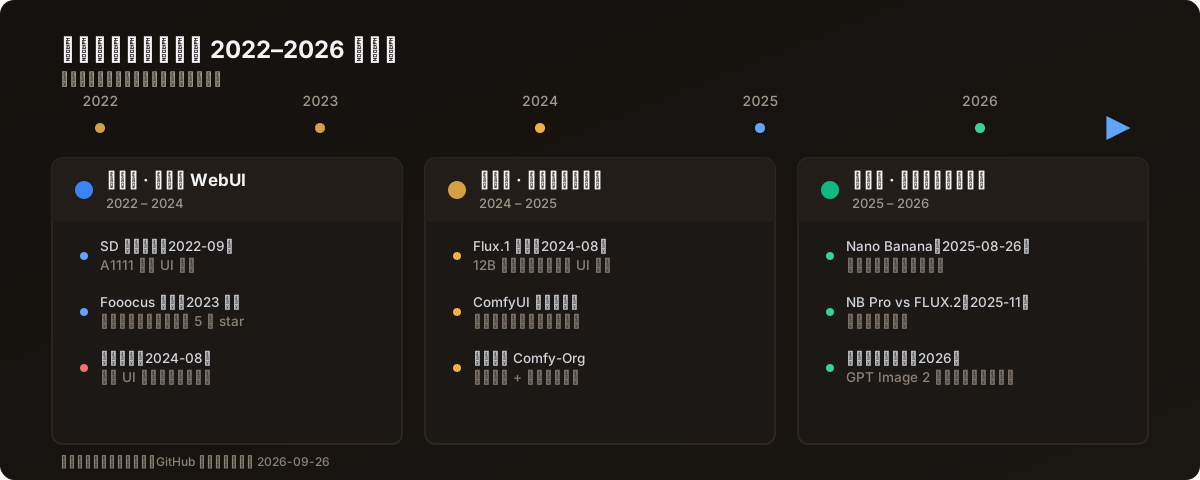
Wave One: The Golden Age of All-in-One WebUIs (2022–2024)
The story starts with AUTOMATIC1111's Stable Diffusion WebUI. When the Stable Diffusion weights went public in September 2022, A1111 was the first project to make "running diffusion locally" a civilian operation: one webui-user.bat, an 8GB GPU, and the largest plugin ecosystem the field has ever seen. Its vocabulary — the prompt box, CFG, samplers, the LoRA loader, the img2img tab — became the default shape of every image UI that followed.
Fooocus was a subtractive rebellion against that paradigm. When it launched in the summer of 2023, its thesis bordered on heresy: users should never see a sampler or a CFG value. It stripped every parameter panel, shipped an offline GPT-2 prompt-expansion engine (Fooocus V2) that rewrote your prompts for you, picked a sensible default checkpoint (juggernautXL), and ran on as little as 4GB of VRAM. From download to first image in under three clicks — the README's own words, and it delivered. Midjourney-grade out-of-box experience, fully offline, fully free: within a year it blew past 50k stars (53,182 as of September 2026) and became synonymous with "local image generation for normal people."
The same era had InvokeAI (canvas-first interaction), Easy Diffusion, and vladmandic's SD.Next among the contenders. It was the most crowded window local image tooling ever enjoyed: the model world was just SD 1.5 and SDXL, the cadence was slow, every UI could keep up, and the axes of competition were usability and feature depth.
That window closed in August 2024.
Star Counts Lie: Real Activity, Measured September 2026
The biggest trap in evaluating tools is substituting star counts for current status. The table below was measured repo-by-repo via the GitHub API on September 26, 2026, sorted by stars:
| Tool | Stars | Last push | Last release | Status |
|---|---|---|---|---|
| A1111 WebUI | 165,132 | 2026-03-02 | v1.10.1 (2025-02) | Near-dead: 7 months no commits, 19 months no release |
| ComfyUI | 135,023 | 2026-09-26 (same day) | v0.37.0 (2026-09-21) | Full speed: three releases in one month |
| Fooocus | 53,182 | 2025-12-01 | v2.5.5 (2024-08-12) | Frozen in LTS: bug fixes only, no new architectures |
| InvokeAI | 28,297 | 2026-09-25 | Continuous | Active: committing the day before this query |
| Forge | 13,032 | 2025-07-31 | — | Dormant: 14 months no commits |
| SD.Next | 7,346 | 2026-09-26 (same day) | Continuous | Active: single maintainer, relentless cadence |
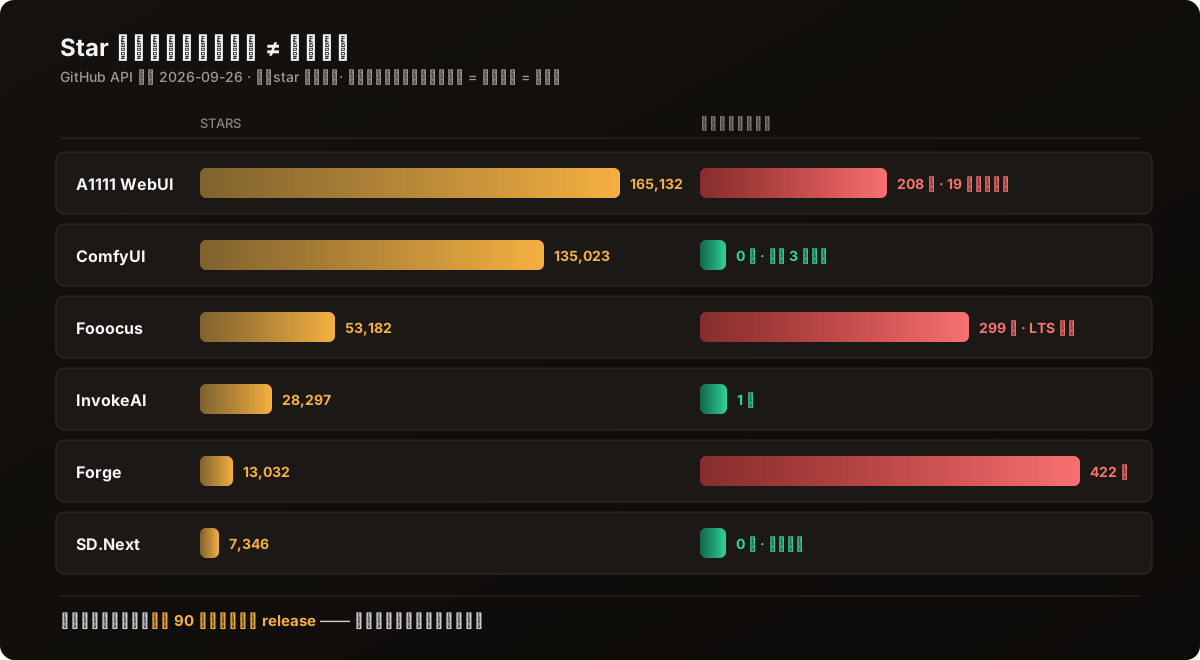
Two inversions hide in this data. First, the most-starred repo, A1111 (165k), is precisely the dead one — its last release dates to February 9, 2025 (v1.10.1), with nothing shipped in the 19 months since; the community survived on the dev branch. Second, Forge — lllyasviel's own designated successor to Fooocus, which absorbed waves of users with its memory optimizations and Flux support — has gone 14 months without a commit. The author himself moved on to video generation (CogVideoX and successors); both projects went dormant in sequence.
Star counts are trophies for historical importance, not health checks. The only reliable selection criterion is "has this shipped a release in the last 90 days" — a single question that filters out half the table above.
Wave Two: The Node Graph Devours Everything (2024–2025)
In August 2024, two things happened within the same month: Black Forest Labs released Flux.1, and Fooocus shipped its final formal release. That's not coincidence — it's causation. The Flux generation of models became the noose around static UIs.
Flux.1 is a 12B rectified-flow architecture with entirely different loading, sampling, and memory characteristics from SDXL. A1111's plugin architecture was designed for the SD era; adapting it meant touching internals just as the maintainer was going quiet. Fooocus simply declined. Meanwhile ComfyUI — quietly released in early 2023 — had a structural property that suddenly mattered more than any feature: a node graph outsources model-adaptation cost to the community. Every new architecture gets a working community workflow on release day, assembled from custom nodes, with official templates following — nobody waits for the core team. That single property let it harvest the entire field through 2024–2025.
The footnote to the harvest is organizational: the repo has migrated from the personal comfyanonymous account to the company org Comfy-Org (verified via the API redirect, September 2026), backed by funded Comfy — desktop app, cloud API, and Comfy Cloud hosting as one stack. With the open-core/commercial-uplift flywheel spinning, its pace only accelerated: three releases in September 2026 alone (v0.35 on the 9th, v0.36 on the 15th, v0.37 on the 21st).
Why did nobody backfill the all-in-one niche? The demand demonstrably exists — the epidemic of fake "Fooocus" download sites in search results is the dark proof — yet no successor emerged. The answer is economics: a pure-usability project has no business model. ComfyUI has a platform business; InvokeAI has a company behind it; SD.Next runs on one maintainer's stamina. A "subtraction tool" has neither enterprise customers nor ecosystem lock-in; when the author leaves, it ends. Good product positioning cannot save an open-source project with no revenue model.
Wave Three: Editing Models Rewrite the Interaction (2025–2026)
On August 26, 2025, Google shipped Gemini 2.5 Flash Image, nicknamed Nano Banana. What detonated wasn't text-to-image — it was conversational image editing: upload a photo, say "swap the background for snow mountains, keep the person identical," and get the edit back. This interaction erases prompt engineering, sampler settings, and inpaint masks — everything image tools spent a decade simplifying, gone in a single chat box.
Then the pace compressed. On November 18, 2025, Google launched Nano Banana Pro (Gemini 3 Pro Image) with Gemini 3 Pro, supporting 4K output and landing inside Adobe Firefly and Photoshop within days. One week later, on November 25, Black Forest Labs answered with FLUX.2 — pro via API, dev as open weights (32B, non-commercial license, 18–24GB VRAM to run locally), flex in between. OpenAI's GPT-Image line fights in the same arena; in third-party rankings as of mid-2026, GPT Image 2 leads both generation and editing boards, with the Nano Banana family and Grok Imagine close behind. The 2026 battleground is no longer generation — it's editing, and industry consensus has shifted editing capability to the top of the selection criteria.
The local camp's response has been to adopt the paradigm: Alibaba's Qwen-Image family (from August 2025) and its edit variants made open-weights editing genuinely usable, and new challengers keep arriving (see our earlier analysis of Boogu-Image-0.1, the "one-tenth data" challenge to closed models). But for the tool layer the shock is more fundamental: when the interaction collapses into a dialog, the entire parameter panel of a traditional image UI loses its reason to exist. ComfyUI's answer is, again, nodes — editing models, ControlNet, upscaling, and regional repainting all orchestrated as graphs. Which re-proves wave two's conclusion: the architectures that survive wave three are the ones that turned "cost of supporting a new model" into a community cost.
The 2026 Landscape: One Quadrant Chart and Four Recommendations
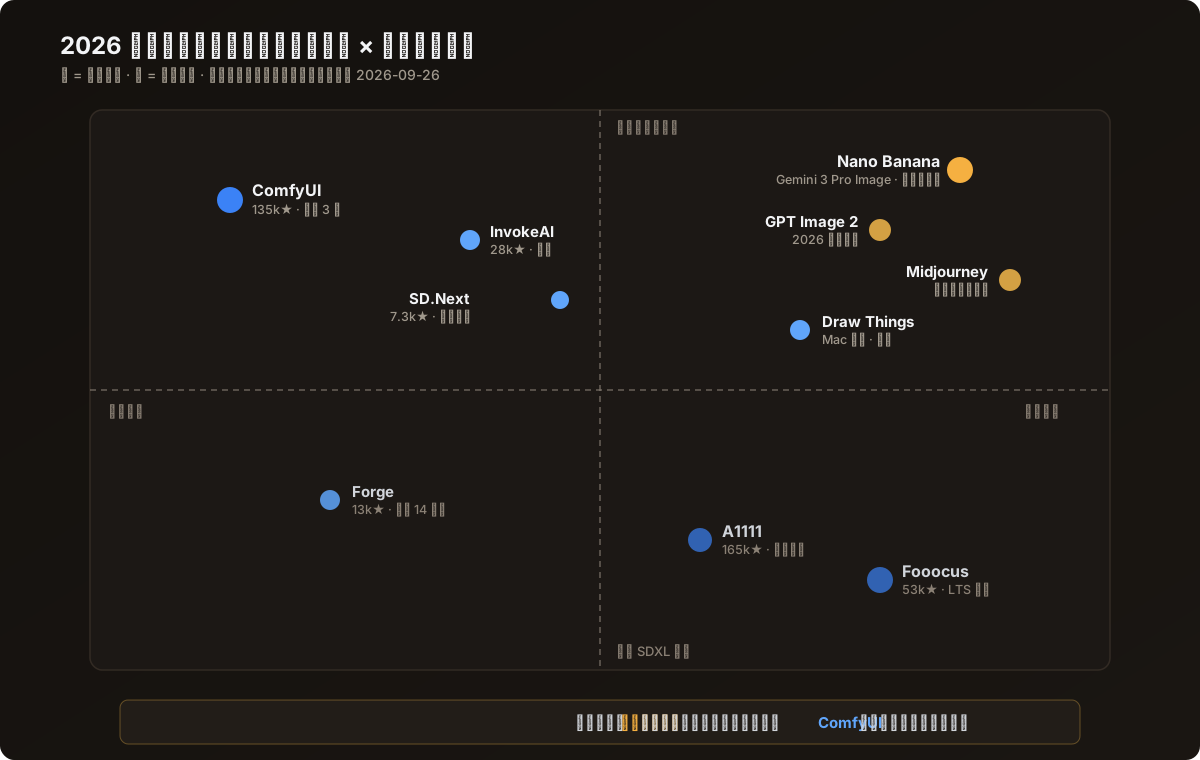
Compressing the analysis into one picture: the horizontal axis is "how far from your first image" (node engineering on the left, zero-click on the right), the vertical axis is "how fast new models arrive" (same-day at the top, frozen in the SDXL era at the bottom), with cloud services and local tools colored apart.
Combined with the quadrant, the September 2026 recommendations are direct:
| Who you are | Pick | Why |
|---|---|---|
| Content creator, results over process | Nano Banana / GPT Image (cloud) | Editing quality and iteration speed are a class ahead; free tiers suffice for trying |
| Want Midjourney aesthetics, offline | Draw Things (Mac) / InvokeAI | The closest active replacements for Fooocus's niche |
| Production at scale, control first | ComfyUI | Same-day new-model support; workflows compound as reusable assets |
| Sitting on A1111 plugin assets | SD.Next, or migrate | SD.Next keeps A1111 compatibility and still ships daily |
Two side judgments. First, Mac users should not pick Fooocus: its PyTorch MPS backend was always a second-class citizen (no native FlashAttention, recurring fp16 issues), and LTS status means Mac-specific breakage will never be officially fixed. On Apple Silicon, "zero-click" means Draw Things; "workflows" means ComfyUI. Second, the reason to generate locally has changed blood: in 2023 it was "free"; in 2026 it's privacy compliance, batch economics, and workflows as durable assets — the two things a cloud subscription structurally cannot give you (our earlier image-generation agent skill survey and Fireworks Tech Graph review converged on the same conclusion: orchestrability is becoming the defining property of a tool).
Three Judgments
Judgment one: the all-in-one local image tool is dying as a category. Not because demand vanished, but because the business model never existed while model cadence doubled. No new Fooocus-scale entrant will appear in the next two years; the "simple" demand will be absorbed by cloud products with free tiers, not by new offline projects.
Judgment two: ComfyUI's winner position is unassailable short-term — but accept that it's no longer a community project. The org migration to Comfy-Org, desktop accounts, and cloud monetization are the fuel behind its pace, and exactly what open-source purists frown at. The flywheel spins only as long as the company lives; that risk is more real than any technical debt.
Judgment three: stop choosing tools, start choosing assets. The greatest lesson of the three-year shakeout: tools die (A1111), freeze (Fooocus), or get orphaned (Forge) — but what you accumulated doesn't: your LoRA library, your workflow files, your prompt templates. Before investing learning time in 2026, ask: if this project dies tomorrow, what do I walk away with? Projects whose answer is "nothing" aren't worth the stars they sit on.
Conclusion
Fooocus's freeze was not an accident but a full-scale ecosystem stress test: it proved that radically simple local image generation has real demand, and that a simplicity-first tool without commercial backing cannot survive a single architecture change. Three waves, three carcasses — A1111 died of adaptation debt, Forge of single-point dependency, Fooocus of a missing business model — and the survivors are the two species that either community-ized the adaptation cost (ComfyUI) or reinvented the interaction itself (Nano Banana). The 2026 answer is correspondingly simple: ComfyUI for production, cloud editing models for creative work, Draw Things for zero-click on Apple Silicon. And that old machine running Fooocus? It can retire with honor.
References
- lllyasviel — Fooocus GitHub repository (LTS statement, v2.5.5, hardware requirements; star/push data measured via GitHub API on 2026-09-26)
- Comfy-Org — ComfyUI GitHub repository (v0.35–v0.37 release records measured via GitHub API on 2026-09-26; repo now 301-redirects to the Comfy-Org org)
- AUTOMATIC1111 — Stable Diffusion WebUI (star/push/release data measured via GitHub API on 2026-09-26)
- lllyasviel — Stable Diffusion WebUI Forge (star/push data measured via GitHub API on 2026-09-26)
- invoke-ai — InvokeAI; vladmandic — SD.Next (activity data measured via GitHub API on 2026-09-26)
- Black Forest Labs — FLUX.2 announcement (2025-11-25; pro/dev/flex tiers and local VRAM requirements)
- Google — Nano Banana / Gemini 2.5 Flash Image (released 2025-08-26; Nano Banana Pro is Gemini 3 Pro Image, launched with Gemini 3 Pro on 2025-11-18 and integrated into Adobe Firefly days later)
- Pixazo — Best AI Image Generation Models in 2026: A Comparison (2026; GPT Image 2 leading generation and editing boards, editing weight rising)
- ViewComfy — Comfy Cloud vs ViewComfy hosting comparison (2026-01; evidence of the ComfyUI cloud ecosystem)