InkOS Deep Dive: The Agent System That Turns Novel-Writing into a State Machine
Anyone who has let an LLM write a novel has hit the same wall: by chapter thirty, the protagonist pulls out a weapon that was lost two chapters ago, and a foreshadowing hook planted three chapters back has simply ceased to exist in the model's mind. InkOS's README cites both examples — and neither is an intelligence problem. It's a state problem. Growing context windows from 8K to 1M tokens never fixed it, because what's missing was never window size; it was a verifiable ledger of facts that lives outside the model.
InkOS's answer is not "use a bigger model." It turns the entire book into a state machine. First, the scale (as of 2026-09-14, from the GitHub and npm APIs): 9,754 stars, 1,796 forks, 233 open issues on GitHub; repository created 2026-03-12, accumulating 1,541+ commits and exactly 6 contributors in five months; the npm package @actalk/inkos recorded 4,381 downloads in the past month (2026-08-13 to 2026-09-11); AGPL-3.0 licensed, current version v1.8.0. One more number that matters later: the most recent commit landed on 2026-08-25 — three weeks of silence as of this writing.
What InkOS Is: Not a Writing Toy, a Vertical Production Line
InkOS calls itself a "Story Creation AI Agent" — a system for long and short novels, screenplays, storyboards, interactive film-games, fan fiction, and multilingual translation. The breadth is almost alarming: serialized long-form; commercial short fiction packages that ship the full text plus a sales blurb and cover prompt; open-world and branching interactive play with user-defined "world contracts" (rarity tiers for cultivation gear, affection levels for romance, evidence lifecycles for detective stories); four fanfic modes (canon / au / ooc / cp); EPUB export; and a daemon that writes chapters autonomously and pushes notifications to Telegram, Feishu, or WeChat Work.
All of these share one execution core, reached through four surfaces: the Studio web workbench (Vite + React + Hono, local port 4567), a terminal TUI, CLI atomic commands, and inkos interact --json — a structured entry point for external agents. The stack is TypeScript on Node 22+, a pnpm monorepo with three packages: cli, core, studio. One engineering decision deserves attention: the agent runtime is not homemade. It's built on Mario Zechner's pi framework (@mariozechner/pi-ai / pi-agent-core), and the credits say so plainly. Delegating the model-calling loop to a dedicated foundation and spending your own energy on domain state — that choice is itself very "state-machine thinking."
The business model is worth a look too: InkOS is in the first batch of Kimi (Moonshot) open-source partners, carries Volcengine sponsorship, has an affiliate link for the huohuaapi data API in its README, and offers a hosted web version. Sponsorship + affiliate marketing + hosted edition — the three most common monetization paths for Chinese open-source AI tools today. We'll return to this in the sustainability score.
My read: InkOS is not "a chat wrapper that can write." It's a vertical production line for the web-novel industry — it takes industrial problems seriously (consistency, throughput, recoverability) rather than demo problems (how impressive a single generation looks).
One Harness, Ten Roles
The v1.8.0 architecture collapse in one sentence: the model understands, proposes, and invokes capabilities; InkOS handles confirmation, context, state, atomic persistence, and artifact truth. In the README's own words — "execution results are grounded in tool results and files on disk, never in the model's verbal claims of completion." That sentence belongs on the monitor of everyone building agent systems; it's the same shift I traced in the big-tech agent harness showdown: the source of agent reliability is migrating from the model layer to the harness layer.
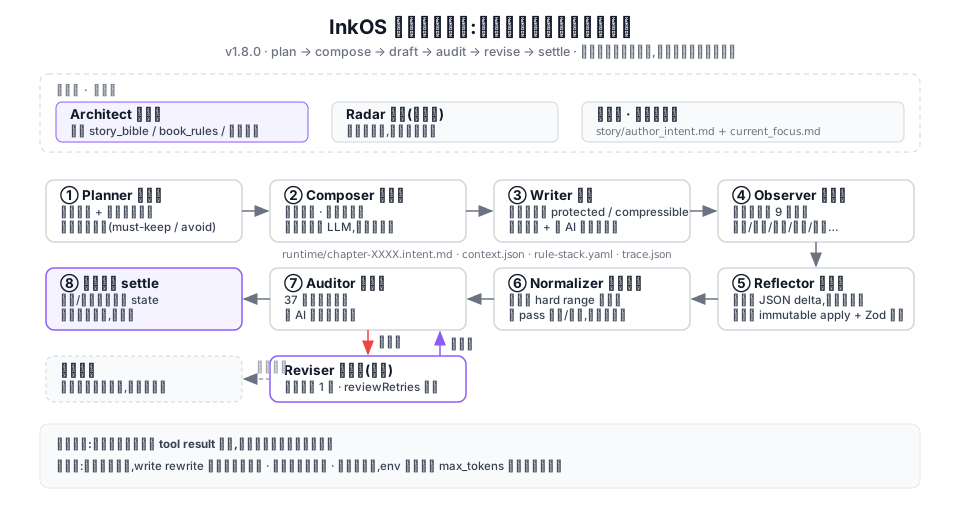
Each chapter runs plan → compose → draft → audit → revise-if-needed → state-settle, with ten roles:
| Role | Responsibility |
|---|---|
| Radar | Scans platform trends and reader taste to steer direction (pluggable, skippable) |
| Planner | Reads control-plane docs + memory retrieval, emits chapter intent (must-keep / must-avoid) |
| Composer | Selects context and compiles the rule stack; no online LLM required |
| Architect | Generates story bible, rules, and long-term control files at book creation |
| Writer | Drafts from the composed, slimmed context; word-count governance and de-AI-flavor rules built in |
| Observer | Extracts 9 fact classes from the draft: characters, locations, resources, relations, emotions, information, foreshadowing, time, physical state |
| Reflector | Emits a JSON delta (not a full markdown rewrite), applied by code after validation |
| Normalizer | Single-pass compression or expansion, only when the draft clearly misses the hard range; never hard-truncates |
| Auditor | 37-dimension continuity checks: character memory, resource continuity, foreshadowing payoff, outline drift, pacing, emotional arc, plus AI-flavor detection |
| Reviser | Fixes critical audit findings; at most one automatic revision pass by default |
Two details are more informative than the roster itself.
First, revision is bounded. If the audit fails, the pipeline runs exactly one revise → re-audit cycle; unresolved issues stay in the state, flagged for human or later commands. You can raise it via writing.reviewRetries, but the default is 1. This is a direct answer to the classic agent-system disease where multi-round auto-repair makes things worse: automation has a boundary, and beyond it, control returns to humans.
Second, multi-agent here is not theater — it's context division of labor. The ten roles don't re-read one giant prompt ten times; each role receives a narrow context composed specifically for it. The auditor never sees the writing prompts; the writer never sees the audit dimensions. It's the same principle as Anthropic's orchestrator tailoring each sub-agent's task brief: context is a scarce resource, budgeted per role.
Three-Layer Memory and Input Governance: The Most Stealable Part
Context engineering in long-form creation fights two enemies: full injection (stuffing the whole book into the prompt until it bursts) and verbal memory (asking the model to "remember" the setting, then watching it drift). InkOS's answer is the most complete one I've seen in a comparable public system.
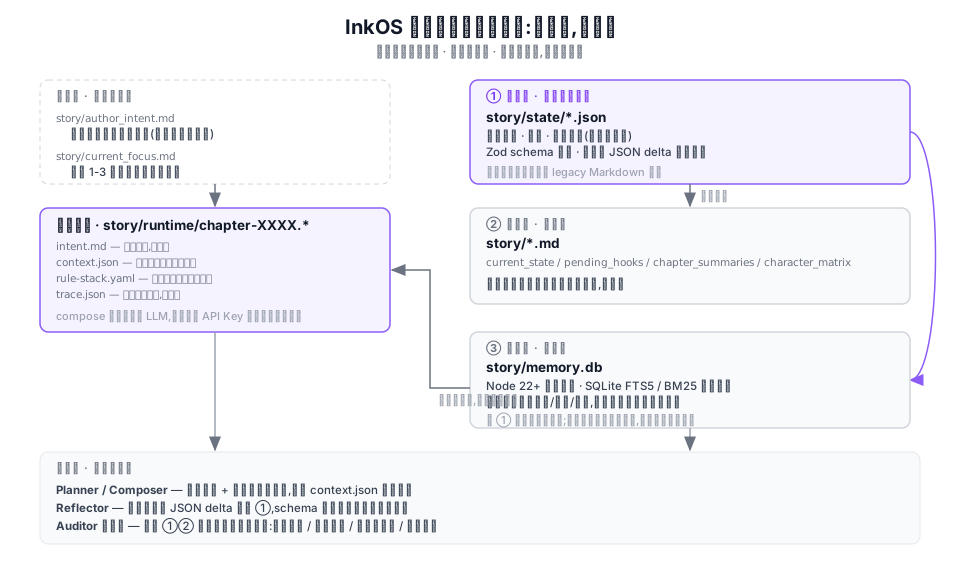
Three memory layers, one job each:
| Layer | Form | Responsibility |
|---|---|---|
| Authoritative | story/state/*.json |
Single source of truth: state, foreshadowing, chapter summaries, Zod-validated |
| Projection | story/*.md |
Human-readable copies: current_state.md, pending_hooks.md, character_matrix.md, … |
| Retrieval | story/memory.db |
SQLite temporal memory, FTS5 / BM25 relevance retrieval, avoids full injection |
This layering echoes the knowledge-layer/memory-layer split I explored in fitting three AI agents with one shared brain, but InkOS commits to it more thoroughly: there is exactly one authoritative copy, projections are generated from state, and the index can be rebuilt from raw files at any time — "raw files remain the source of truth; the index is rebuildable; retrieval results carry source and position."
Input governance: guardrails get compiled before writing. Every book carries two long-lived editable control documents (author_intent.md: what this book wants to be long-term; current_focus.md: what the next 1–3 chapters should focus on), compiled per chapter into runtime artifacts:
inkos plan chapter my-book --context "pull the focus back to the master-disciple conflict"
inkos compose chapter my-book
# → story/runtime/chapter-XXXX.intent.md       for humans
# → story/runtime/chapter-XXXX.context.json    what actually entered context
# → story/runtime/chapter-XXXX.rule-stack.yaml rule priority and overrides
# → story/runtime/chapter-XXXX.trace.json      input compilation trace, debuggable
Brief, volume outline, book-level rules, and the current task no longer blob together into one prompt; they get compiled first — reviewable and debuggable. One especially smart touch: compose requires no online LLM, so you can validate input governance before configuring any API key — separating "are the control inputs right" from "is the output good" and testing them independently.
De-AI-flavor lives at this layer too. The writer's prompt embeds vocabulary-fatigue word lists, banned sentence patterns, and style fingerprints (inkos style analyze extracts sentence-length distributions, word-frequency features, and rhythm from a reference text; style import injects the fingerprint into a book). The audit includes a dedicated AI-flavor dimension (high-frequency words, monotone syntax, over-summarization), and revise --mode anti-detect does targeted rewriting. For a production line whose output must survive platform AIGC detection, this isn't garnish — it's a requirement.
Write-Time Validation: The Reliability Divide
The layers above are about organizing context; this is where InkOS genuinely pulls ahead: bad data is rejected before it's written, not discovered after it breaks something.
The mechanism, unpacked: Reflector no longer asks the model to emit a complete markdown state file; it emits a JSON delta. Code applies it via applyRuntimeStateDelta (immutable update), then runs validateRuntimeState for Zod structural validation — lastAdvancedChapter on a foreshadow must be an integer, status must be one of open / progressing / deferred / resolved; anything else is rejected outright instead of snowballing. Draft, state, foreshadowing, and run snapshots are validated inside a chapter workspace first, then atomically committed — the "state advanced but draft not saved" half-state is structurally impossible.
The same philosophy runs through every corner:
- Per-chapter state snapshots + rollback:
inkos write rewriterolls back any chapter; file locks guard concurrent writes; - Reserved-key filtering:
INKOS_LLM_EXTRA_*env vars can never override core request params likemax_tokens,temperature,model,messages, orstream; - Model-ownership validation:
--service google --model kimi-k2.5fails fast — the request is never sent; - Two-track config isolation: Studio uses only its service config and
.inkos/secrets.json; env overrides apply to CLI / daemon / deployment only — the two paths never pollute each other, and API keys never land ininkos.json; - Honest word-count governance:
--wordsis a target, not a promise; the system derives an allowed range, applies at most one corrective normalization pass, and never hard-truncates. Still out of range after that? The chapter saves anyway, with a warning and telemetry — no pretending it hit the mark.
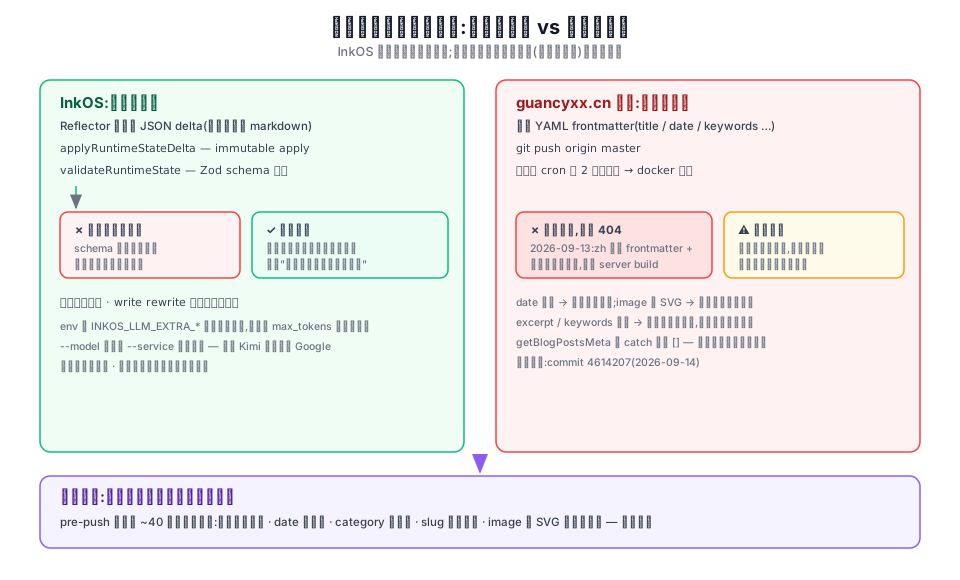
The right half of that diagram is not a strawman — it's this site's own recent incident, next section.
Placing It in the Coordinate System: Against What, on Which Axes
First, why these dimensions: in long-form creation, failure cost compounds with length — a setting collapse at chapter 200 costs far more than a single-generation quality blemish. So consistency, context organization, and recoverability matter more than "peak intelligence," and the comparison revolves around those three.
| Generic chat writing | Generic agent frameworks | Coding harnesses (Codex-class) | InkOS | |
|---|---|---|---|---|
| State consistency | Rides the context window, decays with length | Assemble it yourself | The filesystem is the state | Zod state machine with atomic deltas |
| Context organization | Paste everything | Design it yourself | Repo retrieval + rules | Compiled (context.json + rule-stack) |
| Failure recovery | Start over | Design it yourself | git | Per-chapter snapshots + rollback + atomic commits |
| Domain depth | None | None | Coding-specific | Web-novel / screenplay / interactive-narrative specific |
| Onboarding cost | Zero | High | Medium | Medium (one npm install, Node 22+) |
My position: if your unit of output is a "chapter" — needing cross-chapter consistency, months of serialization, rollback at any point — InkOS is the only one of the four designed for that failure mode. If your output is "one answer," its complexity is pure dead weight; don't touch it.
Multi-Dimensional Scorecard
| Dimension | Score | Reasoning |
|---|---|---|
| Architecture design | 9/10 | Four surfaces, one execution core; pipelines demoted to callable deterministic capabilities; the agent loop delegated to pi instead of reinvented — energy spent on domain state |
| Reliability engineering | 9/10 | Write-time validation / atomic commits / snapshot rollback / reserved-key filtering — systematic and mutually reinforcing; the high-water mark among comparable open-source projects |
| Context engineering | 8.5/10 | Three-layer memory + input governance is the most complete public design; docked for the absence of quantitative effect evaluations |
| Product maturity | 7/10 | doctor diagnostics / EPUB / daemon / multi-surface entry all present; docked for 233 open issues and a steep config surface — the provider-bank compatibility table is itself evidence of the burden |
| Ecosystem & monetization | 6.5/10 | npm + ClawHub distribution and first-batch Kimi partnership are assets; the density of sponsorship and affiliate links in the README now outweighs the engineering narrative |
| Sustainability | 6/10 | Bus factor of 6 contributors; three weeks without a commit as of 2026-09-14 — a clear watch-signal for a production-depended system |
Mapping It onto guancyxx.cn: Four Recommendations and One Warning
This site is a Next.js 14 statically-generated bilingual blog: content lives in content/blog/<lang>/<category>/<YYYY-MM>/<slug>.md, frontmatter is handwritten, and after git push a server cron pulls and rebuilds the container every two hours. A completely different scale of system from InkOS — but as a content pipeline it's isomorphic: both have authoritative data (frontmatter vs story state), a validation-timing question, and a quality-audit stage. Side by side:
| Dimension | InkOS | guancyxx.cn content pipeline |
|---|---|---|
| Authoritative data | story/state/*.json + Zod |
Handwritten YAML frontmatter |
| Validation timing | Write time (validate delta, then atomic commit) | Deploy time (next build) — or never |
| Retrieval / memory | SQLite FTS5 / BM25 | None; internal links rely on human memory |
| Quality audit | 37 dimensions + bounded revision | A writing-standards checklist (executed by humans/agents) |
| Rollback | Per-chapter snapshots | git (sufficient) |
Recommendation 1: Move frontmatter validation from deploy time to commit time (highest ROI — do it first)
Yesterday's real incident: on 2026-09-13 the Chinese daily briefing shipped without its frontmatter, duplicate briefing files appeared at the repo root, and the server build stayed blocked until commit 4614207 (2026-09-14) fixed it. The error was discovered when "the server build failed" — the most expensive discovery point in the entire pipeline.
The sneakier problem is lenient degradation on the read side. Look at the actual code in src/lib/blog.ts: normalizeKeywords quietly returns [] for any invalid input; normalizeImage silently returns null for SVG paths (falling back to the default card image); an invalid date doesn't error — the post "sinks to the bottom of the list"; and getBlogPostsMeta's catch returns [] — an entire post vanishes without raising. Each leniency is individually reasonable; together they postpone errors to the most expensive, hardest-to-locate moment. InkOS's counter-principle is one sentence: bad data is rejected before it's written. Concretely, that's a zero-dependency pre-push script, roughly 40 lines:
// scripts/validate-posts.ts (sketch)
const REQUIRED = ['title', 'date', 'category', 'keywords', 'excerpt', 'author'];
for (const file of allPostFiles()) {
  const { data } = matter(read(file));
  const missing = REQUIRED.filter(k => !data[k]);
  if (missing.length) fail(file, `missing fields: ${missing.join(', ')}`);
  if (isNaN(new Date(data.date).getTime())) fail(file, 'date is not parseable');
  if (!['ai', 'tech', 'business', 'news'].includes(data.category)) fail(file, 'category out of bounds');
  if (/\.svg$/i.test(data.image ?? '')) fail(file, 'image points at an SVG; the card will fall back');
  // zh/en slug pairing: content/blog/zh/**/foo.md must have an en sibling
}
Recommendation 2: Add a structured index — internal links shouldn't depend on human memory
Internal linking is this site's only compounding SEO action, yet it depends on the author remembering what was written where. InkOS's principle — "raw files are the source of truth; the index is rebuildable" — applies directly: generate a content index at build time (slug / title / date / category / keywords / summary), feed link candidates by keyword overlap during writing, and let archive pages and future site search consume the same data. Note the scale judgment: 174 posts × 2 languages means JSON + keyword overlap is enough; SQLite is unnecessary. Steal the principle, not the implementation scale.
Recommendation 3: Deterministic audits first, LLM judgment second
Nearly half the items in this site's writing-standards checklist are deterministically decidable: clichéd openings ("This article will…" / "With the rapid development of…"), quantified numbers without timestamps, a missing references section, zero internal links, wrong author field, image pointing at an SVG. Those should be upgraded from "remind the human" to "the script rejects the commit" — they require no intelligence, only enforcement. InkOS's 37-dimension audit follows the same logic: everything codeable gets coded; only what needs taste (narrative pacing, emotional arcs) is left to models and humans. Handing deterministic checks to a script has a side benefit: scripts don't hallucinate, and they don't get tired.
Recommendation 4: Bound the automation — aim for "audit → one revision → human"
This site's daily briefing is already fully automated (scheduled generation, commit, deploy), and the blog flow is "agent drafts → checklist → human reviews, then push." That's structurally the same as InkOS's "audit → at most one revision → human," so the direction is right; the only gap is the deterministic gate from Recommendation 3. Equally important is what not to copy: a ten-role pipeline and SQLite retrieval would be negative assets here — our bottleneck is quality and judgment, not throughput. Bounded automation isn't laziness; it's defense against unlimited auto-repair making things worse.
One warning, and an interesting convergence
The warning: InkOS is AGPL-3.0. Installing it locally to write novels is fine — AGPL obligations don't infect your work. But copying its validation code into anything that serves users over a network? Talk to a lawyer first. Steal the patterns, not the code.
The convergence: in v1.8.0, InkOS dropped its private skill protocol and adopted standard SKILL.md files as its professional-capability extension — skills provide instructions and reference material only, add no execution permissions, and file creation, writes, and image generation stay behind tools and confirmation gates. Meanwhile, this site's own content production runs on workflows written as SKILL.md files. Two independently evolved systems converged on the same answer: Markdown control documents + deterministic gates + human confirmation to manage unreliable model output. That says more about the Agent Skills format becoming a de facto standard than any single feature could.
Risks and Limitations
- Maintenance load: 233 open issues against 6 contributors; as of 2026-09-14, three weeks since the last commit (2026-08-25). For a system people run in production, that's a signal worth watching. Sponsorship revenue (Kimi, Volcengine) is a plus for sustainability, but the density of affiliate links in the README hints the commercial pressure isn't light either.
- Token cost: every chapter passes through ten roles, each with at least one full model call. The very existence of multi-model routing (Claude for the writer, a cheap model for the auditor, a local model for the radar) is proof the cost is real. Chapter-by-chapter billing adds up — do the math first.
- Numbers that can't be independently verified: "37 audit dimensions," "15 built-in skills," "~25 universal writing rules" are all self-declared in the README, with no public quantitative evaluation of effect. This article is a static analysis based on the v1.8.0 README, repository structure, and GitHub/npm API data — no long-running hands-on testing. That's the boundary of this analysis, stated up front.
- A harness guarantees the floor, not the ceiling: write-time validation keeps state from getting worse, but each chapter's prose ceiling is still set by the foundation model. The state machine cures drift, not mediocrity.
Conclusion
InkOS is a textbook specimen of the "vertical agent harness": it doesn't bet on models becoming reliable — it cages unreliable output inside propose → validate → atomically persist → audit → bounded-revise, converting the deadliest failure of long-form creation, state drift, into an engineering problem with rollback.
Three concrete recommendations, by reader: writers (especially long-form continuation and importing existing works) should install it — npm i -g @actalk/inkos, Node 22+; engineers should read it as a harness-design textbook, stealing three things above all — write-time validation, compiled context, deterministic-audit-first; anyone considering commercial integration should clear the AGPL question first. For this site, the four recommendations by ROI: the frontmatter validation script first (the tuition for one incident has already been paid), the content index second, prose-lint third, and the bounded-automation principle folded into daily practice. This week's first task: those 40 lines.
References
- Narcooo — InkOS GitHub repository (AGPL-3.0; as of 2026-09-14: 9,754 stars / 1,796 forks / 233 open issues / 1,541+ commits / 6 contributors)
- Narcooo — InkOS README (Chinese, v1.8.0) (last consolidated 2026-08-17)
- @actalk/inkos — npm (4,381 downloads, 2026-08-13 to 2026-09-11)
- Mario Zechner — pi-mono: the agent runtime foundation under InkOS
- Galen Guan — The Big-Tech Agent Harness Showdown: Codex, DeepSeek dsh, Grok Build (2026-08-22)
- Galen Guan — Fitting Three AI Agents with One Shared Brain: TencentDB Agent Memory Knowledge Layer (2026-08-25)
- Galen Guan — Google Enters Agent Skills: A Format Winning the De-Facto-Standard War (2026-08-10)
- guancyxx.cn commit 4614207 — "fix: remove root-level duplicate briefings, add missing frontmatter to 09-13 zh" (2026-09-14)