nanobot Deep Dive: How an Open-Source AI Agent Reached 45K Stars in 6 Months
If you track only one open-source AI Agent project in 2026, it should probably be nanobot. First commit on February 1. By mid-July: 45,777 stars, 8,081 forks, contributors from 20+ countries, documentation in 10 languages, and active communities on Discord, Feishu, and WeChat. This isn't "yet another agent framework" — it's a phenomenon.
The team behind it is HKUDS (University of Hong Kong Data Science Lab). MIT licensed. pip install nanobot-ai gets you a self-hosted AI Agent runtime with native support for CLI, WebUI, Telegram, Discord, Slack, WeChat, Feishu, Email, and Mattermost — nine channels in total.
But stars measure popularity, not quality. This article dissects nanobot at three levels — architecture, core mechanisms, and ecosystem positioning — with an honest assessment of strengths and weaknesses, plus a side-by-side comparison against Hermes Agent.
1. Architecture: One Loop, Two Faces
nanobot's architectural philosophy is "centralized Loop + pluggable peripherals." The core is only ~76,000 lines of Python, yet it supports 892 files and 213 modules forming a complete agent system.
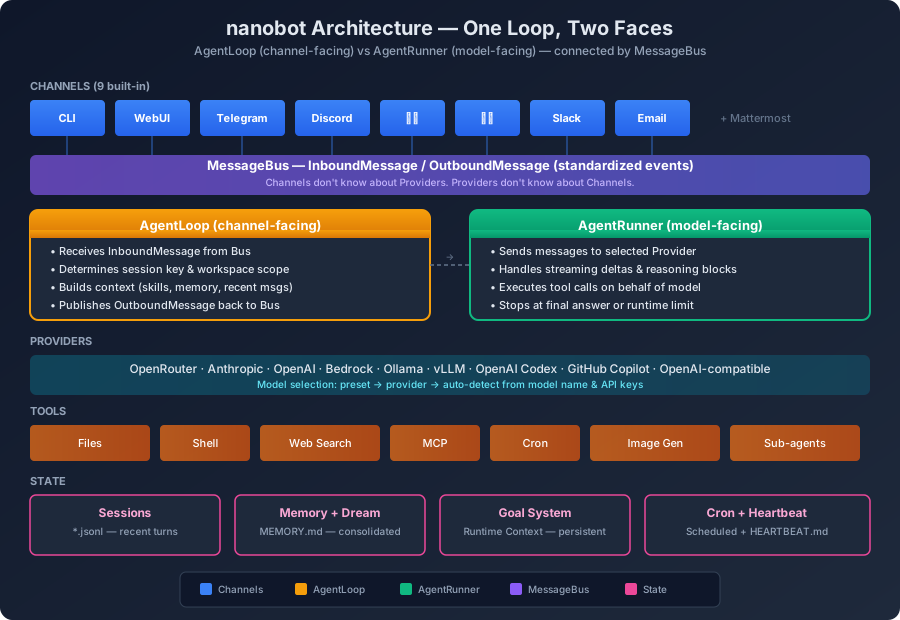
The Key Split: AgentLoop vs AgentRunner
This is nanobot's most important design decision — splitting the agent's core loop into two independent components:
| Component | Responsibility | Key File |
|---|---|---|
| AgentLoop | Channel-facing: receive messages → select session → build context → send replies | nanobot/agent/loop.py |
| AgentRunner | Model-facing: call Provider → handle streaming/reasoning → execute tools → return results | nanobot/agent/runner.py |
Why this split? Because "where messages come from" and "how messages are processed" are independent dimensions of change. Adding a new channel (say, Matrix) only touches the Loop side. Adding a new provider (say, Grok) only touches the Runner side. This separation exists in Hermes Agent as well, but nanobot enforces it as an explicit architectural constraint — AgentLoop and AgentRunner are independent classes, sharing no state, communicating only through MessageBus InboundMessage / OutboundMessage events.
Practical impact: When a Telegram user and a WebUI user talk to the same agent simultaneously, two AgentLoop instances run in parallel, but they share the same underlying AgentRunner — model calls, tool execution, and memory reads all use the same logic. This means behavioral consistency is guaranteed by architecture, not by configuration conventions.
2. The Goal System: How nanobot Remembers What It's Doing
The /goal feature introduced in v0.2.0 is nanobot's most underrated capability.
The Problem
Anyone who has used an AI Agent for long-running tasks knows: the agent starts fixing a bug, and by the fourth file, it's forgotten what it was supposed to do. Not because the model is dumb — because the context window is finite. Earlier messages get compacted, and task intent gets lost in the summarization.
nanobot's Solution
/goal marks the current thread as a sustained objective. Once activated:
- Goal description is locked in Runtime Context — immune to compaction, undiluted by subsequent turns
- Timeout auto-extends — normal agent turns have a wall-clock timeout; under Goal mode, it degrades to an idle timeout: the model won't be killed mid-thought or mid-tool-execution
- Explicit completion signal — the Goal persists until the user calls
complete_goalor the agent determines the objective is achieved
This design directly addresses the three most painful problems in long-running agent tasks: context loss, premature timeout, and goal drift.
Comparison with Hermes
Hermes Agent has no explicit Goal concept. Its "long task" capability relies on:
- Session compaction: old messages get summarized, but critical task information can be lost in the process
- Memory persistence: writing task objectives to MEMORY.md, but this is coarse-grained — Memory is injected on every turn without differentiation
- Cron job continuation:
attach_to_sessionenables intermittent execution, but requires manual user replies to push forward
nanobot's Goal system is more elegant: it decouples "task objective" from "conversation history." Goal is a persistent object independent of session history, with its own lifecycle. This points toward an important evolution in agent architecture — future agents won't be "chatbots," they'll be "task executors with conversational interfaces."
3. Dream Memory: Periodic Self-Consolidation
nanobot's memory system has two layers:
| Layer | Storage | Purpose |
|---|---|---|
| Session | <workspace>/sessions/*.jsonl |
Recent conversation turns, replayed directly into context |
| Memory | <workspace>/memory/MEMORY.md + history.jsonl |
Long-term memory, persistent across sessions |
Dream is the bridge — a periodic job (similar to cron) that reads accumulated history.jsonl, uses an LLM to extract key facts, and updates MEMORY.md.
Comparison with Hermes Memory
| Dimension | nanobot (Dream) | Hermes Agent |
|---|---|---|
| Memory writes | Async (Dream triggers periodically) | Sync (tool calls write immediately) |
| Memory types | Single MEMORY.md | Dual: MEMORY.md (environment) + USER.md (preferences) |
| Retrieval | Full-text injection into context | FTS5 semantic search + context injection |
| Deduplication | Dream batch dedup | Operation-level dedup (replace/remove) |
| Write trigger | Time-driven | Event-driven (tool calls) |
Both approaches have merit:
- Hermes's event-driven approach excels in high-frequency interaction — user says "remember this," immediate write, effective next turn
- nanobot's Dream async approach excels in long-running scenarios — avoids per-turn memory writes, reduces token consumption, but memory takes effect with a delay
Practical recommendation: Production-grade agents should support both modes. Critical preferences use event-driven writes ("remember my name is John"). Non-critical context uses async Dream cleanup ("what projects am I working on lately").
4. Multi-Channel Design: Agent as Message Router
nanobot natively supports nine channels: CLI, WebUI, Telegram, Discord, Slack, Feishu, WeChat, Email, and Mattermost.
Channels Are Core Architecture, Not Plugins
Each channel implements BaseChannel, translating platform-specific protocols into unified InboundMessage / OutboundMessage events. The Agent Loop doesn't know whether a message came from Telegram or WeChat — it only sees standardized message objects.
This design ensures complete behavioral consistency across channels. What you say in Telegram gets the same agent response as what you type in the WebUI. Tool execution, memory reads, Goal tracking — channels are just "entry points," not independent agent instances.
Channel Session Isolation
Each channel's messages map to independent session keys, ensuring conversations across platforms don't interfere. But unifiedSession mode is also supported — single-user multi-device scenarios can share one session.
5. Ecosystem Analysis: Whose Market Is nanobot Eating?
| Competitor | nanobot's Edge | nanobot's Gap |
|---|---|---|
| Open WebUI + Pipelines | Easier install (one command), native multi-channel, Goal system | Open WebUI has more mature frontend, larger community |
| LangChain/LangGraph | Actually runnable, not just a framework | LangChain has richer ecosystem, more enterprise integrations |
| CrewAI / AutoGen | Better single-agent experience, lighter deployment | Multi-agent collaboration isn't nanobot's focus |
| Claude Code / Cursor | Open-source, self-hostable, model-agnostic | IDE integration and code generation accuracy gap is significant |
| Hermes Agent | Open-source + community + WebUI + multi-channel | Skill system depth, cron granularity, native WeChat integration |
nanobot's most direct competitor is Hermes Agent — their feature sets overlap heavily (multi-channel, memory systems, scheduled tasks, skill systems, sub-agents). But nanobot's open-source + community strategy gives it a natural advantage with developers, while Hermes's closed-source + deep integration strategy creates higher stickiness for enterprise and power users.
6. Selection Guide
Choose nanobot if you:
- Want an out-of-the-box open-source agent without vendor lock-in
- Need broad channel coverage (especially WeChat + Feishu + Telegram)
- Have Python-capable team members who want to customize channels or tools
- Value community velocity and rapid iteration
Choose Hermes Agent if you:
- Need deep skill system (atomic/molecular/compound hierarchy, script execution, chained dependencies)
- Depend on fine-grained cron jobs (script mode
no_agent, context injection chains, per-job model selection) - Need FTS5 cross-session semantic search (
session_searchis currently unique) - Accept closed-source but require production-grade stability and enterprise support
Using Both Together
It doesn't have to be either/or. nanobot's Goal system design, Dream async memory pattern, and Heartbeat mechanism are all directions Hermes can learn from. Conversely, Hermes's skill system, cron job granularity, and session_search are areas where nanobot is currently behind but can catch up.
Conclusion
nanobot isn't "yet another agent framework" — it's a watershed moment for the open-source AI Agent ecosystem in 2026. It proves three critical propositions:
- Self-hosted agents can have near-zero barriers to entry —
curl | sh, one command, usable by non-technical users - Multi-channel support doesn't have to be an afterthought — channels are first-class citizens in the core architecture, not plugins
- Goal systems are the correct direction for long-running agent capability — decoupling "task objective" from "conversation history"
Its limitations are also clear: v0.2.x maturity, skill system depth, cron granularity, and memory retrieval capabilities all have a long way to go. But at the current iteration velocity (dozens of PRs per week), these gaps could narrow significantly within 2–3 releases.
Our take: If you're deploying a team-facing open-source AI Agent in H2 2026, nanobot is the current default choice. If you're already on Hermes Agent with deeply customized skills and cron pipelines, there's no reason to migrate — but pay attention to nanobot's Goal system and Dream pattern. They represent two important evolutionary directions for agent architecture.
References
- HKUDS/nanobot GitHub Repository — 45,777 stars, as of 2026-07-17
- nanobot Official Documentation — available in 10 languages
- nanobot Architecture Documentation
- nanobot Concepts Documentation
- nanobot v0.2.2 Release Notes — 2026-06-23
- nanobot PyPI Page