Seed-Audio Deep Dive: How ByteDance's 'Audio World Model' Generates Complete Voice Scenes from a Single Prompt
You've probably used AI to generate speech before. Type some text, pick a voice, get a reading. That works fine — but what if you need six characters having a conversation in a getaway van on a rainy night, with engine idle, rain on the roof, and distant sirens building? Traditional TTS falls apart completely.
This is the problem Seed-Audio 1.0 sets out to solve. It's not "text-to-speech" — it's text-to-audio-scene.
In late June 2026, ByteDance officially launched Seed-Audio 1.0 through Doubao/Volcengine, while third-party platform EvoLink integrated the model and published API documentation and a curated use-case repository. As of July 2026, its predecessor Seed-TTS's evaluation toolkit has garnered 1,569 stars on GitHub, and Seed-Audio itself is rapidly penetrating the creator toolchain through API access.
The Seed Family: From TTS to Audio World Model
To understand Seed-Audio, you have to go back to its origin — the Seed-TTS paper (arXiv:2406.02430) from June 2024.
Seed-TTS is a family of large-scale autoregressive TTS models released by ByteDance's Seed team (the same team behind Seed-Coder, DAPO, and Depth Anything 3). The paper makes three core contributions:
-
Speech In-Context Learning: The model can learn a speaker's timbre, prosody, and style from reference audio samples, achieving near-human speaker similarity and naturalness in zero-shot scenarios.
-
Self-Distillation for Speech Factorization: A self-distillation method that decomposes speech into independently controllable factors — content, timbre, prosody — enabling fine-grained control over emotion, speed, and pitch.
-
Seed-TTS_DiT: A fully diffusion-based non-autoregressive variant that doesn't depend on pre-estimated phoneme durations, achieving end-to-end speech generation and editing.
But when the Seed-TTS paper was published, ByteDance explicitly stated that due to AI safety considerations, they would NOT release model weights or source code, only the evaluation toolkit and test set. Seed-TTS was a closed-source commercial path from day one.
Two years later, Seed-Audio 1.0 emerges as the productized result of that path. It's no longer just a TTS model — it's a multimodal audio generation system.
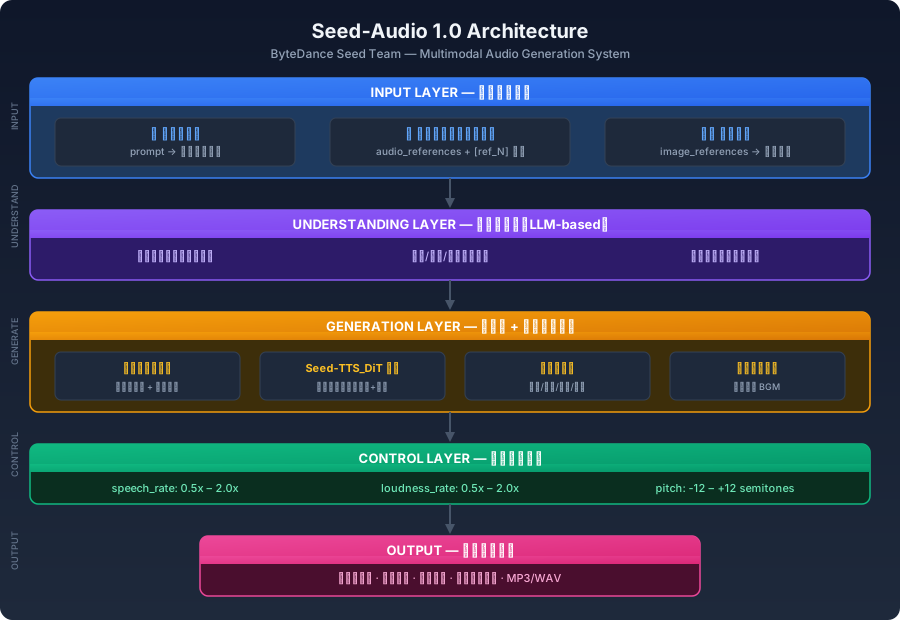
| Layer | Component | Capability |
|---|---|---|
| Input | Text Prompt + Reference Audio/Image | Natural language description of scenes, characters, emotions; optional reference audio for voice cloning, or reference images to guide audio mood |
| Understanding | Instruction Interpreter (likely LLM-based) | Parses character assignments, dialogue structure, emotion directives, and sound effect descriptions from the prompt |
| Generation | Autoregressive + Diffusion Hybrid Architecture | Multi-character voice generation, ambient sound synthesis, background music generation — single inference pass produces complete audio |
| Control | speech_rate / loudness_rate / pitch | Speed 0.5-2x, loudness 0.5-2x, pitch ±12 semitones, precise to two decimal places |
Three Generation Modes: From Narration to Scene
Seed-Audio 1.0's API design exposes three generation modes, auto-switched based on which reference resources you pass:
Mode 1: Text-Only Generation
Pass only prompt, no reference resources. The model generates voice freely.
{
  "model": "doubao-seed-audio-1-0",
  "prompt": "Welcome to the audio generation service. The weather is lovely today.",
  "format": "mp3"
}
This is the basic mode, suitable for simple narration, commentary, and voice assistant scenarios.
Mode 2: Reference Audio (Voice Cloning)
Pass an audio_references array, mixing preset voice IDs and reference audio URLs. Use [ref_N] markers in the prompt to reference the Nth audio resource.
{
  "model": "doubao-seed-audio-1-0",
  "prompt": "[ref_1]: Are you sure about this?\n[ref_2]: I don't have a choice. Engine idling, rain on the roof, distant sirens approaching.",
  "audio_references": [
    "zh_female_vv_uranus_bigtts",
    "https://example.com/reference_voice.wav"
  ]
}
This is Seed-Audio's core capability — multi-character dialogue scene generation in a single API call. Up to 10 reference audio items, each clip within the duration limit. Reference audio and reference images are mutually exclusive per request.
Mode 3: Image-Guided
Pass image_references, and the model generates audio matching the image's mood. The prompt only needs text content — no need to describe emotions, as the model infers them from the image.
{
  "model": "doubao-seed-audio-1-0",
  "prompt": "She pushed open the door and walked into the room she'd left ten years ago.",
  "image_references": ["https://example.com/old_room.jpg"]
}
288 Voices: From News Anchor to Yandere Brother
Seed-Audio 1.0 provides 288 preset voices across two categories:
General Voices (~270): Primarily Chinese, covering Japanese, Indonesian, Mexican Spanish, and dialects including Sichuanese, Shaanxi, and Northeastern Mandarin. From news broadcasting (zh_female_vv_uranus_bigtts) to coquettish schoolgirl (zh_female_sajiaoxuemei_uranus_bigtts), from Sun Wukong (zh_male_sunwukong_uranus_bigtts) to Peppa Pig (zh_female_peiqi_uranus_bigtts), the coverage is extraordinarily broad.
ICL Character Voices (~15 English + ~100 Chinese): This is the most fascinating part of Seed-Audio. English ICL voices include Charlie (American female), Ethan (American male), Alastor, Chucky, Jigsaw, The Grinch, Kevin McCallister, and more. The Chinese ICL voices form a complete "web novel character voice library" — tsundere girlfriend, domineering CEO, yandere brother, cold-faced senior, gentle male deskmate, scheming young master... covering virtually every character archetype in Chinese audiobooks and audio dramas.
All preset voices support controlling emotion, tone, and style through natural-language prompts. Chinese voices can also read English text.
Real-World Use Cases: From Six-Character Getaway to Audio-First Video Pipelines
The EvoLink team curated 11 high-quality use cases (filtered from 93 X/Twitter posts), covering Seed-Audio's primary application scenarios:
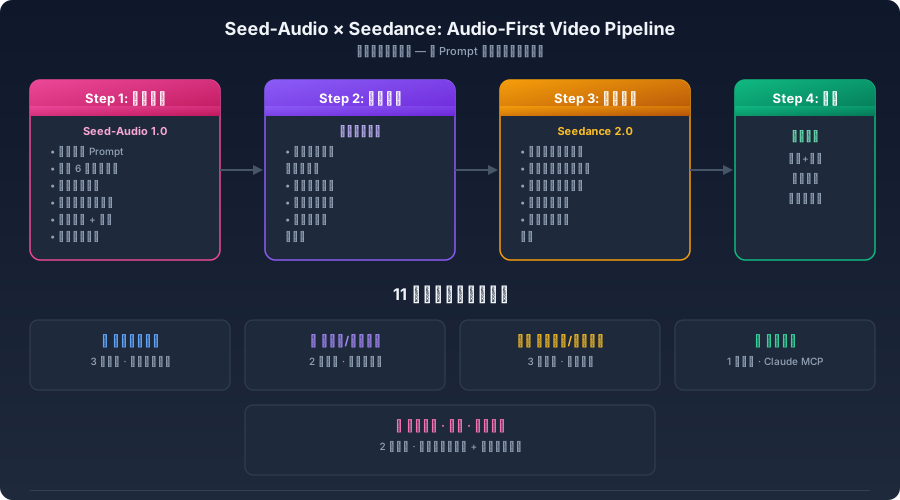
Case 1: Six-Character Getaway Van Scene (@gokayfem)
A single prompt generates dialogue for six named characters + engine idle + rain on the roof + background effects. This audio then guides key visual generation, which feeds into Seedance 2.0 for video. This is an audio-first video pipeline — audio drives the entire scene's rhythm and emotion, rather than being dubbed in after the video is done.
Case 4: Two-Minute Dialogue Drama (with Ambience)
Script-format prompts including environment descriptions, character voice directions, background music, and line-level performance direction. Single generation produces a complete two-minute dialogue scene.
Case 7: Claude MCP Voiceover Integration
Routes voiceovers, voice cloning, and multilingual dubbing through Claude via Higgsfield MCP, with Seed-Audio 1.0 as part of the audio stack — an agent-native workflow.
Case 11: Low-Cost Voice Acting and Foley Testing
Uses Seed-Audio as a low-cost test layer for voice acting and foley — generate reference audio before booking studio time, validating dialogue rhythm, character interaction, and sound design.
Comparison with Similar Products
| Dimension | Seed-Audio 1.0 | ElevenLabs | OpenAI TTS | Fish Audio | CosyVoice | ChatTTS |
|---|---|---|---|---|---|---|
| Multi-character single generation | ✅ 6+ chars | ❌ Single | ❌ Single | ❌ Single | ❌ Single | ❌ Single |
| Ambient/sound effect generation | ✅ Native | ❌ | ❌ | ❌ | ❌ | ❌ |
| Preset voice count | 288 | ~50 | 6 | ~100 | ~20 | ~10 |
| Voice cloning | ✅ Ref audio | ✅ | ❌ | ✅ | ✅ | ❌ |
| Image-guided generation | ✅ | ❌ | ❌ | ❌ | ❌ | ❌ |
| Open source | ❌ API only | ❌ API only | ❌ API only | ✅ Open | ✅ Open | ✅ Open |
| Chinese support | ⭐⭐⭐ Native | ⭐⭐ | ⭐⭐ | ⭐⭐ | ⭐⭐⭐ | ⭐⭐⭐ |
| Dialect support | ✅ 3 dialects | ❌ | ❌ | ❌ | ❌ | ❌ |
| Video pipeline integration | ✅ Seedance | ❌ | ❌ | ❌ | ❌ | ❌ |
| Pricing | Usage-based | $5-99/mo | $15/1M chars | Free/usage | Free | Free |
Seed-Audio has no direct competitor in four dimensions: multi-character scene generation, ambient sound effects, image-guided generation, and video pipeline integration. Its core differentiator isn't "better audio quality" (ElevenLabs still excels at single-character naturalness) — it's a paradigm shift in generation, from "read this text aloud" to "direct this audio scene."
Ratings
| Dimension | Score | Rationale |
|---|---|---|
| Technical Innovation | 9/10 | Speech in-context learning + self-distillation factorization + DiT diffusion — paper-level innovation |
| Multi-Character Capability | 9/10 | Six-character dialogue + effects in a single generation, currently unmatched |
| Voice Diversity | 9/10 | 288 presets + character voice library covering web novel/audio drama archetypes |
| Chinese Quality | 9/10 | Native Chinese + dialects — ByteDance's home turf |
| English Quality | 7/10 | Usable but less natural than ElevenLabs; only 15 English ICL characters |
| Openness | 3/10 | Fully closed-source, API-only, no model weights |
| Ecosystem Integration | 8/10 | Seedance video pipeline + EvoLink + MCP — complete creator toolchain |
| Price Accessibility | 6/10 | Usage-based, no free tier — barrier for small creators |
| Overall | 7.5/10 | The strongest player in multi-character scene generation, but closed-source and pricing limit adoption |
Conclusion
Seed-Audio 1.0's real value isn't "yet another TTS engine" — it's that it redefines the boundaries of AI audio generation. Traditional TTS answers "how should this text be read?" Seed-Audio answers "what does this scene sound like?"
For Chinese content creators — especially audiobooks, audio dramas, short video voiceovers, and game dubbing — Seed-Audio is currently the most complete option. 288 voices + multi-character single generation + ambient sound effects means one person with one prompt can produce content that previously required an entire dubbing team.
But its closed-source strategy is a clear signal: ByteDance doesn't intend to make Seed-Audio open infrastructure. It's a paid capability within the Doubao/Volcengine ecosystem. This means Seed-Audio's capability evolution will be entirely determined by ByteDance's commercial cadence — the community cannot contribute improvements.
Our recommendation: if you need multi-character Chinese audio scene generation, Seed-Audio is currently the only option and worth trying. If you only need high-quality single-character TTS, ElevenLabs or open-source alternatives (CosyVoice, Fish Audio) may be more suitable.
References
- ByteDance Seed Team — Seed-TTS: A Family of High-Quality Versatile Speech Generation Models (arXiv:2406.02430, June 2024)
- BytedanceSpeech — seed-tts-eval (GitHub, 1,569 stars)
- EvoLink — Seed-Audio 1.0 API Documentation
- EvoLink — Seed-Audio 1.0 Voice List
- Evolink-AI — Awesome Seed-Audio 1.0 Guide and Usecases (GitHub)
- @gokayfem — Six-Character Getaway Van Scene Demo (X/Twitter, June 26, 2026)
- @gavinpurcell — Multi-Clip Story Video Audio Planning (X/Twitter, June 25, 2026)
- @EvoLinkAi — Audio-First Seedance Reference Workflow (X/Twitter)