Summarizer Agent Skills: Three Missing Capabilities — Map-Reduce, Keyframe Anchors, and Cross-Source Synthesis
Summarization capability is AI Agent infrastructure. We have youtube-content (transcript to summary), blog-source-content (source to blog), llm-wiki (knowledge digestion), and daily-news-brief (news aggregation), but all share the same bottleneck: reliance on single-pass context window, truncation on long content, inability to fuse multi-source information.
Summarization Projects on GitHub
| Project | Stars | Core Function |
|---|---|---|
| JimmyLv/bibigpt-skill | 73 | Video/audio summarization via BibiGPT CLI |
| keepongo/video-summarizer | 25 | Video subtitle extraction + structured summary + keyframe screenshots |
| specstoryai/agent-skills | 24 | Extract reusable Skill files from execution logs |
| doudouwer/skills-summarizer | 6 | Agent execution logs → Skill extraction |
| HarrisHan/ai-daily-digest | 4 | RSS → scoring → summary pipeline |
| jielou/youtube-summarizer | 3 | YouTube structured interactive summary |
All projects are open-source and free, with no paid API dependencies.
Six Summarization Patterns
-
Map-Reduce: Long document → chunk → summarize each → combine summaries. LangChain classic pattern, the only reliable approach for content exceeding context window.
-
Refine (Iterative Refinement): First chunk generates initial summary, subsequent chunks progressively refine it, preserving contextual coherence. Output quality typically exceeds Map-Reduce but takes longer.
-
Chunking + Overlap: Retain overlapping windows when chunking to avoid semantic breaks. Technical detail but impacts summary quality.
-
Structured Output: Enforce output structure (JSON Schema/Markdown template), e.g., keyframe screenshots + key points + timestamps.
-
Score-then-Summarize: Score and filter first, then summarize high-value content only. ai-daily-digest pattern for cost reduction.
-
Hierarchical: Section-level → document-level, multi-level progressive summarization. Suitable for books, papers with clear structure.
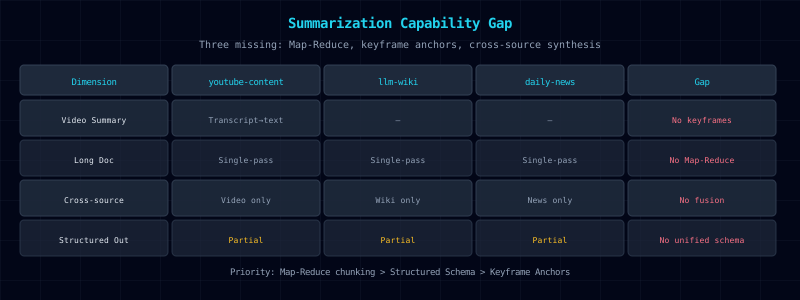
Capability Gap Analysis
| Dimension | Our Existing | Competitor Advantage |
|---|---|---|
| Video summary | youtube-content | keepongo adds keyframe screenshots, timestamp anchors |
| Blog summary | blog-source-content | Roughly equal |
| Knowledge digestion | llm-wiki | PaperPal supports academic paper structured parsing |
| Daily digest | daily-news-brief | ai-daily-digest has RSS scoring + multi-channel push |
| Map-Reduce long docs | Missing | No chunked summarization; relies on single-pass context |
| Execution log summary | Missing | skills-summarizer extracts reusable Skills from logs |
| Cross-source synthesis | Missing | No cross-source (video+blog+paper) comprehensive summary |
| Structured output templates | Partial | Competitors commonly support JSON Schema enforced output |
Three Key Missing Capabilities:
- Map-Reduce chunked summarization — The only reliable approach for long content (books, long papers, complete codebases)
- Keyframe + timestamp anchors — Video summaries can jump to corresponding positions in the original video, significantly improving UX
- Cross-source synthesis — Multi-source information fusion (video + blog + paper + news), producing insights impossible from any single source
Priority and Recommendations
Priority ranking: Map-Reduce > Structured Schema > Keyframe Anchors
Map-Reduce chunked summarization should be implemented first. Simple to implement: chunk → summarize each → combine, no external dependencies. Can be embedded in youtube-content and llm-wiki as a fallback strategy for long content.
Structured output schema second. Unified summary output format (title/key points/citations/tags), enabling downstream skill consumption.
Keyframe anchors require video processing capability (ffmpeg), higher implementation complexity, can be enhanced later.
All three capabilities can be implemented with local LLMs, no paid APIs needed.
Sources:
- bibigpt-skill: https://github.com/JimmyLv/bibigpt-skill (MIT, 73 stars)
- video-summarizer: https://github.com/keepongo/video-summarizer (MIT, 25 stars)
- ai-daily-digest: https://github.com/HarrisHan/ai-daily-digest (MIT, 4 stars)
- youtube-summarizer: https://github.com/jielou/youtube-summarizer (MIT, 3 stars)
- youtube-content: Hermes Agent built-in skill
- llm-wiki: Hermes Agent built-in skill
- daily-news-brief: Hermes Agent built-in skill