Keeping the Face: Character Consistency in AI Short Drama — from Industry Paradigm to Engineering
Anyone building multi-shot AI drama hits the same wall: in shot 1 the heroine's hair, jacket, and face are right; by shot 12 she has a different face. Character drift is the most expensive open problem in AI video today — and short drama gets hit hardest, because an episode has thirty or forty shots and the lead has to read as the same person in every one. Across AI short-drama industry surveys from 2025–2026, the field number for solo creators is 20–30 hours of work per finished minute — and most of that isn't creation, it's maintaining consistency, re-tuning prompts, and regenerating the shots that drifted.
The good news: by mid-2026 this stopped being black magic. The industry has converged on a fairly stable paradigm, and I recently wired it into the copilot pipeline of my own product (magicedit / Magic Canvas). This post covers two things: what the paradigm looks like, and where the real engineering difficulty is once you turn it into a pipeline that runs itself.
The paradigm: fix identity → lock the reference → fan out shots
One sentence captures the mainstream approach today: consistency is locked at step two, not re-argued in every shot. It has three stages:
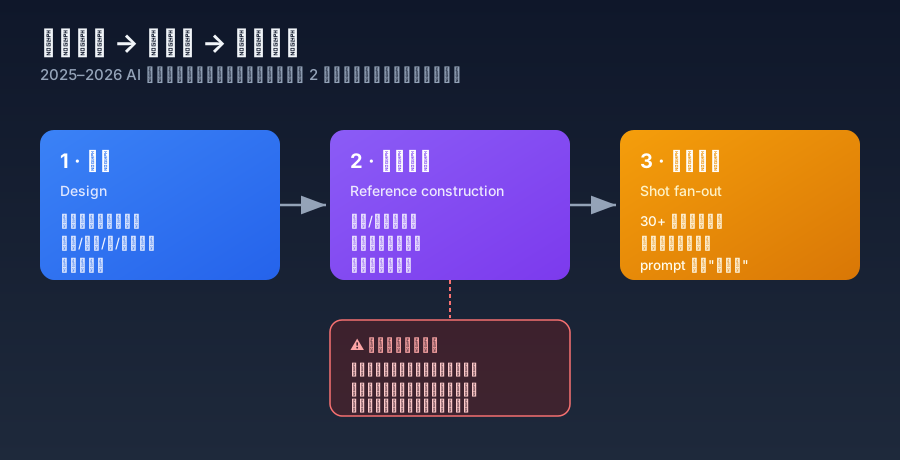
- Design — write the text bible first and lock the identity: face, build, age, hair, signature features. The crucial move is to separate identity from wardrobe — identity is invariant across the whole film, wardrobe changes per scene. Fuse them and the character can't change clothes without changing face.
- Reference construction — freeze that identity into a single reference image (or a set) that becomes the character's "digital identity signature," reused by every shot afterward.
- Shot fan-out — generate 30+ shots in parallel, each referencing the same image; the prompt no longer describes the look, only the motion.
The most counter-intuitive — and most valuable — point in the paradigm: step two is exactly the step most creators skip, and drift starts precisely there. If the reference isn't locked hard, every shot in step three re-imagines "what she looks like" from scratch, and the model improvises fresh each time. The industry compresses the whole consistency trick into one phrase — "character digital-identity binding + multi-angle presetting + style locking" — and all three live in step two.
The reference isn't just any image: from a single portrait to a multi-view model sheet
Default generation hands you one front or 3/4 half/full-body portrait. It's the cheapest anchor, but it only pins one angle — the moment a shot needs a turn, a profile, or a back view, the model invents it, and inventing means drifting.
Two layers of work are missing here.
Layer one is the hard constraints on the reference image. A character reference is an identity anchor, not a shot. If it carries a scene, dramatic lighting, or an exaggerated pose, that pollution rides through the reference into every shot that uses it. The industry spec for a reusable reference is quite specific:
- single subject, no second face in frame;
- front or 3/4 angle, centered, face not cropped;
- soft even lighting, no harsh directional shadows;
- plain neutral backdrop (studio grey), not an environment;
- as high resolution as possible (≥1024 on the short edge).
Scenario's multi-view guidance is even more granular: at least 6 reference images covering front and left/right 3/4, even lighting, with the face occupying 30–50% of the frame. These aren't aesthetic preferences — they're the engineering precondition for i2i/i2v models to read the identity stably.
Layer two is the tier of reference. Beyond the single portrait there's a whole set of "advanced" formats — three-view, four-view, model sheet, expression sheet, pose sheet. More is not better; each tier has an explicit trade-off:
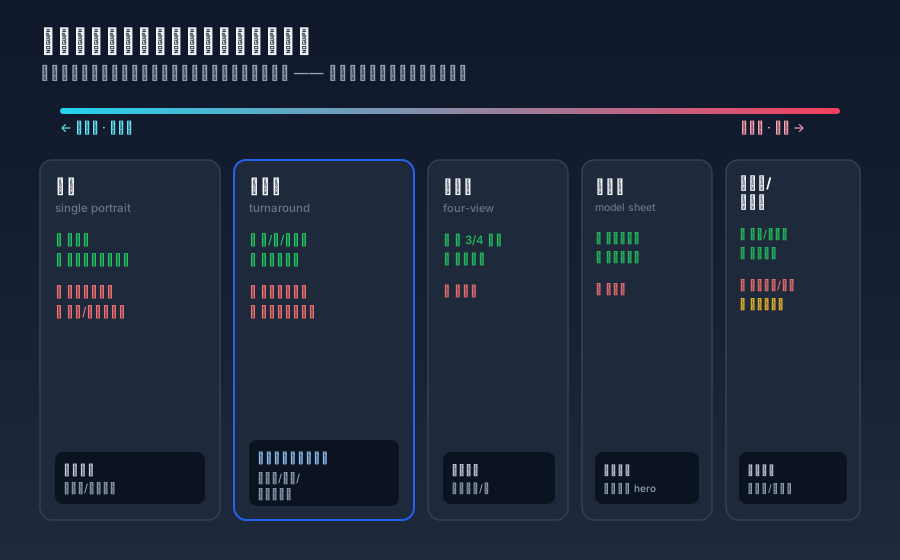
| Sheet | What it is | Pros | Cons | Use when |
|---|---|---|---|---|
| Single portrait | one front/3-4, half or full body | cheapest, all resolution on one face | only one angle; turns/profiles are invented | one-shot / background roles |
| Turnaround (three-view) | front + side + back, full body, plain bg | locks silhouette + proportion + costume all-round; the community-standard anchor | wide canvas thins per-panel resolution, faces shrink | any recurring lead (default) |
| Four-view | three-view + a 3/4 view | the added 3/4 gives i2v an interpolation hinge → smoother turns | more panels, smaller faces | leads that turn/move a lot |
| Model sheet | turnaround + head close-up + prop/costume callouts | the full identity bible page; locks fine props | most complex prompt, most drift-prone | a hero with intricate costume |
| Expression sheet | one head × many emotions | locks the face across dialogue beats; kills face-morph | ignores body/costume; pair with a turnaround | dialogue-heavy / emotional / lipsync roles |
| Pose sheet | same character × several key poses | locks body-in-motion identity and silhouette | small face, not for fine facial lock | fight / dance / sport shots |
There's a handy "four-layer formula" for a turnaround prompt: subject description (concrete down to hair color, features, fabric — the more concrete, the less the model improvises) + view instruction (character sheet, three views, front / side / back view, full body) + style lock (flat color, clean lines, no shadows to kill noise) + layout/format (white background, grid layout). The whole mindset reduces to one line: the more feature points you specify, the less room the model has to improvise.
My practical advice is blunt — don't over-build: single portrait for minor roles; a turnaround for recurring leads; add an expression sheet for dialogue leads; only a hero with complex costume earns a full model sheet. Every extra sheet is another node, another generation, another charge — and more panels shrink each face and make it drift more.
Three technical routes for locking consistency
Once the reference exists, what mechanism welds it into every shot? Three mainstream routes, each with its niche:
| Route | Method | Trade-off | Fits |
|---|---|---|---|
| Training-based | train a LoRA / lock the face with IP-Adapter FaceID | strongest consistency, but needs training cost + assets | leads, recurring, highest-consistency demands |
| Reference-based (i2i) | single/multi reference + img2img, carry the reference into every shot | zero training, cheapest, but still has a luck factor | the 2026 default |
| Multi-subject model | a video model with native multi-subject support | locks several people in one frame, but bounded by model capability | multi-character scenes |
Reference-based is today's default because it needs no per-character training — but the cost is uncertainty: both img2img and image-to-video carry luck, and success often comes from repeated retries. The multi-subject route is advancing fast; for example Vidu's Q2 model claims up to 7 subjects in one frame while holding character, costume, and scene consistent in dynamic scenes (as of 2026).
These three routes solve "how to weld the reference into a shot." But they share one blind spot — the next section.
Locking the reference isn't enough: verify after generation, and expect to regenerate
The paradigm's third stage — "every shot references the same reference" — hides an assumption: the reference image itself is correct. In reality a generation can succeed yet return a different person. Reference-based is especially prone to this; img2img has an inherent drift probability.
So every mature pipeline hides a "verify-then-regenerate" loop. There's a blunt field number for it: roughly 30% of character images / shots need a regeneration to push drift down to acceptable. Treating that as part of the process (budget ~30% for regen) rather than as failure is the line between a professional pipeline and a roll-the-dice one.
The verification is best split into two layers — one cheap, one strict:
- The cheap layer is the nine-panel grid. Compose a shot's nine keyframes on one canvas and the same person naturally stays the same — it's both a consistency mechanism and the cheapest human eyeball checkpoint before video spend. Is it still the same person across all nine panels? If not, fix it upstream rather than burning the far more expensive clip. I wrote about this at length: Why the Nine-Panel Grid Became AI Video's Consistency Workhorse.
- The strict layer is a visual identity check. The grid catches per-shot composition drift, but not "generation succeeded, yet the base reference is simply a different person." That needs a visual language model (VLM) comparing the generated image against the identity spec one attribute at a time — face, build, hair, each signature feature — emitting PASS or which descriptors drifted.
Wiring the paradigm into a pipeline: an auto-building copilot + three gates
Everything above is methodology for a manual creator. What I build is a copilot that lays out nodes on a canvas and generates the short film itself — so the real work is translating the paradigm into rules the copilot can execute automatically. This week I merged it into magicedit's character/shot stages (landed 2026-07-24), and the core is adding three anti-drift gates to the pipeline:
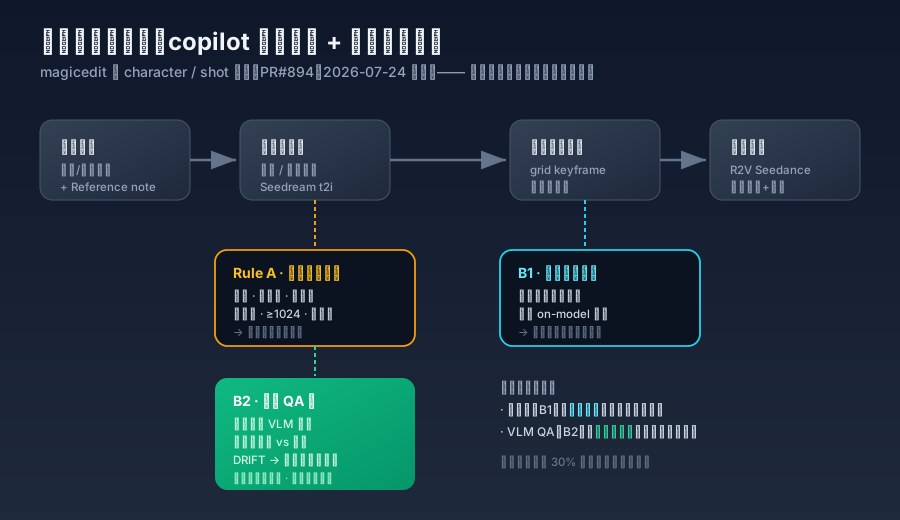
Rule A — hard constraints on the reference image. Previously the copilot generated character images by stuffing the identity description into the prompt without constraining framing/lighting/background — often producing a scene still instead of a clean identity anchor. Now the character-image prompt appends a fixed clause: single subject, plain neutral backdrop, even lighting, face uncropped, ≥1024, explicit negatives (busy background / dramatic lighting / second face / …). And the character bible carries a Reference note: line per character so "single portrait vs multi-view sheet" is decided at design time, not improvised at image time. The multi-view formats (turnaround / four-view / model / expression / pose) live in a dedicated skill leaf so the copilot picks the lightest tier the role needs.
B1 — the nine-panel checkpoint. Reusing the existing keyframe-grid mechanism, made explicit as "the last human on-model check before spending on video": if the character drifts across the nine panels, fix upstream (re-run the character image / re-grid) rather than generating a whole clip on a bad keyframe.
B2 — a runtime VLM identity-QA gate. This is the most deliberate gate and the one that best shows the engineering constraints. After character images are generated and before the shot stage consumes them, the copilot builds a VLM node on the canvas, wiring the generated image and its bible entry into it separately (image into the image field, identity text into the prompt field — an easy trap: two differently-typed inputs must name their target field explicitly, or the identity text gets fed in as a second image and the whole check silently fails), compares attribute by attribute, and emits PASS or DRIFT. On DRIFT it surfaces a regen card pointing only at the drifted nodes.
B2 has two deliberate, non-obvious design decisions worth calling out:
- Never read pixels in the backend — the check must be a runtime node on the canvas. Intuitively, "do these two images look alike" could just run a vision model quietly server-side. But our pipeline is human-in-the-loop, spend-on-confirm: image understanding must land explicitly on the canvas, be run by the user's click, and stay visible and auditable. A backend pixel read both bypasses the cost confirmation and hides "on what grounds did the system call it drift." That constraint ranks high enough that I wrote it into the copilot's hard rules.
- Never auto-regenerate. Regen costs money. DRIFT only lights up a regen card and lets the user choose which nodes to re-run — it does not let the copilot burn a round of credits on its own. One drift is normal (remember the ~30% field number), not a process failure.
Stacked together, the three gates are a defense with clear division of labor: Rule A keeps the anchor itself clean, B2 proves the anchor is actually still the same person, and B1 catches per-shot composition drift at the last cheap moment.
Limits and open problems
Honestly: this suppresses drift, it doesn't eliminate it.
- Reference-based still carries luck. i2i's uncertainty is a model-level property; the pipeline can only backstop it with "verify + regen," and what it can't backstop still needs human retries. A real cure means either stronger models or falling back to training-based (LoRA) — which is too heavy for a copilot that outputs a film from a couple of chat turns.
- Multi-view has a resolution tax. Three/four-view locks identity more completely at the cost of fewer pixels per face. The model sheet holds the most information and is also the most likely to drift during composition. A real trade-off, not a free lunch.
- The VLM judge can misjudge too. Making a vision model the referee means it can flag a correct image as drift or wave through a drifted one. B2 is opt-in and cost-capped today — it lowers the escape probability, it doesn't guarantee zero misses.
- Cost remains the through-line constraint. Every added check, every extra multi-view sheet, every regen is real money. The recurring word in the whole design is "don't over-build" — pick the lightest tier that covers the need.
Conclusion
By mid-2026, character consistency in AI short drama has moved from black magic to engineering. The paradigm has converged cleanly: fix the identity, lock the reference, fan out the shots — and the whole thing rides on the middle step, the "reference construction" most people skip.
For creators, the practical takeaway is three lines: separate identity from wardrobe; give recurring leads a spec-compliant multi-view reference (but don't over-build — pick the lightest tier); treat "~30% needs a regen" as part of the process, not a failure.
For pipeline builders, my biggest lesson this time: whether the model can generate is no longer the bottleneck. The bottleneck moved to how to systematically prevent drift and verify it cheaply. And when you automate the verification, the hard part isn't the algorithm — it's the constraints: the check must stay human-in-the-loop, must be visible and auditable, and must never spend the user's money for them. Those three constraints decide whether the whole thing is actually usable more than any single vision model does.
Sources
- Juying AI — How to Make a 90-Second AI Short Drama in 1 Hour: Complete Workflow
- Vidu AI — Consistent Character AI: Workflows & Tips
- Scenario — Generate Character Turnarounds with AI: Consistent Multi-View Design
- Flick — img2img Character Consistency: The 2026 Guide
- DesignHero — 8 Ultimate Character Sheet Prompts for Nano Banana
- Explinks — 2025 AI Short Drama Full-Pipeline Guide: Script, Video Synthesis, Quality Control
- Jiemian / JMedia — 2025: The Eve of AI Short Drama's Explosion?
- Alignify — Best AI Short Drama Platforms (2026): Script-to-Screen, Character Consistency, Vertical Distribution
- TVtalk — AI Short Drama In-Depth Research Report (2023–2026)
- Galen Guan — Why the Nine-Panel Grid Became AI Video's Consistency Workhorse