Moving Beyond Central Orchestrators: Decentralized Agentic Architecture for Generative Canvas Systems
Anyone who has engineered complex AI generative workflows or multimodal agent systems for more than three months eventually hits the exact same wall: your central orchestrator (or supervisor) becomes increasingly bloated, while the system grows increasingly fragile.
To make agents parse screenplays, inspect raw video footage, extract kinematic motion signals, wire up execution graphs, and assemble finished clips, engineering teams instinctively pour more domain rules into the central orchestrator's system prompt. This starts with aspect ratio constraints and shot duration mathematics, and balloons into hundreds of lines of bespoke process gates. Soon, this all-knowing "mastermind" prompt swells beyond 100 KB. Yet during long-horizon multi-turn ReAct loops, it still gets lost in its context window—frequently falling into absurd regression loops where it asks users to re-confirm decisions they finalized in the previous turn.
This is not a failure of prompt engineering. It is an architectural bottleneck inherent to hub-and-spoke centralized orchestration.
Recently, two breakthrough papers from industry and academia presented compelling alternatives from different angles: Microsoft Research's Agensh (arXiv:2609.26781, September 2026) demonstrated that removing the central orchestrator entirely and coordinating via a shared workspace allows multi-agent organizations to scale up to 1,024 agents; while Stanford SAIL's DeLM (arXiv:2606.10662, June 2026) proved that by relying on a shared verified context with admission-time gates, multi-agent reasoning costs can be cut in half while boosting accuracy.
In our earlier piece, Deconstructing Generative Canvas Agent Architecture: From Cognitive Convergence and Lazy DAG Scheduling to Git for Canvas, we examined cognitive settling and graph scheduling. In Why Is AI Video Remaking Always Unstable? 2026 Landscape and Architectural Divergence, we unpacked the stability differences between compiler-driven and agentic pipelines. In this article, we dive deeper into the core question: when the central orchestrator breaks down under complexity, how should generative canvas systems evolve toward decentralization?
1. The Four Failures of Central Orchestrators: The Fallacy of Private State
Across production-grade generative canvas systems, many teams undergo the exact same cycle of orchestrator churn:
- Introduce a single monolithic planner;
- Decompose into a supervisor plus multiple worker agents;
- Attempt to constrain flows via explicit finite state machines (FSM) or deterministic routers;
- Introduce a compound orchestrator to supervise execution progress.
Yet across repeated stress testing and edge cases, these high-level supervisor abstractions consistently get rolled back or deleted. Tracing the root cause of these failures reveals a single, fundamental vulnerability:
"The high-level orchestrator maintains an internal ledger of progress and state in private memory, and that ledger quickly drifts away from reality—the physical graph of nodes, edges, and artifacts on the canvas."
In a generative canvas environment, this centralized pattern creates three systemic points of failure:
1. The Monolithic Orchestrator Bottleneck
When a central model is tasked with simultaneously understanding creative intent, dispatching tasks to specialists, and acting as referee for dozens of domain gates, the per-turn context rapidly saturates. Juggling dozens of hops forces the orchestrator to ingest micro-details from every sub-domain. Cognitive overload follows, causing malformed tool calls or self-contradictory logic.
2. The Multi-Agent "Rework Tax"
In audiovisual generation, trial and error is exceptionally expensive. If Specialist A fails when attempting a depth extraction algorithm (e.g., due to heavy character occlusion), or if a user clicks a button rejecting a specific asset reuse, that negative finding is typically buried deep in conversation logs. Downstream specialists or the orchestrator in the next turn cannot see it. Consequently, they repeatedly offer already-rejected options or call doomed algorithms again. Unless you eliminate rework, token burn and user wait times remain permanently elevated.
3. Verification Logic Infiltrating the Scheduling Loop
To guard against hallucinated workflows, engineers inevitably wedge procedural checks into the central dispatch loop (e.g., checking whether video cuts are measured or whether a remake node is connected to character references). This causes the scheduling code to balloon into thousands of lines of fragile conditional branching, where changing one domain parameter risks breaking the entire loop.
2. Theoretical Foundations: What Agensh and DeLM Teach Us
Microsoft's Agensh and Stanford's DeLM do not simply optimize prompt formats; they introduce system-level mechanism designs.
1. Microsoft Agensh: The Shared Workspace Is Ground Truth
Evaluating against the rigorous ProgramBench software engineering benchmark (where scaling from 1 to 128 agents boosted test pass rates from 19.31% to 28.78%, and scaling to 1,024 agents on the pandoc task lifted pass rates from 33.89% to 55.06%), Microsoft's researchers demonstrated that multi-agent scaling does not require a centralized dispatcher.
Agensh decouples collaboration into two orthogonal layers:
- Git-backed Shared Workspace as Single Source of Truth: There is no central manager handing out files. Workers run asynchronously and concurrently, inspecting, branching, claiming, and merging directly against the Git repository.
- Five-Step Self-Organizing Cooperation Loop: Every worker runs a decentralized loop:
Gather context ➔ Claim sub-tasks ➔ Take action & broadcast findings ➔ Verify results ➔ Asynchronously merge progress. As organization size scales, specialized roles like code reviewers and integrators emerge naturally without rigid routing hardcoding.
2. Stanford DeLM: 3-Tier Verified Context and Admission-Time Gates
Stanford SAIL's team proved on SWE-bench Verified and long-context reasoning benchmarks that removing the central orchestrator cuts inference costs by roughly 50% while improving accuracy by up to 10.5 percentage points. Their framework rests on three pillars:
- 3-Tier Context Layering:
- Gist: A hyper-compact summary (~100 tokens) of core goals and boundaries, universally visible to all agents;
- Reference-Grounded Summary: Structured summaries referencing verbatim source tags, retrieved on demand;
- Raw Context: Full source data and code payloads, expanded only when execution units require them.
- Admission-Time Verification Gate: Rather than policing agents with dynamic supervisory monitoring, DeLM establishes a lightweight verifier right at the boundary where findings are written to the shared context. Deductions unsupported by ground-truth evidence are rejected at admission and healed in place, preventing hallucination cascading across workers.
- Negative Findings as First-Class Citizens: Documenting what failed and which hypotheses were disproven directly in shared context stops parallel threads from repeating doomed investigations, eliminating the rework tax.
3. The Generative Canvas Swarm Architecture
Translating these breakthroughs into generative canvas systems requires a fundamental conceptual pivot: The canvas itself (its graph topology, node types, handles, and execution outputs) IS the Git repository—the shared workspace for all agents!
Instead of an all-seeing orchestrator micromanaging steps in memory, the system evolves into a decentralized swarm built on four orthogonal pillars:
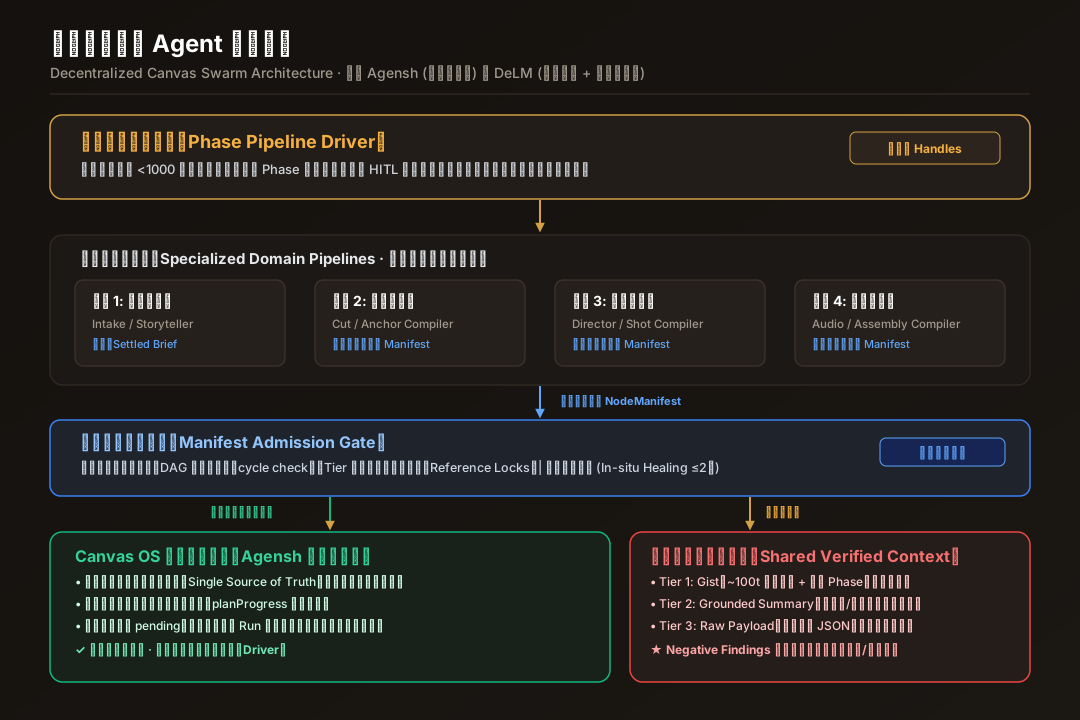
Pillar 1: Manifest Admission Gate
Eliminate the dozens of procedural gates cluttering the orchestrator's main loop.
- Separation of Architectural Design and Physical Execution: Domain specialists (storyteller, director, cut, anchor, audio) act purely as designers. They output deterministic, structured specifications—
NodeManifest—containing node intent, parameter configs, and wiring dependencies. - Static Admission Gate: Before any
NodeManifestreaches the canvas driver for physical graph creation, it passes through an automated verification barrier:- Schema & Handle Contract Validation: Node types match authorized vocabularies; input/output handles exist and align with type signatures;
- Topological Cycle Checks: Fast static DAG traversal ensures proposed connections introduce no dependency deadlocks;
- Hard Constraints & Reference Locks: Video remake nodes must bind validated character anchors or keyframe references; duration cannot exceed target model tiers;
- In-Situ Healing: When admission verification fails, the producing compiler repairs the spec locally (capped at 2 attempts). Errors are never allowed to crash the main loop, nor are they allowed to degenerate into asking the user to re-confirm basic steps.
Pillar 2: Orchestrator Slimmed Down to a Phase Pipeline Driver
Historically, orchestrators spent up to 40 ReAct hops micro-managing tool invocations, creating immense fragility. In the decentralized model:
- The Four Universal Production Phases: Media creation converges strictly into
Brief & Script➔Assets & Anchors➔Shot Generation➔Post & Assembly. Remaking or recutting existing media is merely an input parameter branch of the first two stages, never an ad-hoc custom stage. - Driver Manages Only Lifecycle and Human-in-the-Loop (HITL) Cards: The top-level driver does not solve domain mathematics. It simply tracks whether phase exit criteria are satisfied, advancing the pipeline and presenting approval cards for human decisions;
- Within each phase, tasks execute through dedicated compiler pipelines in bulk. This trims orchestrator code from thousands of sprawling lines to under 1,000 clean lines, holding system prompts strictly below 15 KB.
Pillar 3: Negative Findings Registry
To permanently solve the "rejected options resurfacing" pathology:
- The shared context maintains an append-only negative findings registry:
sharedContext.negativeFindings = { rejected_options: ["reuse_ref_#102"], // Options explicitly rejected by users on interactive cards incompatible_routes: { // Routes proven unviable via geometric or kinematic analysis clip_3: { approach: "control_extracted", reason: "occlusion_exceeds_threshold" } }, failed_tiers: [] // Model tiers incompatible with source resolution or duration }; - Mandatory Consumption Rule: Before interactive card generators or compilers assemble option candidate sets, they apply strict filtering:
Pruning invalidated paths at the data layer eliminates regressions where models propose rejected approaches in subsequent turns.const validCandidates = allCandidates.filter( c => !sharedContext.negativeFindings.rejected_options.includes(c.id) );
Pillar 4: 3-Tier Context Decoupling (DeLM Paradigm)
The control plane exchanges only lightweight resource handles, never bloated text payloads:
- Tier 1: Gist (~100 tokens): Immutable settled briefs (aspect ratio, visual tone, target runtime) and the active production phase, universally visible to all agents;
- Tier 2: Grounded Summary: Structured mappings generated per phase (shot tables, edit timecodes, anchor slot binds), bound only when respective domain specialists are active;
- Tier 3: Raw Payload: Verbose node JSONs and raw execution outputs, inspected by the canvas driver on demand via node handles during physical graph updates. Upstream reasoning LLMs never ingest raw JSON payloads.
4. Defensive Engineering Boundaries
Embracing decentralized coordination does not mean letting agents drift into chaotic randomness. Production deployments demand three non-negotiable boundaries:
| Dimension | Fatal Anti-Pattern | Architectural Defense |
|---|---|---|
| State Tracking | Maintaining private progress ledgers in memory | Progress is always derived dynamically from canvas topology |
| Execution Authority | Allowing autonomous server-side render loops | Agents never execute renders autonomously; nodes are staged as pending, and execution requires an explicit user click on a Run card |
| Phase Taxonomy | Inventing fragmented pseudo-stages (e.g. lock, remake) |
Strictly adhere to the four universal phases; Canvas Agent remains a zero-creativity physical graph driver |
These boundaries form the breakwater of the system. Whether scaling agent concurrency or accelerating compilation, the canvas remains the grounded physical truth, bounded securely by human-in-the-loop oversight. This matches the core principle outlined in The Complete Guide to Harness Engineering: Paradigm Shift from Prompts to Organizational Design: constraints and sandboxes matter far more than unconstrained autonomy.
5. Conclusion: From Policing Models to Mechanism Design
Microsoft's Agensh and Stanford's DeLM illuminate the industrial maturation path for multi-agent systems: When task complexity escalates, cramming longer prompts and denser reflection loops into a central orchestrator delivers diminishing returns before triggering collapse.
The real breakthrough lies in mechanism design:
- Anchor state in the shared workspace: Let the canvas serve as the single physical truth;
- Enforce quality at admission gates: Replace supervisory micro-policing with static schema and topological verification;
- Persist failed paths: Eliminate rework taxes via a first-class negative findings registry;
- Encapsulate domains in deterministic pipelines: Assign physical measurements to deterministic tools and creative reasoning to specialized models.
Transitioning from a centralized orchestrator to a decentralized canvas swarm transforms more than code organization—it fundamentally bends the cost and reliability curves for complex long-horizon tasks. For engineering teams navigating generative canvas architectures, making this shift early is the key to enduring scalability.
References
- Zhihao Zhan, Ting Song, Li Dong, Shaohan Huang, Jianxun Lian, Yan Xia, Furu Wei — Agensh: Scaling Organizational Intelligence to 1,024 Agents (Microsoft Research, September 2026, arXiv:2609.26781)
- Yuzhen Mao, Azalia Mirhoseini — Decentralized Multi-Agent Systems with Shared Context (Stanford SAIL, June 2026, arXiv:2606.10662)
- Google Research — Towards a science of scaling agent systems: When and why agent systems work (December 2025, arXiv:2512.08296)
- Galen Guan — Deconstructing Generative Canvas Agent Architecture: From Cognitive Convergence and Lazy DAG Scheduling to Git for Canvas (2026-09)
- Galen Guan — Why Is AI Video Remaking Always Unstable? 2026 Landscape and Architectural Divergence (2026-09)
- Galen Guan — The Complete Guide to Harness Engineering: Paradigm Shift from Prompts to Organizational Design (2026-08)