Code-Drawn Animation Meets Its Rivals: A Full Competitor Landscape of huashu-art-motion
On September 24, 2026, OpenAI shut down the Sora API with no successor model listed anywhere in its help docs. The same month, ByteDance's Seedance 2.5 was still making headlines for basic-tier members who couldn't get through queueing at peak hours (Sina Finance, 2026-03-01). Creators who want AI to produce a video are down to two routes: prompt-lottery text-to-video, or having a coding agent draw the animation frame by frame in code.
The second route gained a flagship on October 6. Huashu (GitHub @alchaincyf) open-sourced huashu-art-motion, an agent skill that teaches Claude Code to generate art animation in pure code. As of 2026-10-08 (GitHub API), this two-commit repository sits at 1,623 stars and 189 forks, and the launch thread on X recorded 361K impressions and 2,900 bookmarks (xbangdan leaderboard, checked 2026-10-08).
Who is it actually competing with? After lining up every rival, the answer is more interesting than expected: text-to-video models, code-animation frameworks, and peer skills in the agent ecosystem each outweigh it by one or two orders of magnitude, and none of them stands where it stands.
What the skill actually precompiles
One-line definition: after npx skills add alchaincyf/huashu-art-motion, the agent draws with HTML Canvas, captures frames with Playwright, and assembles video with ffmpeg. Runtime dependencies are uv, ffmpeg, and one Playwright Chromium. The rendering pipeline itself is worthless knowledge; headless-browser frame capture plus ffmpeg has been tutorial-grade material for years. What carries value is the three layers of assets wedged inside the pipeline.
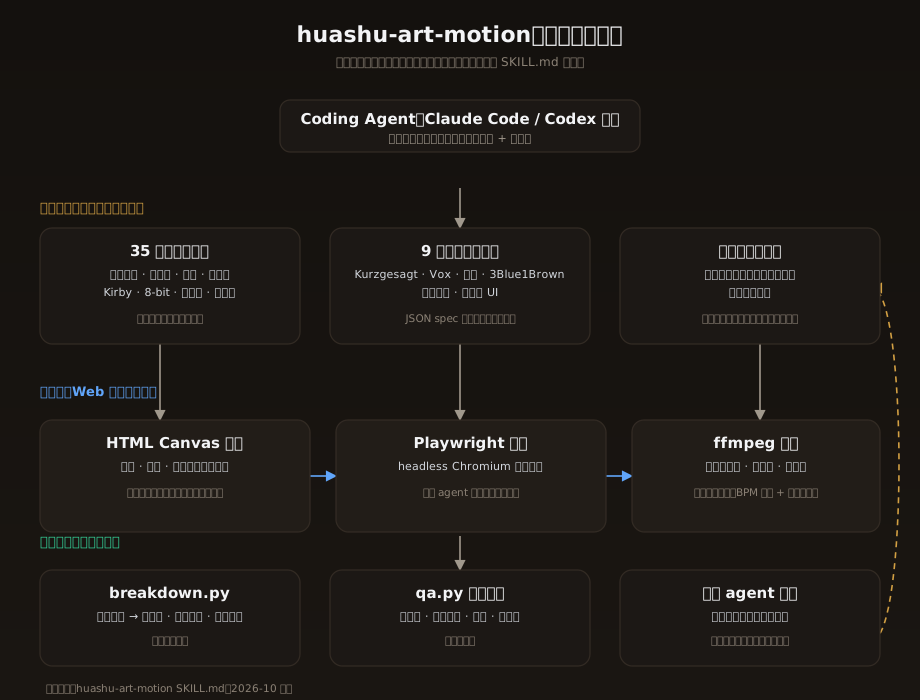
Recipe layer: 35 style recipe cards, from cave painting, ancient Egypt, Van Gogh, and Bauhaus to Kirby comics, 8-bit, vaporwave, and Shinkai Makoto. Each card maps to a runnable Canvas scene with a style renderer, and the card itself documents quality level and known weaknesses. Nine narration grammars (Kurzgesagt, Vox, whiteboard, 3Blue1Brown, finance charts) are driven by JSON specs with frame-accurate durations in landscape, portrait, or transparent background. A long-scroll skeleton lets a character walk left-to-right through famous paintings, switching styles at each border.
Engine layer: scenes, camera moves, and transitions are all drawn in code; characters come from an image-generation model as frames, with code handling compositing and frame swapping. All randomness is seeded, so the same code renders pixel-identical output twice. Music is synthesized in code too: BPM grids, motif-to-instrument mapping, ending sound sequences.
Acceptance layer, the least visible and most valuable one: breakdown.py decomposes a reference animation into cut points, beat grids, and motion heatmaps; qa.py quantifies stability, per-frame cost, motion intensity, and smoothness; before delivery, an independent agent that never participated in production reviews the final cut cold; fresh experience flows back as new recipe cards and pitfall notes.
# Two typical commands after install (from the README)
uv run --with playwright python scripts/engine/render.py --solo 09_postimp --stills 0.3 --out preview
uv run --with playwright python scripts/engine/render.py --spec scripts/engine/examples/t3_finance_chart.json --out finance_chart.mp4
Reading the SKILL.md surfaces three non-obvious design decisions:
- Aesthetic decisions are precompiled into assets. For an agent, "how to paint Van Gogh, and where it fails" is a multiple-choice question on a recipe card; writing a Van Gogh scene from scratch is an open-ended question. LLMs are dramatically more reliable at multiple choice, and that is the core engineering bet of the entire skill.
- The evaluation function is built in. General frameworks never define what "good" means; qa.py plus independent cold-review turn "good" into quantified metrics plus a third-party opinion, closing the agent's self-correction loop.
- Hard rules run counter-intuitively fine-grained: every new style must first ship three candidate frames, no exceptions; frame-difference acceptance must skip the 0.35-second camera-shock window after transitions; underage characters must wear modest, long clothing or the image model's safety filter rejects the frames outright. Every one of these constraints was paid for in real production pain.
The origin story (from the README) is worth retelling: the author saw Tak's 15-second "Art History Speedrun" on X and asked Claude to replicate it. His first version, transitions between static paintings, was rejected by himself because in the original "each era may last one second, but the elements inside the painting are fully in motion". He switched to decompose-first, then paint layer by layer and set the elements moving, which produced the 2-minute-08-second, 23-style "Huashu Through Art History". The acceptance bar is blunt: a viewer must recognize the artist or era at a glance, and the painting must be alive.
Front one: text-to-video models, domination and failure at once
The defining event of this front in 2026 was Sora's exit: OpenAI notified developers on 2026-03-24, killed the web and app experiences on 04-26, and closed the API on 09-24, taking all Sora 2-family models offline (OpenAI Help Center). Anyone who bet their pipeline on a single closed video platform lost their assets and workflow within six months, the most extreme platform-risk sample on record.
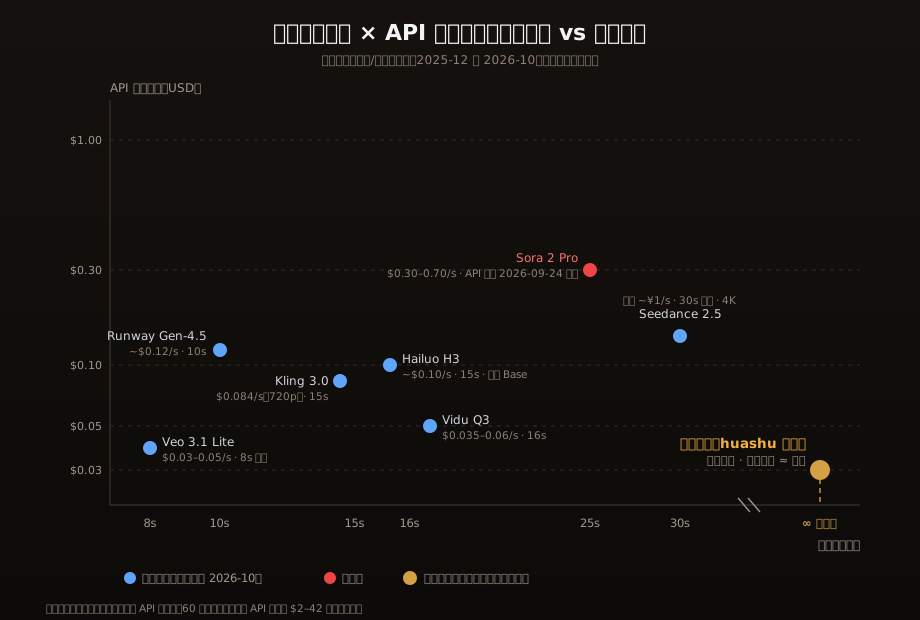
| Model (version date) | Max clip length | API price | Strength vs. code animation | Weakness vs. code animation |
|---|---|---|---|---|
| Sora 2 / 2 Pro (2025-09, shut down 2026-09-24) | 25 s | $0.10–0.70/s before shutdown | Photoreal physics, native audio sync | The product no longer exists |
| Google Veo 3.1 (2025-10-15) | 8 s native, ~148 s via Flow stitching | Lite $0.03–0.05/s, Standard $0.40/s (2026-03) | Native synced dialogue, lowest price floor | 8-second native cap, scene drift when stitching |
| Runway Gen-4.5 (2025-12-01) | 2–10 s | ~$0.12/s | Rare same-seed reproducibility pledge; Aleph region editing | 10-second cap, edits are re-generations |
| Kling 3.0 (2026-02-04) | Director mode, 6 shots, 3–15 s, 4K/60fps | $0.084–0.42/s (2026-01) | Multi-shot narrative, 5-language lip sync | 15-second cap; cross-clip consistency is "similar", never exact |
| MiniMax Hailuo H3 (2026-07-31) | 15 s, 2K | ~$0.08–0.13/s | Open-weight Base, local deployment possible | Local runs need a serious GPU; Base trails the commercial model |
| ByteDance Seedance 2.5 (2026-07-31) | 30 s native, 4K | ~¥1/s commercial API (Volcano Engine, 2026-03-04) | 30-second narrative ceiling, 50 multimodal references | Peak-hour queueing; a 60-second clip costs ¥60+ in generation alone, before re-rolls |
| Vidu Q3 (2026-02) | 16 s, 1080p | $0.035–0.06/s | Reference-to-video, improved multilingual text | Text cannot be laid out on a timeline; no alpha output |
| Code animation (huashu-art-motion route) | Unlimited (ffmpeg assembly) | Local rendering, marginal cost ≈ electricity | Determinism, frame-level control, alpha, zero queueing | Will never look "filmed" |
Where text-to-video has already won: photoreal texture and physics, real humans on camera, one-shot creative clips under 30 seconds, natively synced dialogue performance, and extensions from existing imagery. Writing code for those jobs is self-inflicted pain.
The reverse list is equally sharp. Frame-accurate narration sync (highlight the third word at 4.2s, finish growing the second bar at 5s) is only guaranteed by code. The edit model differs in kind: text-to-video revises by re-rolling the lottery, code revises one parameter and re-renders the whole film. Deterministic reproduction turns "replicate this reference animation" and "35 styles as 35 shareable recipes" into tradable assets, while seed reproduction breaks across hardware on most platforms (Runway's 2025-11 docs are the rare explicit pledge). The cost structures differ by an order of magnitude: 60 seconds of content costs $2–42 in API fees plus re-rolls, versus tokens and electricity. And no vendor natively outputs alpha channels or layered assets; everything goes through green screens.
As of October 2026 the dividing line between the two routes has hardened: text-to-video crushes code animation on "looks filmed"; code animation wins on "sayable, editable, reproducible, cheap". Sora's death adds the fifth dimension: betting a workflow on a single closed platform is itself systemic risk.
Front two: code-animation frameworks, sliding from engine to recipe
| Framework | Data (as of 2026-10-08, GitHub API) | Position | Stance toward agents |
|---|---|---|---|
| Manim (ManimCE) | 41,336 stars, v0.21.0 (2026-08-10) | De-facto standard for math explainer animation | Thickest research base, scattered community skills/MCP, no official move |
| Remotion | 62,369 stars, rapid v4.0.x releases | Video in React, VC-free bootstrapped company | Deprecated its MCP, went all-in on Agent Skills |
| Motion Canvas | 19,251 stars, last stable 2024-12 | TypeScript explainer animation | Effectively stalled; community fork carrying on |
| p5.js | 24,098 stars | Creative coding, not video-oriented | No official integration |
Manim's moat is math typesetting and geometry (native LaTeX) plus the thickest training corpus: LLMs write Manim more reliably than any niche framework, and academic work on LLMs writing Manim has run continuously since 2024 (MathViz-E, arXiv:2407.17544, 2024-07). The weaknesses are equally famous: slow rendering is admitted in its own docs; the environment is heavy since TeX hard-depends on a full LaTeX distribution; CJK support is a chronic pain point, with a long issue trail covering ctex configuration, encoding errors, and misaligned baselines in mixed Chinese-English text. Its visual register is "math blackboard", poorly suited to art animation out of the box.
Motion Canvas has elegant syntax and a great live-preview editor, but the original project's last stable landed in 2024-12, the official site is offline, and the repository hosts an issue titled "Is the repo dead?" (#1221, 2025-12). A community fork, canvas-commons (253 stars), is carrying the torch. There is no official agent integration, so when generated code hits a deprecated API, there is nobody to ask.
Remotion is the most commercialized player on this front and the most agent-friendly. In 2026 it deprecated its official MCP server and went all-in on Agent Skills: npx skills add remotion-dev/skills ships 12 sub-skills (best-practices, markup, captions, maps, render, and more), the docs explicitly name Claude Code, Codex, Kimi Code, and Cursor, and the remotion-dev/skills repository itself holds 4,882 stars (as of 2026-10-08). A framework vendor killing its own MCP to freeze best practices into skills is the industry's hardest confirmation that skills are the right interface for agents. The license has a thorn, though: companies pay $25/month per person writing code (remotion.pro, checked 2026-10), and the terms explicitly count people "writing Remotion with agentic coding tools" as billable seats, a real cost for teams mass-producing video through agents.
Lined up together, the key shift on this front is that competition is moving down a layer. Manim, Remotion, and Motion Canvas ship Turing-complete but opinion-free engines, where style, rhythm, and composition are all decided by the agent from scratch; huashu-art-motion ships precompiled aesthetic assets, downgrading the agent's job from creation to selection and parameter-filling. Remotion building official skills proves framework players have started squeezing downward, which is the biggest medium-term threat to huashu.
Front three: the agent-skill ecosystem, a confirmed category of one
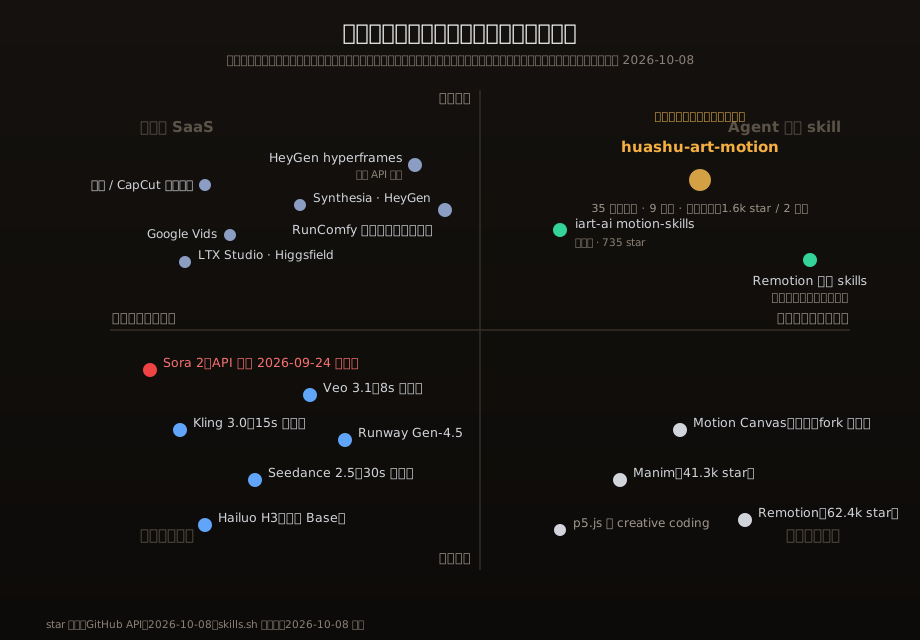
Anthropic's official anthropics/skills repository (180,058 stars as of 2026-10-08) holds 19 skills, from docx and pptx to canvas-design and algorithmic-art, and not a single video or animation skill. Of 36 community PRs matching "video", zero have been merged (checked 2026-10-08), including remotion-best-practices submitted by Remotion itself. The official position deliberately excludes video; the demand spills entirely into the third-party ecosystem.
On the skills.sh directory (scraped 2026-10-08), video skills split into two camps, neither doing aesthetics:
- API-wrappers: skills that call external video models. RunComfy's video-edit sits at 431K installs; HeyGen's hyperframes-animation at 707K. The model API is the product.
- Framework-engineering: skills that teach agents to drive a framework. Remotion's official remotion-best-practices holds 584K installs; the content is framework best practice with no style library.
The closest peer is iart-ai/motion-skills (735 stars, created 2026-06-22): 50 open-source skills teaching agents motion design, data-viz, vertical short video, and WebGL. Broad and shallow. huashu-art-motion is narrow and deep: one skill threading recipes, grammars, a long-film skeleton, acceptance, and music through a single chain. One reference number: motion-skills needed three and a half months to reach 735 stars; huashu took two days to reach 1,623 (both as of 2026-10-08). Deep recipes plus Chinese-language fit plus instant usability is a real, unmet demand in this ecosystem.
Adjacent AI-video SaaS (Google Vids, LTX Studio, Higgsfield, CapCut smart assembly, Synthesia, HeyGen) all bill by minutes or credits, generate pixels with models, and run in closed clouds; they share no cost structure with "render locally, ship readable code", so they compete only indirectly.
The boundaries of the reception deserve recording too: 361K impressions on the X launch thread (xbangdan, 2026-10-08); 4,182 plays on the Bilibili demo film (2026-10-08); on GitHub, zero issues and two PRs, both fixing Windows rendering blanks and local concurrency problems; zero discussions findable on HN or Reddit, and skills.sh has not indexed it. The heat is concentrated in the Chinese-speaking bubble, and cross-platform reliability is only now being stress-tested. A telling detail: huashu's own 52-skill catalog, huashu-skills, has not listed this new repository yet. It forms three complementary lines with seedance-skill (model-generated video via Seedance, 34 stars) and huashu-design (24,653 stars, static design and UI motion), with art-motion holding the "pure-code art animation" point.
Multi-dimension scoring
| Dimension | huashu-art-motion | Remotion skills | Manim | Seedance 2.5 | HeyGen hyperframes |
|---|---|---|---|---|---|
| Onboarding ease (higher = easier) | 9 | 7 | 4 | 9 | 8 |
| Frame-level control | 10 | 9 | 9 | 2 | 3 |
| Aesthetics out of the box | 9 | 4 | 5 | 7 | 6 |
| Marginal cost at scale | 10 | 7 | 9 | 3 | 4 |
| Ecosystem maturity | 3 | 8 | 8 | 7 | 7 |
| Platform & license safety | 8 | 5 | 9 | 4 | 4 |
Scoring rationale: huashu and Seedance tie on onboarding, one command and it runs, while Manim scores lowest because LaTeX setup repels most newcomers. hyperframes and Seedance represent "prompt-level control" and cannot score above 3 on frame control. Aesthetics is huashu's reason to exist: 35 recipe cards versus Remotion's opinion-free engine is a generational gap, and Seedance earns 7 on model taste but cannot reproduce itself. Marginal cost estimates a 60-second finished clip. Ecosystem maturity gives huashu a 3, with 2 commits, 0 issues, and no English community. On risk, MIT plus local rendering is safest, while Remotion loses points on seat-license terms and Seedance on queueing and content review.
Moat and fragilities
The moat has four planks. First, recipes are hand-accumulated tacit knowledge: "keeping the character consistent across style switches" was named by a Threads commenter as the hardest part of AI animation, and it is know-how polished across 35 scene files, unwritable in a single conversation. Second, the distribution machine: 10.4K GitHub followers plus traffic from nuwa-skill (33,754 stars) and huashu-design (24,653 stars), on top of X, Bilibili, and WeChat channels (all as of 2026-10-08); almost nobody in the Chinese-speaking sphere can replicate that launch path. Third, system synergy: Nuwa manufactures skills, Darwin evolves them, fanbox is the cockpit, the 52-skill catalog distributes; art-motion is a new flagship in a product line, an isolated work. Fourth, cost structure: MIT license plus zero API fees, aimed straight at SaaS credits models.
The fragilities are five, and harder. The underlying method is not proprietary; headless-browser capture plus ffmpeg is public tutorial knowledge, and Remotion and hyperframes offer more industrialized bases. The engineering is embryonic: 2 commits, first PRs all fixing Windows and concurrency bugs, cross-platform reliability unproven. The aesthetic ceiling is locked to the upstream model; paint quality depends directly on the Opus generation's code ability, and if Anthropic ships an official animation artifact, the value dilutes on the spot. English-circle penetration is zero, so growth hangs entirely on personal traffic and "open-source at 10K likes" pacing, which is volatile. And the commercial license has small barbs: Huashu's cartoon likeness is restricted to demonstration use, stroke-order data carries the Arphic license, and fonts carry their own terms, all of which corporate adopters must audit first.
Conclusion
Concrete recommendations for three groups. Creators making explainer videos, narration-synced animation, or anything that reuses a style: install huashu-art-motion now; frame-accurate control at zero marginal cost has no substitute today. Anyone needing filmed texture, real humans, or a one-shot 15-second creative: use text-to-video (Kling 3.0 or Seedance 2.5); forcing code would be the wrong tool. Teams industrializing marketing-video production: Remotion's official skills, paying the seat fee for maintenance and component depth is a fair trade. Manim belongs to math creators, ideally with LaTeX patience pre-installed.
The core judgment of this comparison compresses to two sentences. The dividing line in animation generation is determinism, and it was never picture quality: quality decides whether it "looks filmed", while determinism decides whether it is sayable, editable, reproducible, and cheap, which is the actual demand of explainer and mass-production scenarios. The correct interface for the agent ecosystem is sliding from the framework layer to the recipe layer: Remotion killing its MCP for skills is the hardest industry evidence of that migration, and huashu-art-motion occupies the "aesthetic recipe library" niche, which currently has no second player. That position has no technical moat, only a content moat; the window lasts as long as the Remotions keep squeezing downward, and as long as the 35 recipe cards keep compounding into thicker assets through evolution mechanisms like Darwin.
For the wider picture: why skills pay off as recipe assets rather than tool wrappers is quantified in skill-graphs-2.0, and how agent capability boundaries moved from the model layer to the context layer, making skills a standard interface, is traced in the harness engineering complete guide.
References
- Huashu — huashu-art-motion GitHub repository (released 2026-10-06)
- Huashu — huashu-art-motion SKILL.md
- OpenAI Help Center — What to know about the Sora discontinuation (2026)
- The New York Times — OpenAI Shutting Down Sora (2026-03-24)
- Remotion — Agent Skills documentation
- Remotion — License (seat fees and agentic coding terms)
- ManimCommunity — manim repository (41,336 stars as of 2026-10-08)
- ManimCommunity — Changelog v0.21.0 (2026-08-10)
- MathViz-E — Paper (arXiv:2407.17544, 2024-07)
- motion-canvas — Issue #1221: Is the repo dead? (2025-12)
- canvas-commons — Community fork of Motion Canvas (253 stars as of 2026-10-08)
- Anthropic — anthropics/skills repository (180,058 stars as of 2026-10-08)
- Anthropic — anthropics/skills video PR search (36 PRs, zero merged) (checked 2026-10-08)
- skills.sh — Skill directory (install counts scraped 2026-10-08)
- iart-ai — motion-skills repository (735 stars, created 2026-06-22)
- Kling — Kling 3.0 Multi-shot Guide; API pricing (2026-01)
- Runway — Gen-4.5 announcement (2025-12-01); API docs
- Google — Veo 3.1 / Flow announcement (2025-10-15); Gemini API pricing
- ByteDance — Seedance 2.5 (2026-07-31); Wireflow review (2026-09-25); Sina Finance queueing report (2026-03-01)
- MiniMax — Hailuo H3 release and open-sourcing (2026-07-31)
- Shengshu — Vidu Q3 (2026-02)
- Huashu — Bilibili demo "Art history short film made by Opus 5.5" (published 2026-10-05, 4,182 plays as of 2026-10-08)
- xbangdan — X leaderboard entry for the launch thread (checked 2026-10-08)