MiniMax Music 3 API Deep Dive: A Horizontal Review of Music Generation in AI Video Pipelines
Everyone building AI video agents hits the same wall: image and video generation has raced ahead to one-click finished cuts, while scoring is still "dig through a stock library" or "generate in Suno, download, drag into the timeline." The bigger surprise comes when you try to wire music into an automated pipeline — as of July 2026, Suno has no official API, and Udio's own help center says "we know there's keen interest, but we don't currently offer one." The entire AI music category is collectively absent at the developer door, until MiniMax Music 3 put an official API, an MCP server, and open weights on the table all at once.
This post does three things: break down the music_generation API contract parameter by parameter (from the official API reference, not a marketing-page paraphrase — plus seven real API calls to fill in what the docs leave out: how long the timeout really needs to be, whether you can control duration, and what a failure actually looks like); compare five music generation APIs on status and pricing; and finally, using a real node-based AI video canvas I maintain, lay out the full integration checklist for toolifying music generation into an agent system — including why its synchronous design makes the executor simpler than a video node.
What Music 3.0 Actually Upgraded
The official positioning is three sentences: an upgraded semantic model reduces AI-generation drift; mixes reach commercial-recording grade (no more cramped or muddy sound), with support for specific instruments and real playing techniques like slides and legato; and a new vocal engine removes high-frequency "digital hiss" with control over melody, pronunciation, breathing, and layered harmonies. Output spec: full songs up to 5 minutes, 44.1kHz stereo.
The more useful engineering framing is the capability boundary: it covers three scenarios in one API — writing a song from scratch (prompt + lyrics), instrumental-only BGM (is_instrumental: true, no lyrics needed), and cover generation (music-cover model + reference audio). These three map exactly onto the three real tiers of video scoring. That "one endpoint, three tiers" structure is the foundation of the integration design later in this post.
The API Contract, Layer by Layer
Endpoint and Calling Model: Synchronous, Not Polled
curl --request POST \
  --url https://api.minimax.io/v1/music_generation \
  --header 'Authorization: Bearer ***' \
  --header 'Content-Type: application/json' \
  --data '{
  "model": "music-3.0",
  "prompt": "Indie folk, melancholic, introspective, longing, solitary walk, coffee shop",
  "lyrics": "[verse]\nStreetlights flicker, the night breeze sighs\n...",
  "audio_setting": { "sample_rate": 44100, "bitrate": 256000, "format": "mp3" }
}'
The response comes back in one shot:
{
  "data": { "audio": "hex-encoded audio data", "status": 2 },
  "extra_info": {
    "music_duration": 25364,
    "music_sample_rate": 44100,
    "music_channel": 2,
    "bitrate": 256000,
    "music_size": 813651
  },
  "base_resp": { "status_code": 0, "status_msg": "success" }
}
One counterintuitive point deserves emphasis: generating a 5-minute song is heavy compute, but the API is not task-polling. No task_id, no query endpoint, no state machine — the request hangs, and anywhere from tens of seconds to several minutes later the entire response returns with the hex-encoded audio. Compare this with MiniMax's own video generation (submit + poll) and the async-task pattern of most image APIs: this design directly determines the shape of integration code. The executor needs no polling loop, no task-interruption recovery, no task_id persistence. The trade-off: every hop in the HTTP chain needs generous timeouts.
How generous, exactly? Measurement beats estimation. I ran seven real generations against music-3.0 with one key:
| Output length | Generation time |
|---|---|
| 35.3s | 29.0s |
| 55.6s | 34.9s |
| 63.8s | 38.2s |
| 72.9s | 44.3s |
| 223.6s (instrumental) | 206.1s |
Generation time scales roughly linearly with output length — and you do not control output length (more on that in the next section: this API has no duration parameter at all). So the timeout has to be set for the worst case: gateway and client timeouts should be ≥300s, not the 180s a "one or two minutes" intuition suggests. A three-and-a-half-minute instrumental walks straight through a 180s ceiling.
One more contract detail you only learn by actually calling it: failed requests still return HTTP 200. The error hides in base_resp.status_code (2013 for an invalid model, 2049 for auth failure). A client that only checks the HTTP code will pass an error response downstream as if it were audio.
The output_format parameter has a url option that returns a hosted URL — but the docs explicitly warn it expires after 24 hours. Any integrator must re-upload to their own object storage immediately; treating the temporary URL as a persistent link is the easiest trap in this documentation.
Parameter Map: Three Tiers, One Contract
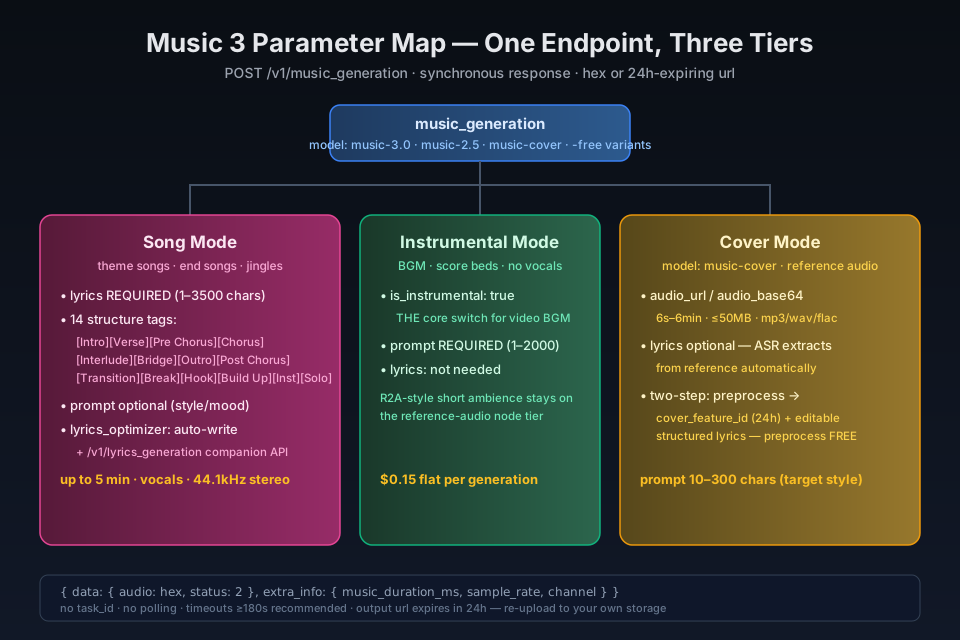
| Parameter | Song mode | Instrumental mode | Cover mode (music-cover) |
|---|---|---|---|
model |
music-3.0 (paid, RPM 120) |
music-3.0 |
music-cover |
prompt |
optional, ≤2000 chars | required, 1–2000 chars | required, 10–300 chars (target style) |
lyrics |
required, 1–3500 chars | not needed | optional (omitted → ASR extracts from reference) |
is_instrumental |
false | true (the core switch) | — |
lyrics_optimizer |
true + empty lyrics → auto-write | — | — |
audio_url / audio_base64 |
— | — | reference: 6s–6min, ≤50MB, mp3/wav/flac |
cover_feature_id |
— | — | two-step cover: from preprocess API (24h valid), mutually exclusive with audio_url |
What's absent from this table matters just as much: there is no duration parameter anywhere in the contract. audio_setting covers only sample_rate / bitrate / format; slip a duration in and it won't error — it gets silently ignored. I sent the same prompt and lyrics five times and got 35.3s, 55.6s, 63.8s, 72.9s, and 223.6s. Same input, six-fold spread.
That constrains product design harder than it sounds: you cannot promise a user "a 30-second BGM," and your node or form shouldn't show a duration field — it would be a lying control. If you truly need a fixed length, loop or truncate with ffmpeg after generation. On the flip side, the flat $0.15 per call pairs naturally with that uncertainty: long and short cost the same, so the model handing you three extra minutes never costs you extra.
Another easy assumption to get wrong: instrumental mode requires explicitly sending is_instrumental: true — omitting lyrics does not imply instrumental. Send only a prompt with neither field and the API returns 2013 invalid params, lyrics is required.
Lyrics support 14 structure tags: [Intro] [Verse] [Pre Chorus] [Chorus] [Interlude] [Bridge] [Outro] [Post Chorus] [Transition] [Break] [Hook] [Build Up] [Inst] [Solo]. That's an entire layer of song-structure control most "paste some lyrics" competitors don't offer — for a 5-minute piece, where the chorus lands, where the bridge sits, how long the interlude runs is the line between "listenable" and "sounds like a song."
Two companion APIs complete the workflow: /v1/lyrics_generation (mode: "write_full_song" — generate fully structured lyrics from a one-line theme) and /v1/music_cover_preprocess (reference audio → cover_feature_id + structured lyrics + segment timestamps, this step is free, feature ID valid 24 hours).
On model tiers, every paid model has a -free variant (e.g. music-3.0-free) with RPM throttled from 120 to 3, open to all API keys — you can validate the full chain on the free tier before switching. A genuinely developer-friendly design.
Pricing: $0.15 Flat Official, 4x Spread on Aggregators
As of August 2026, MiniMax officially charges $0.15 per generation regardless of length (5 minutes and 30 seconds cost the same; instrumental and vocal the same). This flat-per-call model is fundamentally different from competitors' per-minute billing — in BGM scenarios a 30-second loop and a full theme song cost the same, a clear advantage as content gets longer. Previous-gen Music 2.5 was also $0.15; Music 2.0 was $0.03; the lyrics API has run Limited Free promos.
The aggregator spread is worth noting: fal-ai/minimax-music on fal.ai is listed at $0.035/generation — 23% of the official direct price. The trade-offs: aggregators don't guarantee day-one support for the newest model versions (verify which version fal actually serves), and add a dependency layer. For pipelines already on fal or similar, that's a significant cost-optimization slot; for stability-critical production paths, official direct + free-tier fallback is safer.
The Horizontal Comparison: Real Status of Five Music APIs
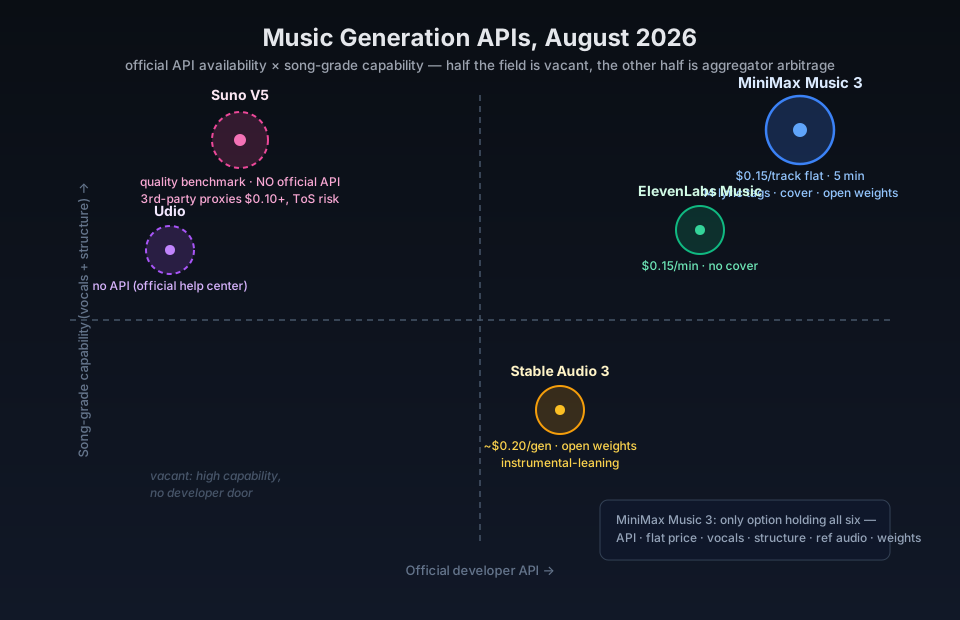
Bottom line first: half this category's developer surface is vacant, and the other half is aggregator arbitrage.
| Dimension | MiniMax Music 3 | Suno V5 | Udio | ElevenLabs Music | Stable Audio 3 |
|---|---|---|---|---|---|
| Official API | ✅ sync REST + MCP server | ❌ none (confirmed 2026-07) | ❌ none (per official help center) | ✅ enterprise-grade | ✅ Stability API |
| Pricing | $0.15/track flat | 3rd-party proxies $0.10+/track | none official, pricier proxies | $0.15/minute | ~$0.20/generation |
| Full songs w/ vocals | ✅ lyrics structure tags | ✅ (quality benchmark) | ✅ high fidelity | ✅ | ⚠️ instrumental/SFX-leaning |
| Max duration | 5 min | ~4–8 min (tiered) | ~4 min | ~3 min | ~3 min |
| Open weights | ✅ (self-hostable) | ❌ | ❌ | ❌ | ✅ |
| Structure control | 14 lyrics tags | metatags (weak) | none public | prompt prose | prompt prose |
| Cover / reference audio | ✅ music-cover + free preprocess | ✅ (in-product) | ✅ (in-product) | ❌ | ❌ |
One-line status per player:
Suno: still the quality benchmark (V5 vocals rated "most convincing"), but no self-serve API developer surface as of July 2026; its Zapier/Make integrations are in-product automation, not an open API. Every "Suno API" on the market (gcui-art/suno-api reverse-engineering cookies, sunoapi.org, AIMusicAPI aggregation) is an unofficial wrapper that can break at any time with ToS risk. Wiring it into production means betting a core pipeline on someone else's reverse engineering.
Udio: the official help center's words from March 2025 — "we know there's keen interest, but we don't currently offer a public API." Third-party information is chaotic (some "guides" describe a Developer Portal that doesn't exist); api-evangelist's maintained note (May 2026) is unambiguous: no public developer API, consumer web only. Great instrumental fidelity reputation, same developer vacancy.
ElevenLabs Music: a clean, enterprise-integration-first API (an April 2026 review called it "the cleanest API built for enterprise integration"), but $0.15/minute billing runs 3–5x MiniMax's flat rate for full songs, with no reference-audio/cover capability.
Stable Audio 3: open weights + self-hosting is the unique pitch, and its AudioSparx-licensed training data gives it a clearer commercial-use framework than Suno/Udio (consensus in July 2026 comparisons), but it leans instrumental and sound design — vocal theme songs are not its home turf.
MiniMax Music 3's position in this table is clear: official API, flat per-call pricing, song-grade vocals, structure control, reference audio, open weights — it holds all six dimensions. It isn't the strongest on every single axis (Suno on vocal ceiling, Udio on instrumental fidelity, ElevenLabs on API cleanliness), but it's the only option with no disqualifying weakness — and for anyone wiring into an automated pipeline, "has an official API" outweighs a 5% quality delta.
Case Study: Wiring Music 3 into an AI Video Canvas
The last part is practice. Take a node-based AI video pipeline I maintain — the canvas has text-to-video and image-to-video nodes, TTS nodes, and on the audio side: a reference-audio generation node (text/audio/image → short BGM, SFX, ambience, Seed Audio-powered) plus a local ffmpeg mixing node (laying a track under the video's own audio). In this architecture's five-layer audio model (BGM / voice / ambience / foley / spot SFX), the "singing voice" layer is entirely blank — scoring a finished cut with a theme song means faking it with instrumental-only.
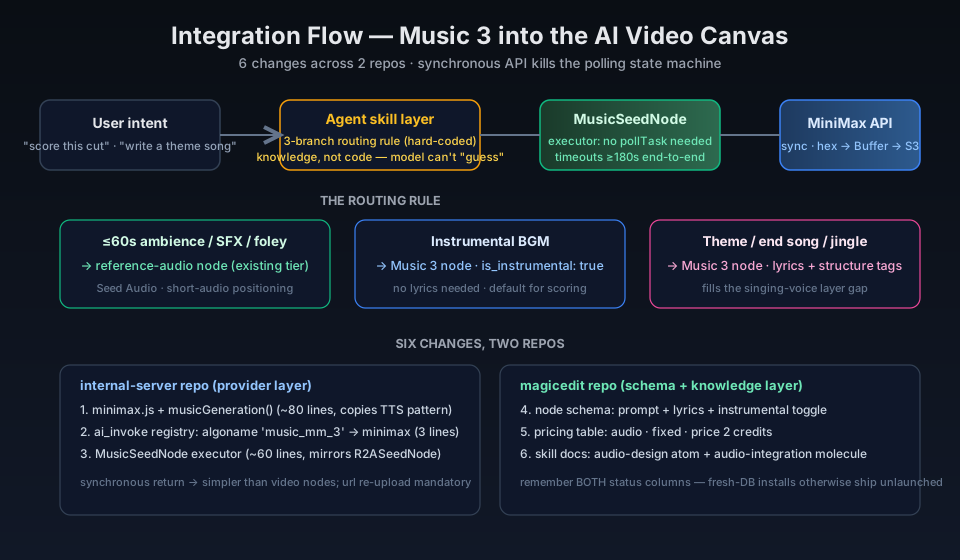
Music 3 fills exactly that hole, at surprisingly low cost. The plan follows existing patterns: six changes across two repos.
Provider layer (3 changes): add a musicGeneration() function to the MiniMax client file (following the existing TTS pattern: request → hex to Buffer → upload to object storage); one algoname mapping line in the invoke registry; a new node executor (the synchronous API means no polling implementation — simpler than a video node, the calling model above paying off directly here).
Schema + knowledge layer (3 changes): the node definition (required prompt + optional lyrics + instrumental toggle defaulting true for BGM); one pricing-table line; and the most easily missed change — updating the agent's domain knowledge and build playbook with a hard-coded three-branch routing rule:
≤60s ambience/SFX/foley      → reference-audio node (existing, short-audio tier)
Instrumental BGM (no vocals) → Music 3 node (is_instrumental: true)
Theme/end song / jingle      → Music 3 node (lyrics + structure tags)
Without this rule, an agent facing two audio-generation nodes picks randomly, or asks a song model for 10 seconds of rain — model capability boundaries must be written into the agent's skill docs, not left for the model to "figure out."
Looking sideways at how other frameworks do it, three levels of inspiration:
OpenMontage (open-source AI video agent, 52 production tools) puts Suno (unofficial API) and ElevenLabs music tools under a unified 7-dimension scored provider selector — task fit, quality, controllability, reliability, cost, latency, continuity — logging alternatives and rationale for every selection. Music providers aren't hardcoded; they're scheduled by the same scoring machinery. That's exactly what most homegrown pipelines lack: a provider abstraction layer. Single-provider direct connections (like this canvas) should treat the second provider as the cheapest moment to add that layer — register Music 3 as a peer option to Seed Audio, with routing rules living in the knowledge layer, not code. OpenMontage has more worth stealing across its audio chain; I covered its 3D world pipeline in a separate teardown.
ComfyUI takes another road: official templates now include MiniMax Music with a new text-to-audio tier, and in the same PR the project deleted every partner node's custom price extractor plus a 144-line local price table, unifying billing into the x-comfy-credits system. The meaning of that move: pricing is configuration, not code. Any pipeline hardcoding a model price table (ours included, workflow_model_price.js) should migrate toward server-side/config-driven pricing — otherwise every price change is a release.
MiniMax's own MCP server (MiniMax-AI/MiniMax-MCP) represents the other direction for agent integration: wrapping music_generation, voice_clone, and friends as MCP tools pluggable into Claude Desktop/Cursor. For the general agent ecosystem that's the lowest-friction path; for an embedded canvas pipeline, bypassing MCP and wrapping REST into your own node remains the more controllable choice — what you need isn't a generic tool, it's one that grows into your billing, retry, and storage systems.
One Lesson from the Mixing Floor
How does the generated track get into the video? Our mixing node uses local ffmpeg to lay the track under the video's own audio (not replacing): shorter tracks loop, longer ones trim. Sounds trivial; the implementation hides three traps — filter_complex labels can be consumed exactly once, loudnorm's -16 vs -14 are two different distribution strategies, and amix's default normalize secretly ducks voice by -6dB. I broke all three down (with production-grade parameters) in The Three Traps of FFmpeg Audio Mixing; the one-line takeaway here: amixing an AI-generated track into a video almost certainly sounds unbalanced — a parameterized loudnorm + ducking chain is a requirement, not an optimization.
Scoring and Verdict
| Dimension | Score | Basis |
|---|---|---|
| API design | 8/10 | Clean synchronous contract, three tiers in one parameter set, friendly free tier; docked for the 24h URL expiry and mainland/international model-name inconsistency |
| Generation quality | 8/10 | Commercial-grade mixing claims + structure control; vocal ceiling still trails Suno V5 by reputation, no authoritative benchmark yet |
| Cost | 9/10 | $0.15 flat + $0.035 fal channel — best combination of the five |
| Integration cost | 9/10 | Synchronous return eliminates the polling state machine; hex→Buffer→S3 copies the existing TTS implementation |
| Ecosystem position | 7/10 | MCP server + open weights + full aggregator coverage; docked for brand recognition and English-community content volume |
Verdict in one line: if you're wiring music generation into an AI video/content pipeline in 2026, MiniMax Music 3 is currently the only choice without a disqualifying weakness — not because it wins every dimension, but because it's the only option that simultaneously has an official API, flat per-call pricing, song-grade vocals, structure control, and reference audio. Suno's quality reputation can't buy a stable API ticket; ElevenLabs' clean API can't buy covers or flat pricing; Stable Audio's openness can't buy vocal theme songs. For the integration side, copy this post's three-branch rule, and put these four items on your checklist: the URL expires in 24h and must be re-hosted, sync timeout ≥300s (206s measured worst case; 180s isn't enough), duration is uncontrollable — don't ship a duration field in your UI, and failures still return HTTP 200, so read base_resp.status_code.
The longer-term question this case really raises isn't "which API to pick" but when to build the provider abstraction: the first provider can be a direct connection; the second is when you abstract. Music 3 will keep iterating (open weights are out; self-hosting is plausible), and Suno/Udio will eventually ship official APIs — at which point the winner isn't the pipeline that picked the right vendor, it's the one where switching providers is a one-line registry change.
References
- MiniMax — Music Generation API Reference (accessed 2026-08)
- MiniMax — Music Generation Guide (accessed 2026-08)
- MiniMax — MiniMax-MCP (GitHub)
- fal.ai — fal-ai/minimax-music model page ($0.035/generation, quoted 2026-08)
- Udio Help Center — Udio public API (updated 2025-03, "no public API")
- api-evangelist — udio (GitHub) (May 2026 note: no public developer API)
- AIMusicAPI — AI Music Generation API Comparison: The Developer's Guide (2026-07-03)
- AIMusicAPI — Suno API status ("As of mid-2026, Suno has no public self-serve API")
- gptproto — Suno AI API Guide 2026 (2026-07, no official API confirmed)
- Chartlex — AI Music Generator Comparison 2026 (2026-07-11, Stable Audio licensing)
- digitalapplied — AI Music Generation 2026: Suno, Udio, ElevenLabs Compared (2026-04-28)
- gcui-art — suno-api (GitHub) (example of unofficial reverse-engineered wrapper)