The Endgame for Repository-Scale Code Cognition: A Deep Dive into AOCI and Enterprise Agent Engineering
When software engineers hand an existing codebase of over 100,000 lines to an autonomous coding agent—whether Claude Code, Codex, Cursor, or OpenCode—they invariably encounter two fatal friction points within the first two hours.
The first failure is aimless context exploration and token hemorrhaging. On every fresh run or after context compaction, the agent begins with a clean slate. It executes rounds of grep, find, and reads top-level configuration files, spending tens of thousands of tokens and multiple conversational round-trips before writing a single line of business logic.
The second, far more dangerous failure is violating invisible contracts (Black Swan failures). AST parsers, language servers (LSP), and code graphs can reliably pinpoint that "function A is invoked by file B." What they cannot tell the agent is why it was designed that way and what must never be altered. For instance: an API endpoint that must silently fall back to a relational database if a cache fails; an active database table that must never participate in automated ORM migrations; or cross-service constants that must remain binary-compatible across languages. An agent inspects the syntax tree, crafts elegant code, passes unit tests, and yet breaks production by violating an undocumented architectural invariant.
Standard search engines and code graph tools answer where code resides and how symbols connect syntax-wise. They fail to capture why an object exists and what non-obvious constraints prevent catastrophic bugs.
The open-source project AOCI (AOCI-CODE, AI-Oriented Cognition Infrastructure) tackles this challenge from the operating foundation. Rather than introducing external vector databases or heavyweight graph clusters, it maintains a dense, versioned, plain-text cognitive map directly inside Git, delivering holistic system understanding to the host agent prior to task execution.
In our previous analysis, GitNexus Deep Dive: Injecting Code Knowledge Graphs into Coding Agents, we analyzed call graphs and blast radius computations; in Decentralized Canvas Agent Architecture, we examined multi-agent shared workspace topologies. This article dives deeper into code cognition infrastructure: How does AOCI actually work? What makes its FRAS contract and S-field discipline unique? And when deployed in large-scale multi-agent monorepos, what real-world engineering frictions emerge?
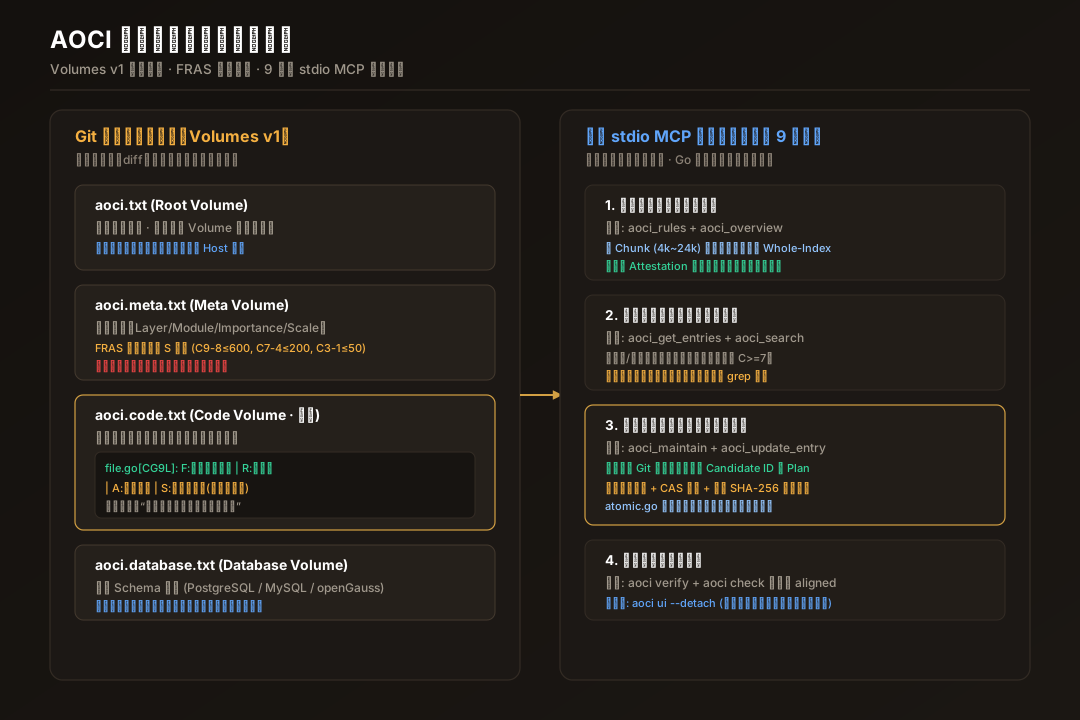
1. The Core Paradigm: Semantics to the Model, Governance to the Engine
As of October 2026, AOCI-CODE has released version v0.1.0-rc20 under the FSL-1.1-MIT license (Fair Source 1.1, permitting internal use and non-competing commercial integration, automatically converting to standard MIT after two years).
Engineers encountering AOCI for the first time often misjudge it as another script generating Markdown repository summaries. That misses its central thesis:
"Semantics belong to the model; governance belongs to the engine."
AST parsers and static linters capture mechanical syntax facts, but they cannot deduce architectural intent or business risk. Large language models excel at synthesizing high-level semantics, but they fail completely at maintaining deterministic state, concurrency boundaries, and long-term consistency.
AOCI divides labor deliberately: The host model reads source code and drafts dense, single-line semantic entries; a single-binary Go deterministic engine manages scope boundaries, Git SHA-256 evidence binding, Compare-And-Swap (CAS) concurrency locks, and atomic file publication.
In its Volumes v1 layout, AOCI formalizes cognition into four Git-tracked plain-text assets:
| Asset File | Role & Scope | Core Architectural Responsibility |
|---|---|---|
aoci.txt |
Root Volume | Activation entry point declaring participating volumes and schema versions. Published last in transactions to prevent partial cognition reads. |
aoci.meta.txt |
Meta Volume | Defines tag dictionaries (Layer, Module, Importance, Scale) and character quotas. Enforced by the binary; repository configs cannot loosen limits. |
aoci.code.txt |
Code Volume | Model-authored single-line entries for code assets, segmented by directory. Exactly one line per managed file. |
aoci.database.txt |
Database Volume | Optional table-level cognition (PostgreSQL, MySQL, openGauss 6.0.5 LTS) bound to catalog schema evidence hashes. |
.aoci/ |
Governance State | Local directory storing config.json, baseline.json, locks, and transaction ledgers. Ignored by Git. |
Because these assets live alongside code in Git, onboarding a new developer, switching agent runtimes (e.g., from Claude Code to Codex), or recovering from host context compaction requires only a single read of the index to establish full-framework cognition in seconds.
2. The Semantic Core: FRAS Model and S-Field Discipline
AOCI's most impactful contribution is not its transport protocol, but its formal FRAS lexical specification.
Inside aoci.code.txt, every managed file is compressed into a single line formatted as follows:
atomic.go[CG9L]: F:Provides durable replace CAS, create CAS, and atomic writes | R:code:internal/fs/lock.go | A:AtomicWrite,AtomicWriteCAS | S:Native publication never degrades to an overwriting rename; on race preserve third-party state and fail closed
The compact tag [CG9L] locates the object within the system architecture: C represents shared foundational infrastructure, G denotes cross-domain general utility, 9 marks maximum importance (on a 1–9 scale), and L indicates a large file (>400 lines). In the entry body, four fields serve distinct roles:
- F (Function): Core functional anchor. AOCI enforces concise anchors (typically under 15 words) and explicitly rejects naive filename translations (e.g., translating
user_service.gointo "User service implementation"). - R (Relations): Strong cross-file dependencies. Lists only files and database tables that an agent must inspect together to safely understand or modify this object. It rejects mechanical import dumps.
- A (API): Public external contracts, commands, or observable interfaces. Private helpers and internal utilities are discarded.
The Soul of the S-Field: The Double Question Test
In software documentation, developers routinely produce bloated paragraphs that communicate negligible technical signal. AOCI institutes an uncompromising admission rule for the S-field (Non-obvious Constraints). Before writing any statement in S, the model must pass two consecutive questions:
- Question 1: Can this statement be inferred from the preceding four layers (filename, tag, F, R, A)?
- Question 2: Does this statement directly prevent an agent from making an error when modifying code?
Only when both answers are an absolute "yes" does the statement qualify for admission. In practice, this reduces to a single operational question:
"If this sentence is omitted, will the model make a mistake?"
To keep the S-field clean, AOCI establishes a high-entropy checklist:
- File-level operational invariants where violations cause outages (e.g., rigid execution order, prohibited concurrency);
- Deliberate exceptions counter to statistical defaults (e.g., catching specific exceptions to execute fallbacks);
- Cross-language or cross-service implicit contracts (e.g., enums that must match across independent repositories);
- Hard-won post-mortem lessons formulated as current facts.
Critically, AOCI's validator actively flags Evolution Narrative. Statements such as "Refactored in PR #402" or "Fixed race condition in August 2026" are rejected. Evolution belongs to Git history; historical narratives embedded in cognition decay into misleading noise. The S-field states only the current accumulated invariant.
To prevent context bloat, character quotas are bound to importance tiers: C9–C8 objects are granted up to 600 characters, C7–C4 objects are limited to 200, and peripheral C3–C1 files receive at most 50. Overages fail the engine's error gate immediately.
3. Four Code Intelligence Paradigms Compared
In modern agent engineering, developers frequently conflate AOCI with vector RAG, AST outlines, and code knowledge graphs. In reality, they operate on distinct conceptual layers.
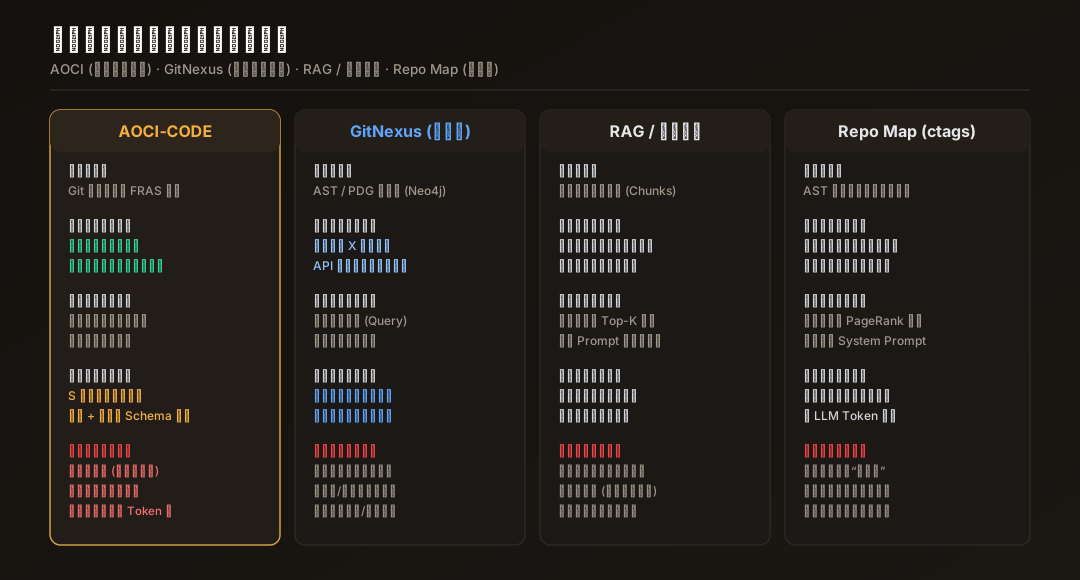
| Dimension | AOCI-CODE (Cognition Infrastructure) | GitNexus (Code Knowledge Graph) | RAG / Vector Retrieval | Repo Map (ctags / Aider) |
|---|---|---|---|---|
| Core Artifact | Git-versioned plain-text FRAS index map | Property graph (Neo4j / PDG / Call trees) | Text chunks with vector embeddings | AST-extracted signatures and class names |
| Best Question Answered | How is the system organized? What hidden traps exist? | Who does symbol X break three hops down the call chain? | Where is semantically similar code located? | What files and function signatures exist? |
| Consumption Timing | Loaded once at session start (Whole-Index) | Queried on demand during implementation | Top-K snippets retrieved during search | Statically injected into every prompt |
| Invariant Coverage | Maximum (Business rules, S-field invariants) | Low (Captures syntax call paths only) | Minimal (Fragmented snippets, no negative space) | None (Pure signature listings) |
| Maintenance Cost | Model reads source + Go CAS engine | Automated compiler and AST parsing | Automated embedding updates | Millisecond AST parsing |
| Engineering Limitation | Initial bootstrap is slow; worktree friction | Requires graph database; lacks business context | Precision search suffers from hallucinations | Lacks intent; agents misinterpret complex modules |
In enterprise environments, AOCI and code graphs are complementary rather than competing. The recommended configuration is straightforward: Deploy AOCI's Whole-Index to provide global macro-cognition and invariant guardrails before work begins; utilize GitNexus during active editing to trace precise call paths and API blast radius; and rely on automated test suites for final verification.
4. Inside the Engine: 9-Tool MCP Governance and Whole-Index Delivery
The AOCI binary functions both as a CLI tool and as a stdio-based Model Context Protocol (MCP) server. It exposes exactly nine public tools to the host agent:
Reading:     aoci_rules, aoci_overview, aoci_get_entries, aoci_search
Maintenance: aoci_maintain, aoci_update_entry, aoci_remove_entry
Evidence:    aoci_header, aoci_report
Across a complete development task, the agent interacts with AOCI through four stages:
[Session Start] → aoci_overview delivers Whole-Index via Chunk cursor chain → Submit Attestation
      ↓
[Implementation] → aoci_get_entries / aoci_search inspects specific modules → Edit source code
      ↓
[Task Wrap-up]  → aoci_maintain computes Git drift → Issues candidate batches
      ↓
[Update Apply]  → aoci_update_entry (Source SHA-256 binding + CAS validation) → Converges to aligned
1. Chunked Delivery and Attestation Challenges
When tool outputs exceed host transport limits, platforms often truncate payloads or dump results to disk, silently breaking cognitive delivery.
AOCI addresses this via delivery chunk budgeting: chunks default to 7,000 tokens (configurable between 4,000 and 24,000). When an index exceeds this budget, AOCI forces the agent to traverse a continuous next_cursor chain. Once transmission completes, AOCI issues a deterministic Attestation Challenge. The model must verify the entry sequence SHA-256 and state its framework mastery percentage (system_mastery_percent), ensuring holistic cognition has landed in context.
2. Unified Database Cognition
In full-stack architectures, agent errors frequently stem from disconnected backend schemas. AOCI unifies database schemas into its cognition plane for PostgreSQL, MySQL, and openGauss.
Its security boundary is strict: AOCI queries only read-only database catalog metadata (never touching user rows) to produce Schema Evidence hashes. Database credentials are referenced exclusively via environment variable names (e.g., AOCI_DB_PRIMARY_DSN), with zero secrets stored on disk. Code entries declare dependencies directly via R:database://primary/public/orders, allowing agents to reason across database tables, foreign keys, and application state machines simultaneously.
5. Enterprise Monorepo Realities: Scope Explosion and Worktree Conflicts
Subjecting AOCI to a production monorepo containing over 500,000 lines of frontend canvas components, workflow state machines, and multimodal agent execution nodes exposes real engineering tensions. In practice, two specific friction points require deliberate architecture.
1. Pre-Configuring Scope Boundaries: Taming the 5,000-File Trap
Running an unconstrained scan on an enterprise monorepo yields a sobering diagnostic:
dry-run: 6,218 files discovered
5,156 files require entries: approximately 168 Maintain rounds (50 entries/round)
Estimated Whole-Index size: ~600,000 tokens!
Allowing the agent to read 5,156 files and draft FRAS entries sequentially would consume millions of tokens and require over 10 hours of continuous API execution.
Inspecting the repository structure reveals vast asset tracts: static icons, font bundles, build outputs (dist/, build/), and ephemeral scratchpads. In AOCI's model, scope exclusions configured prior to baseline creation are lightweight; reducing scope after baseline creation requires a formal, audited Scope Change transaction.
Engineers must configure precise exclusion rules prior to running aoci scan:
# Exclude static bundles, fonts, and build outputs
aoci scope rule add exclude-public --action exclude --pattern "public" --pattern-kind directory --reason "Static assets require no code semantics"
aoci scope rule add exclude-all-public --action exclude --pattern "**/public/**" --pattern-kind glob --reason "Exclude nested public assets"
aoci scope rule add exclude-dist --action exclude --pattern "dist" --pattern-kind directory --reason "Build artifacts excluded"

# Downgrade test suites and documentation to observe status
aoci scope rule add observe-test --action observe --pattern "test" --pattern-kind directory --reason "Tests are observed for changes rather than indexed"
aoci scope rule add observe-docs --action observe --pattern "docs" --pattern-kind directory --reason "Docs observed without formal FRAS entries"
This single governance pass reduces baseline files from 6,200 down to 4,200, and compresses the active code index to 3,300 files. The resulting Whole-Index token footprint drops into a range that agents can comfortably ingest.
2. Resolving Git Worktree Concurrency Clashes
Modern engineering teams deploying autonomous agents rely heavily on isolated concurrent git worktrees: parallel agent sessions operate in dedicated worktrees (wt-feature-a, wt-feature-b), with a central orchestrator reviewing and merging pull requests.
This setup collides directly with AOCI's storage design:
- AOCI consolidates all code entries into a single file:
aoci.code.txt; - AOCI tracks drift against a local state baseline:
.aoci/baseline.json.
When multiple agents in separate worktrees modify code and invoke aoci_maintain simultaneously, their respective changes to aoci.code.txt trigger line-level Git merge conflicts when branches are squashed or rebased. Worse, their baseline fingerprints diverge and invalidate one another.
The production-tested resolution is the Read-Only Feature Branch, Centralized Main Reconciliation pattern:
- Read-Only Consumption in Feature Worktrees: In parallel feature worktrees, agents use
aoci_overview,aoci_rules, andaoci_get_entriesstrictly for read-only consumption. They leverage the global map to guide implementations and avoid invariants, but are instructed not to invoke write tools or commit changes toaoci.code.txt. - Central Reconciliation upon Pull Request Merge: When feature branches pass testing and merge into the primary development branch, the host environment in the main checkout executes a single, unattended
aoci_maintainpass. Operating against the single source of truth, the agent generates entries for the newly merged files and advances the baseline cleanly.
This workflow grants parallel agents full access to cognitive guardrails while eliminating Git merge contention entirely.
6. The Pragmatic Adoption Roadmap
AOCI holds up an instructive mirror to modern software engineering: Source code is no longer written solely for compilers; it is written for AI agents to comprehend and evolve. As autonomous agents shoulder greater implementation responsibility, maintaining a versioned, governed cognition plane becomes standard infrastructure.
For teams planning their adoption, a three-phase progression is recommended:
Phase 1: Internalizing Invariant Discipline (Zero Runtime Cost)
Begin without deploying the binary. Incorporate AOCI's FRAS specification and S-field admission rules ("If this sentence is omitted, will the model make a mistake?", "Prohibit evolution narratives") into existing repository conventions and agent system prompts. Mandating that agents document high-entropy invariants in module headers eliminates a substantial portion of cross-boundary regression bugs.
Phase 2: Sandbox Deployment on Standalone Repositories
Select a focused, standalone service under 50,000 lines with an active relational database (PostgreSQL or MySQL).
Install the aoci binary, run aoci init, configure scope filters, and launch aoci ui --detach on the local loopback port to inspect compression ratios. Run 3 to 5 real-world feature iterations to evaluate how reliably the model maintains entries at task close.
Phase 3: Monorepo Scope Governance and Pipeline Integration
When expanding to large monorepos with parallel agent workflows, enforce strict asset exclusions and decouple read consumption from write reconciliation by anchoring maintenance to the primary merge pipeline.
Software engineering will not remain in the era where agents blindly search repositories from scratch. By anchoring cognition in Git, bounding writes with deterministic engines, and capturing invariants through model semantics, code cognition infrastructure establishes the foundation for AI agents to reliably govern complex software systems.
References
- AOCI-CODE Repository — aoci-spec/aoci-code (GitHub) (v0.1.0-rc20, October 2026)
- AOCI Public Runtime Specification — AOCI MCP Runtime Contract v1
- AOCI S-Field Normative Discipline — S-Field Discipline Specification
- AOCI Cognition Volumes Specification — AOCI Cognition Volumes v1 Specification
- Galen Guan — GitNexus Deep Dive: Injecting Code Knowledge Graphs into Coding Agents (May 2026)
- Galen Guan — Decentralized Canvas Agent Architecture: Moving Beyond Centralized Orchestrators (October 2026)
- Galen Guan — Harness Engineering Complete Guide: From Prompts to Production Systems (May 2026)