Holding the Set: Scene Consistency in AI Short Drama — Establishing Shots, Set References, Spatial Grounding
Last time I wrote about how AI short drama keeps the lead from swapping faces. But consistency has two halves, and the other one is quieter and more easily missed: the scene drifts. In shot 1 the living room wall is off-white, the door is on the left, an old mantel clock sits on the coffee table; by the next shot the wall is grey, the door has moved right, and the clock is gone. Viewers may not name what's wrong, but "this isn't the same room" is a real dissonance — especially in short drama, where thirty or forty shots usually happen in only a handful of locations, and each must read as the same place.
Scene drift gets discussed less than face drift, but it's the same "can I keep watching" threshold. The good news: the solution is isomorphic to the character one — with a few crucial mirror-images and one extra dimension. This post makes it concrete, plus how I wired it into my own product's (magicedit / Magic Canvas) copilot pipeline over the last couple of days.
Same paradigm, a mirrored anchor
The character paradigm is "fix the identity → lock the reference → fan out the shots." Scenes translate it directly: fix the location → lock a scene anchor → every shot references it. The scene version of the "identity anchor" has a dedicated name — the establishing shot: a location's master wide that anchors how every shot set there looks.
But there is one crucial inversion worth remembering on its own:
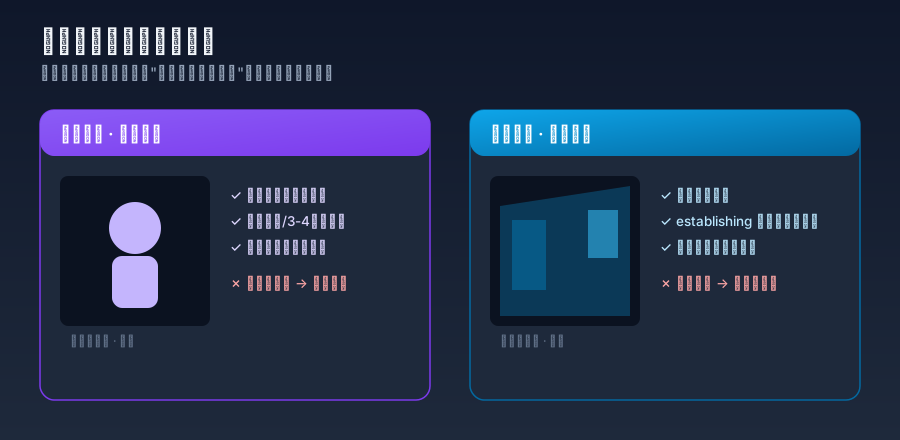
- A character anchor wants a plain neutral backdrop + one clear subject — the cleaner the background, the less the scene bakes into the identity.
- A location anchor is the opposite — it IS the environment, and it must be empty of people. A figure standing in an establishing image rides through the reference into every shot that uses this location. Frame it wide so the full space and defining architecture read, not tight on one corner.
Same principle (a clean reusable anchor), mirrored constraints. That inversion is where the scene side is easiest to get wrong — many people grab a still that has a character, dramatic lighting, and a tight face as the scene reference, then wonder why every shot's background keeps changing.
Scene references have tiers too: from an establishing shot to a multi-angle set reference
Like characters, a scene anchor isn't "one image and done." The industry (invideo puts it bluntly) is uploading "multi-angle reference grids, similar to character sheets" — the wide, reverse, and key-detail angles of a set on one canvas, locking the whole space. The tiers have the same trade-offs:
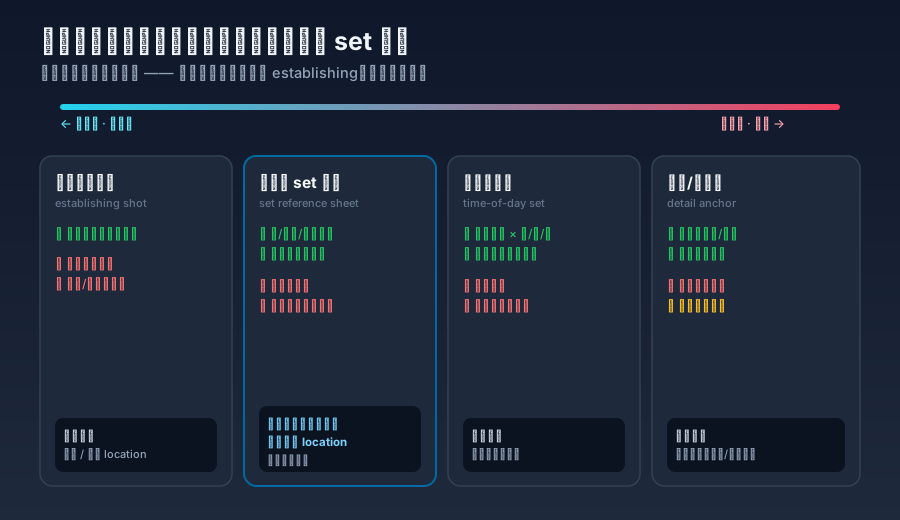
| Scene reference | What it is | Pros | Cons | Use when |
|---|---|---|---|---|
| Single establishing shot | one master wide of the location, no people | cheapest, one clean anchor | only one vantage; reverse/detail invented | one-scene / background locations |
| Multi-angle set reference | wide + reverse + key detail on one canvas | locks the angles coverage needs; spatially coherent shot/reverse-shot | wide canvas thins resolution; architecture harder to keep coherent | recurring locations with lots of coverage (default) |
| Time-of-day set | same space × day / dusk / night | reads as the same room across time jumps | more panels; lighting must stay plausibly same-room | a location shown across day and night |
| Detail / prop anchor | close-ups of signature props / textures | continuity of key objects and materials | ignores the whole space; pair with an establishing | a location with a plot-critical prop or signature texture |
The practical advice is as blunt as the character side — don't over-build: one-scene location → a single establishing shot; recurring, heavily-covered location → a multi-angle set reference; a place shown across time → a time-of-day set; a signature prop → add a detail anchor. Every extra panel is a generation, a charge, and one more thing to keep coherent across panels.
The 4-layer prompt formula parallels the character one: subject (architecture / materials / era / layout, concrete, no people) + view instruction (establishing wide shot, full location visible, plus wide / reverse / detail for a set) + style/lighting lock (single light source per time-of-day, one palette) + format (no people in frame; grid layout).
The dimension scenes have that characters don't: spatial grounding
Character consistency roughly ends there. Scenes have one more axis characters lack — spatial geometry.
A location gets covered by several shots from different camera positions. If each shot re-imagines the space's geometry, shot/reverse-shot won't line up: door on the left in shot A, on the right in shot B, and the cut throws the viewer out. The 2026 practice for this is spatial grounding: instead of purely descriptive language, describe the camera position relative to fixed anchors — DramaDirector's (arXiv:2606.24107) geometry-guided approach retrieves spatial layouts and aligns them with the script, and Digen's guide recommends describing in a 3D coordinate system outright ("camera at 45°, 3 meters from the subject").
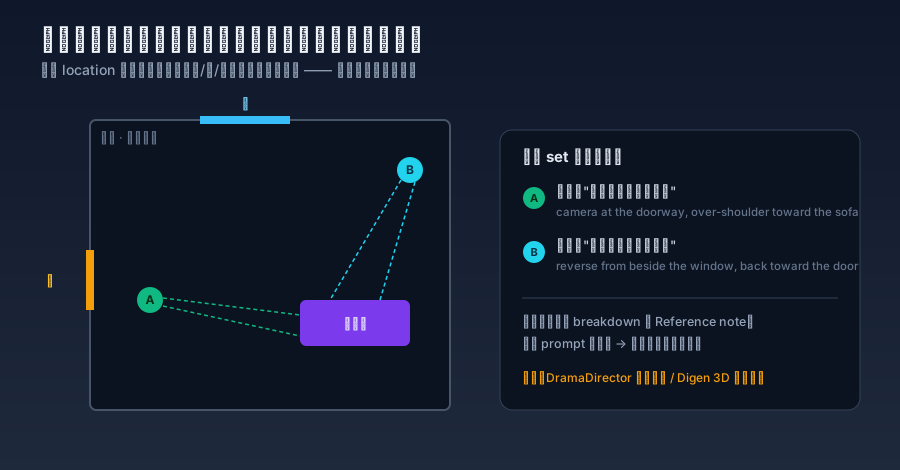
In a pipeline it's mundane: record the location's fixed anchors in the scene breakdown — door, window, hero furniture — then position each shot against them ("over-shoulder from the doorway toward the sofa", "reverse from beside the window toward the door") rather than inventing the geometry per shot. That's what keeps one set's coverage spatially coherent and cuttable. It's the most "only-obvious-once-you've-actually-done-it" part of scene consistency.
Locking the reference isn't enough: scenes need verification and regen too
Exactly as with characters, "every shot references the same scene reference" hides an assumption: the reference is correct. A generation can drift the same way — wrong architecture, a person leaking into frame, lighting that clashes with the story tone.
The mature practice is the same "verify-then-regenerate" loop, with a neat mantra: "fix the source, not the shot." If a location's background is wrong, update that scene reference and every shot using it inherits the fix — one fix to one reference beats rescuing shot by shot.
Verification splits into the same two layers: the cheap one is the nine-panel grid (check not just the same character but the same background across the nine panels); the strict one is a visual language model (VLM) comparing the generated scene image against the breakdown attribute by attribute — architecture, defining features, lighting/palette — and confirming no people are in frame, emitting PASS or what drifted.
Wiring the paradigm into a pipeline: a no-people constraint + a runtime scene-QA gate
That's methodology. What I build is a copilot that lays out nodes on a canvas and generates the short film, so it has to become rules it can execute automatically. This week I completed the scene side (landed 2026-07-24), fully symmetric to the earlier character change:
- Rule A — hard constraints on the scene reference. Previously the copilot generated scene images by just stuffing the location description in, without constraining framing — often a still with a person, tight on a corner. Now it appends a fixed clause: establishing wide, full space and defining architecture visible, no people in frame, single light source and one palette, high resolution, with negatives explicitly blocking people / faces / tight crops / mixed lighting. And the scene breakdown carries a
Reference note:line per location recording the fixed spatial anchors (door / window / hero furniture) and deciding single establishing vs multi-angle set. - B1 — the establishing shot as a checkpoint. A new location's establishing shot (the first, widest one) is naturally the cheapest on-location check before the rest of that location's coverage; the keyframe grid checks same-location too.
- B2 — a runtime VLM scene-QA gate. After scene images generate and before shots consume them, the copilot builds a VLM node on the canvas, wiring the generated scene image and its breakdown entry into separate fields (image into
image, text intoprompt), comparing architecture/lighting and confirming no people, emitting PASS or DRIFT and surfacing a regen card only for the drifted nodes. The two iron rules match the character side: never read pixels in the backend (image understanding must be an on-canvas node the user runs, visible and auditable) and never auto-regenerate (regen costs money — only light up a card and let the user decide).
Limits and open problems
Honestly, same as the character side: this suppresses drift, it doesn't eliminate it.
- Spatial grounding isn't real 3D. "Frame against the door and window" makes text prompts more grounded; it isn't a 3D reconstruction. Big camera moves and complex occlusion still expose the model.
- Multi-angle sets have a resolution tax. Locking a space from several angles means fewer pixels per angle, and complex architecture can go inconsistent during composition.
- The VLM judge misjudges. Making a vision model the scene referee means false flags and misses; B2 is opt-in and cost-capped.
- Time-of-day plausibility. A room reading as the same place by day and night needs lighting logic that holds up — still hard for models.
- Cost is the through-line. Every multi-angle sheet, every regen is real money; "don't over-build" stays the recurring word.
Conclusion
Scene consistency is the quieter half of AI short drama, but it carries the viewer's belief that "this is one world." The paradigm is isomorphic to characters — fix the location, lock the scene anchor, fan out the shots — but remember three scene-specific things: the anchor's hard constraints are the exact inversion of a character's (wide, no people); locations need spatial grounding (frame against fixed anchors) for coverage to cut together; and don't forget to confirm "no people in frame" during verification.
For creators: treat locations as assets to lock, just like characters; give recurring scenes a spec-compliant multi-angle reference and record the door/window/furniture anchors in it; "fix the source, not the shot."
For pipeline builders: the scene-side engineering maps almost one-to-one onto the character side, and the value is precisely that symmetry — one abstraction ("reference hard-constraints + two-layer verification + human-in-the-loop regen") serves both characters and scenes, halving maintenance.
Sources
- invideo — AI Filmmaking in 2026: The Complete Guide to Producing Short Films With AI Agents
- Digen — AI Video Generation Scene Stability: 2026 Evolution Guide
- AI Magicx — AI Multi-Shot Video: Consistent Characters and Scenes Across Clips
- DramaDirector — Geometry-Guided Short Drama Generation (arXiv:2606.24107)
- Genra AI — How to Create AI Short Dramas Solo with Genra: Production & Retention Guide
- Galen Guan — Keeping the Face: Character Consistency in AI Short Drama
- Galen Guan — Why the Nine-Panel Grid Became AI Video's Consistency Workhorse